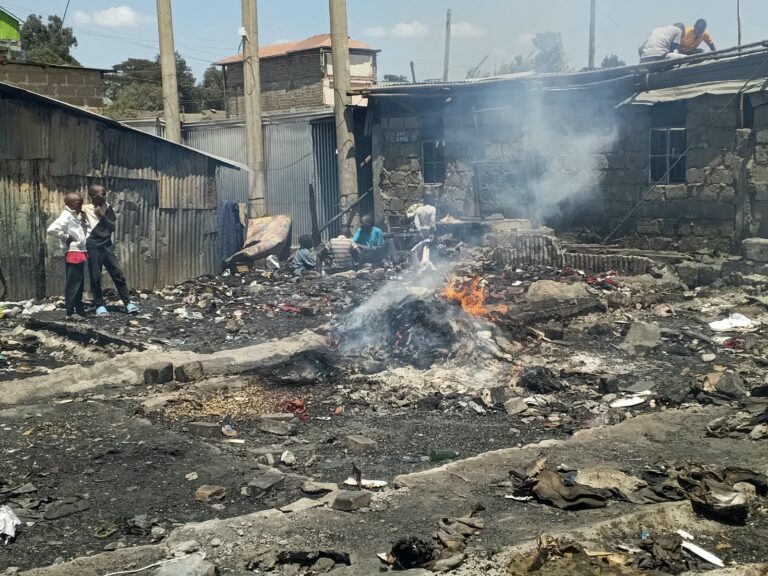
Blood-red waters of Lake Bogoria in Kenya, a natural phenomenon caused by the bloom of salt-loving microalgae. (Photo/Courtesy).
By Daisy Okiring
Baringo Kenya, 18th June 2025
Is it the end of days?” whispered 72-year-old Mama Chebet as she stood at the cracked edge of Lake Bogoria, watching its waters shimmer with a crimson hue under the burning Kenyan sun.
For generations, the lake had been a place of peace, a mirror of the sky, dotted with pink flamingos and boiling geysers. But now it looked like blood. In her village of Loboi, whispers of divine wrath, poison, and disappearing birds spread faster than the dry wind.
For the communities around Lake Bogoria, the transformation of their treasured lake has not just been visual—it has been spiritual, economic, and ecological. And the question on everyone’s mind remains: what is happening to Lake Bogoria?
Not blood, not pollution—but Algae
Contrary to the terrifying rumors, scientists say the color change is not the result of pollution or biblical plagues. It is a naturally occurring phenomenon caused by the explosive growth of Dunaliella salina, a salt-loving microalgae that thrives in highly alkaline waters. These algae produce beta-carotene, a red-orange pigment also found in carrots, which causes the lake to appear red under certain conditions.
“When temperatures soar and evaporation intensifies, the lake’s salinity spikes,” explains Dr. Wycliffe Kiptoo, an environmental scientist at Egerton University. “This creates an ideal environment for algal blooms. It’s nature’s chemistry—not contamination.”
Also Read: Climate change and corruption behind Kenya’s abandoned tourist destinations
Lake Bogoria is not alone in this. Similar occurrences have been documented in Lake Retba in Senegal, Australia’s Lake Hillier, and Lake Natron in Tanzania, all of which periodically turn shades of red or pink due to similar biological processes.

A living lake at risk
Lake Bogoria is much more than a visual wonder. It is home to over 2 million lesser flamingos, making it one of the most important avian breeding sites in East Africa. According to the Kenya Wildlife Service, the lake is also a crucial stopover for migratory birds along the Great Rift Valley flyway.
These flamingos feed on the same microalgae that cause the lake to turn red. However, experts warn that when the algae bloom becomes too dense, it depletes oxygen in the water, threatening both aquatic life and the birds themselves.
“If the water becomes a dead zone, we’ll lose one of Kenya’s most unique ecosystems,” warns Faith Mwikali, an ecologist with the National Environment Management Authority. “We’ve already noticed erratic flamingo migration and unexplained deaths along the shoreline.”
Also Read: Vanishing villages: The human cost of climate change in Baringo
Tourism is another victim. Lake Bogoria draws thousands of tourists annually, generating more than KSh 60 million for the county each year. With a poverty rate of over 40% in Baringo County, the economic stakes are high.
“Lately, tourists show up out of curiosity, but they leave worried,” says Peter Lokorio, a local tour guide. “We need to reassure the world that this is natural, not toxic.”

Climate crisis: The silent agitator
Behind the lake’s transformation lies a more ominous force—climate change. Rising temperatures, prolonged droughts, and erratic rainfall have all played a role in altering the lake’s chemistry.
The Intergovernmental Panel on Climate Change (IPCC) has noted that East Africa is facing increased vulnerability to extreme weather events. In Kenya alone, average temperatures have risen by 1.2°C over the past 50 years, and Lake Bogoria’s surface area has shrunk by nearly 30% since 1990, based on recent satellite imagery.
“The shrinking of Lake Bogoria is not just a local issue. It reflects a regional climate emergency,” says UNEP climate analyst Rose Achieng. “And red lakes, while stunning, are signs of an ecosystem under distress.”
The National Drought Management Authority recently classified Baringo as one of 23 counties experiencing progressive desertification. Water sources are drying, pastoral communities are clashing over dwindling resources, and food insecurity is rising.

Old myths, new fears: Faith vs science
For the Indigenous Endorois and other pastoral communities who have lived around the lake for generations, scientific explanations only go so far. Many elders believe the red water is a spiritual message.
“The Bible says in Revelation that the waters shall turn to blood,” said Pastor Jonathan Mutai of Baringo Revival Church. “People see this and connect it to prophecy. We must not ignore divine warning.”
Social media has fueled this belief. Viral TikTok videos and WhatsApp forwards claim the lake is a sign of the apocalypse or is poisoned by industrial waste. This misinformation poses a new threat: public panic.
UN Secretary-General António Guterres warned in 2023, “We live in a post-truth era where misinformation spreads faster than facts. Climate denial, science denial, and fear are the enemies of progress.”
Locally, government officials are urging calm. The Ministry of Environment has begun outreach programs to help locals understand the phenomenon and separate myth from reality.

The road ahead: Conservation or collapse?
Without immediate action, the beautiful spectacle of a red lake could be a precursor to ecological collapse. Experts are calling for a combination of policy change, investment, and community engagement to preserve Lake Bogoria.
Among the key strategies proposed are the protection of wetland buffer zones to control runoff and maintain ecological stability. Scientists also recommend installing early warning systems that monitor salinity, temperature, and oxygen levels to anticipate dangerous algal bloom cycles.
Additionally, public education campaigns are vital. Local leaders, scientists, and religious figures must collaborate to combat misinformation and promote environmental stewardship. Unregulated livestock grazing, deforestation, and human encroachment must also be addressed to protect the catchment areas feeding into the lake.
In a March 2024 environmental summit hosted in Nairobi, President William Ruto declared, “Kenya’s lakes, rivers, and forests are not infinite. We must treat them as sacred pillars of our national survival—not just economic assets to exploit.”

Blood, beauty, and a battle for truth
For now, Lake Bogoria remains both a marvel and a mystery—its red waters hauntingly beautiful and deeply symbolic. But beneath the beauty lies a complex truth: climate change, ecological imbalance, and misinformation are converging to threaten one of Kenya’s most iconic natural treasures.
As the sun dips behind the Laikipia escarpment, the crimson lake glows like molten fire. Flamingos paddle across the surface, seemingly unaware of the fear their lake now evokes. For Mama Chebet and her neighbors, the story of the lake is far from over.
“Maybe it is not a curse,” she says at last. “Maybe the lake is crying out—telling us to listen before it’s too late.”


About the Author