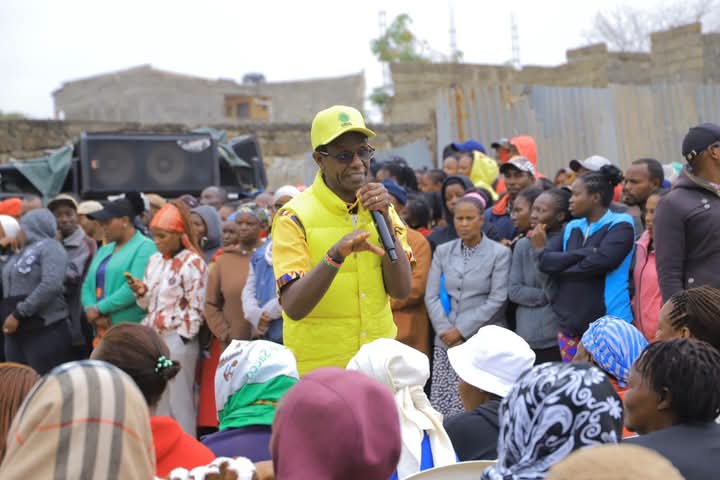
Thousands march to Kenya's Parliament and Supreme Court in Nairobi to protest the rising cases of violence against women [Gerald Anderson/Anadolu Agency].
By Newsflash Reporter
In a landmark decision that marks a turning point in the fight for justice and recognition of sexual violence survivors in Kenya, the government has paid KSh16 million (approximately USD 124,000) in compensation to four survivors of the 2007-2008 post-election sexual violence.
This is the first time in Kenya’s history that survivors of conflict-related sexual violence have received official compensation from the State.
The four were part of eight survivor-petitioners in the long-standing Petition 122 of 2013, a case filed over a decade ago to demand justice and redress from the government for failing to protect its citizens during the post-election chaos.
The recent compensation, although partial, is a significant milestone that reflects the power of persistence, courage, and the rule of law.
Justice delayed but not denied
The journey to this historic moment began in the aftermath of Kenya’s disputed 2007 presidential election, which unleashed waves of politically motivated violence. Thousands were killed, and many others subjected to unspeakable brutality, including widespread sexual violence. Survivors who came forward were not only physically and emotionally scarred but also met with silence and inaction from the State.
In December 2020, after years of legal hurdles, the High Court ruled in favor of four petitioners, finding the Kenyan government liable for its failure to protect them and to investigate their cases effectively.
Read more:IMLU: Protect women human rights defenders and survivors of violence
These survivors included three individuals violated by state security forces and one who reported the crime to the police, only for the authorities to fail to take any action. The court ordered compensation—but the government delayed payment for nearly five years, until now.
“This moment is not just about financial redress. It is about recognition, healing, and setting a precedent that the state is obligated to effectively investigate, prosecute, and provide reparation for conflict-related sexual violence,” read a joint statement from civil society organizations involved in the case.
Ongoing appeal for justice
While the payout is a monumental victory, justice for the remaining four survivors in the petition is still pending. These survivors were assaulted by non-state actors, and the court did not hold the State responsible for those violations. However, an appeal—Civil Appeal Case E645 of 2021—is ongoing, challenging this exclusion and arguing that the government still bears responsibility for failing to prevent the attacks and respond adequately.
Read more: Ex-police convicted for defilement in Kiambu
The organizations supporting the survivors—including the Coalition on Violence against Women (COVAW), Physicians for Human Rights (PHR), the Kenya Human Rights Commission (KHRC), and others—are calling on the government to adopt a comprehensive approach.
This includes developing a national reparations policy, operationalizing the Restorative Justice Fund, and implementing the Victim Protection Act.
“This case must not be an isolated instance,” said the coalition. “It must mark the beginning of sustained state action to ensure accountability and justice for all survivors of sexual and political violence in Kenya.”
Survivor speaks
For survivors, the battle has not just been fought in courtrooms. It has been a personal and painful journey through stigma, trauma, and years of waiting. One of the compensated survivors expressed both relief and hope: “I thought I would die before receiving my court-ordered compensation. Many thanks to the Government of Kenya for humanizing me and for hearing our cry.”
Although International Justice Day was marked globally on July 17, for many Kenyan survivors, justice has never adhered to any calendar. It has been a continuous struggle for acknowledgment, support, and redress.
The civil society has vowed to remain by the survivors’ side until all pending interest on the compensation is paid, the appeal is concluded, and all affected individuals receive justice.


About the Author