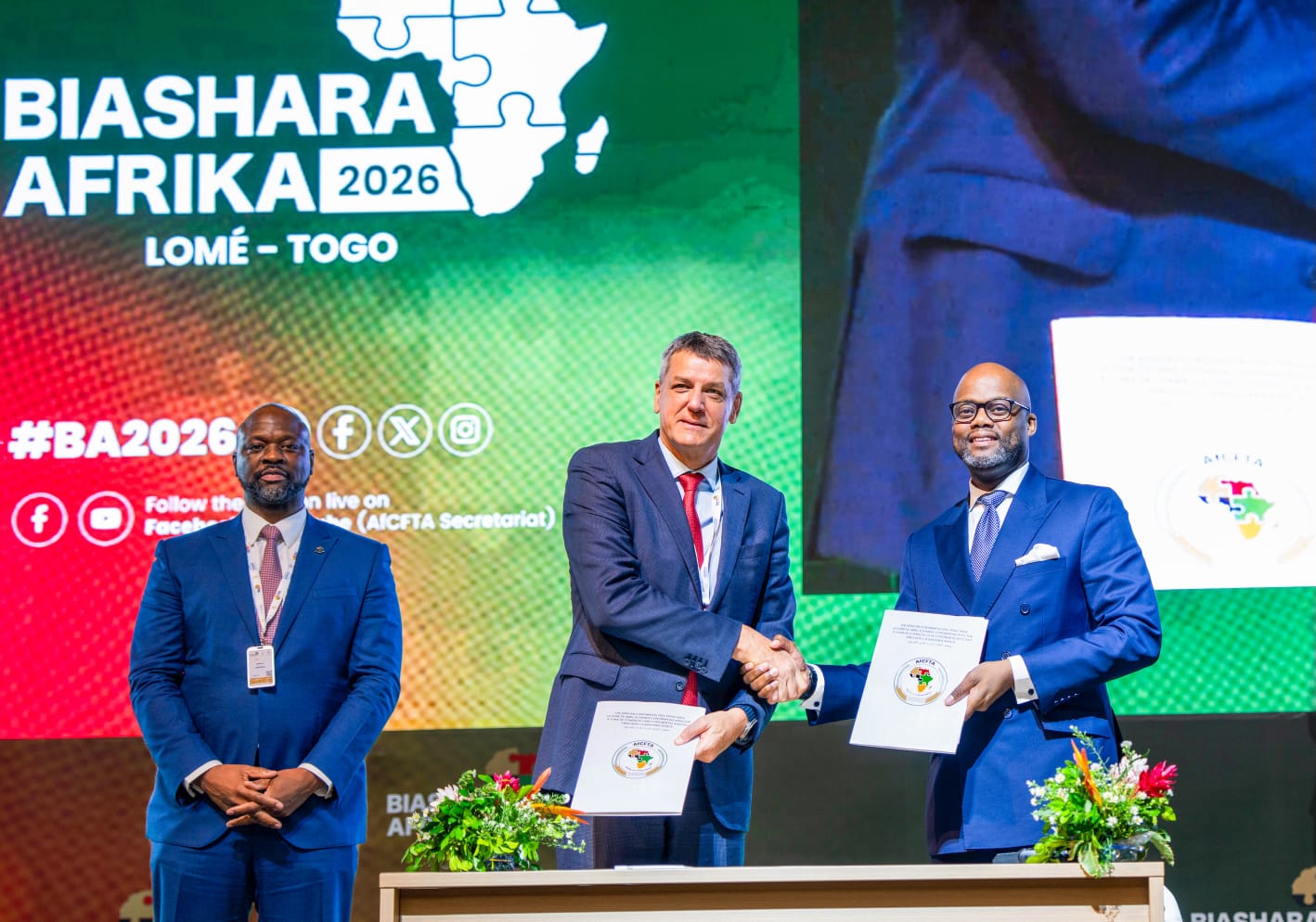
Left to Right: Yomi Ademola, Stephen Jennings and Wamkele Mene during the signing ceremony of the partnership between the African Continental Free Trade Area and Rendeavour at the Biashara Afrika 2026 summit in Lomé, Togo. Photo/Courtesy
By Lawrence Ongaro
The African Continental Free Trade Area (AfCFTA) Secretariat has entered into a partnership with Rendeavour to accelerate industrialisation and trade infrastructure development across Africa through integrated economic zones and modern urban centres.
The partnership, announced on Thursday, May 21, during the Biashara Afrika 2026 summit in Lomé, Togo, makes Rendeavour the AfCFTA’s inaugural implementation partner in supporting infrastructure-led industrialisation and intra-African trade.
Under the agreement, Rendeavour will work with the AfCFTA Secretariat in three key areas, including strengthening the role of Special Economic Zones (SEZs) as engines of industrial growth, mobilising private investment for trade-enabling infrastructure and supporting the development of industrial and trade corridors linked to master-planned cities and logistics hubs.
Push for infrastructure-led industrialisation
The partnership comes at a time when Africa is seeking to increase trade among its countries under the AfCFTA framework, which aims to create a single continental market for goods and services.
According to the AfCFTA Secretariat, the continental free trade agreement covers a market of more than 1.3 billion people with a combined Gross Domestic Product (GDP) exceeding USD 3.4 trillion.
The Secretariat estimates that the agreement could unlock an additional USD 450 billion in income across Africa by 2035 if barriers to trade are reduced and industrial production expanded.
Read more: Nakuru set for grand Second Edition Trade & Tourism Expo
However, intra-African trade currently accounts for only 14 per cent of Africa’s total trade, highlighting the need for stronger transport, logistics and industrial infrastructure to support regional commerce.
The continent also hosts only about 230 Special Economic Zones out of more than 5,400 globally, a gap that officials say has slowed Africa’s manufacturing growth and export competitiveness.
Speaking during the signing ceremony, Stephen Jennings said Africa’s growing economic potential was increasingly attracting global investment interest.
“Africa is not only the fastest-growing region in the world, but with time it will also become one of the safest and most reliable destinations for investment,” he said.
Jennings noted that the partnership would help create environments where manufacturing, trade and investment can thrive through modern infrastructure and efficient operating systems.
Rendeavour expands across Africa
Backed by investors from the United States, Norway, New Zealand and Britain, Rendeavour has developed large-scale urban and industrial projects in Kenya, Nigeria, Ghana, Zambia and the Democratic Republic of Congo.
Its projects combine residential communities, industrial parks, schools and recreation facilities within infrastructure-ready economic zones.
Among its flagship developments are Tatu City and Alaro City, which have attracted billions of dollars in local and foreign investment.
Read more: Fragmented policies cost Africa billions in livestock trade
Other projects under the company include Kiswishi City, Jigna City, Roma Park, Appolonia City and King City.
The company says its developments are currently valued at more than USD 5 billion and host over 250 businesses, 10,000 mixed-income homes and schools serving more than 6,000 students.
Over the past five years, the projects have created more than 50,000 jobs across the continent.
AfCFTA eyes stronger regional trade
AfCFTA Secretary-General Wamkele Mene said the partnership reflected increasing private sector confidence in Africa’s single market agenda.
He noted that Special Economic Zones, logistics platforms and integrated industrial infrastructure would be critical in strengthening regional value chains and boosting manufacturing capacity.
“The implementation of the AfCFTA requires strategic partnerships that can translate the opportunities of the Agreement into commercially viable industrial and trade ecosystems,” he said.
Read more: SMEs traders gather for business growth forum
Mene added that integrated infrastructure development would help facilitate cross-border trade and accelerate regional economic integration.
The AfCFTA officially came into force on May 30, 2019, with trading under the agreement commencing on January 1, 2021.
The agreement is one of the flagship projects under the African Union’s Agenda 2063 development blueprint and seeks to eliminate trade barriers while increasing value-added production and services across the continent.


About the Author