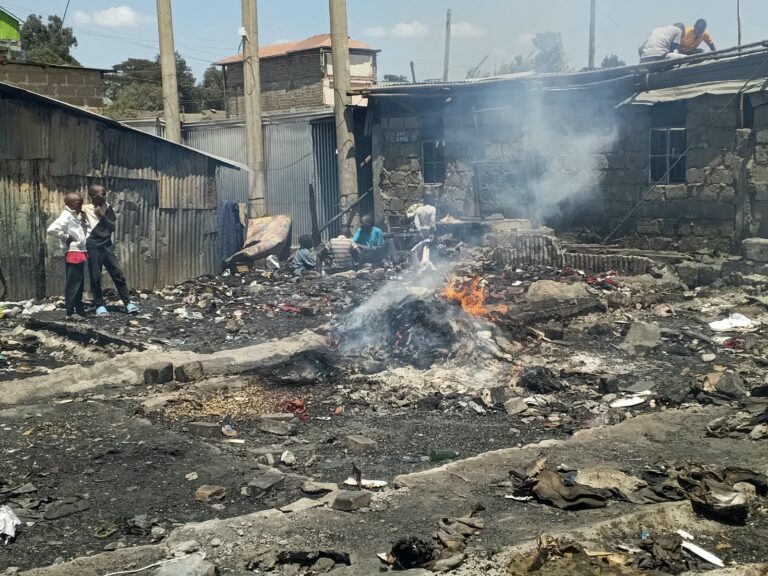
Flooded homes in Kapomboi Ward after River Sabwani burst its banks, displacing more than 3,000 families in Trans Nzoia County. Photo/Courtesy
By Daisy Okiring
When River Sabwani broke its banks after days of pounding rain, the tranquil farms of Kapomboi Ward in Trans Nzoia were swallowed whole. Homes vanished, crops disappeared, and families fled in panic as torrents of muddy water rushed through their villages.
At first glance, the floodwaters resembled a vast lake shimmering under the November sky — but this was no natural wonder. It was the face of a growing crisis. More than 3,000 families are now displaced, according to county officials, while dozens more remain unaccounted for.
“We lost everything,” said Clare Mwenje, a resident of Namanjalala. “Our crops are gone, our homes destroyed, and we have nowhere to go.”
Her neighbor, Bernard Mulipuko, recalled the chaos: “The river flooded so fast, we barely escaped with our children.”
A warning from nature
The flooding of River Sabwani is the latest in a series of climate-related disasters sweeping across Kenya. In the past year alone, the country has experienced deadly landslides in Elgeyo Marakwet, flash floods in Kisumu, and droughts in the arid north.
According to the Kenya Meteorological Department, rainfall intensity in western Kenya has increased by about 25 percent over the past decade, driven by changing weather patterns linked to climate change. Warmer temperatures in the Indian Ocean have led to heavier and more erratic rainfall, while prolonged deforestation along river catchments has weakened the land’s ability to absorb water.
Read More: How disaster-ready are African countries? Study reveals slow but steady progress
“Deforestation and unplanned cultivation near rivers have reduced the natural buffer zones that used to protect communities,” explained Dr. Sheila Atieno, an environmental scientist at Egerton University. “We are reaping the consequences of neglecting conservation.”

Conservation failure and human cost
The Sabwani River disaster is not just a weather event — it’s a human-made catastrophe. Residents say the tragedy could have been avoided if the county had completed the construction of protective dykes along the riverbanks.
“Had the dykes been finished, this wouldn’t have happened,” lamented Dawson Mudenyo, a local farmer.
Trans Nzoia County officials admit that stalled projects and inadequate disaster planning worsened the impact. Charles Yabuna, the sub-county administrator, said the government is working with national agencies to deliver aid and assess the damage, but acknowledged that long-term mitigation has lagged.
The Kenya Red Cross reports that over 45,000 people across the Rift Valley region have been displaced by floods in the past six months. Nationally, more than 300 lives have been lost to flood-related incidents since the start of 2025.
Read More: How human neglect and climate change has fueled the Elgeyo Marakwet landslides
When conservation fades, floods follow
Experts say the destruction of forest cover around Mount Elgon and Cherangany Hills — which feed the Sabwani River — has reduced water retention capacity in the soil. Forest Service data shows that Kenya loses approximately 5,000 hectares of forest cover every year, largely due to illegal logging and land clearing for agriculture.
“What we are seeing in Trans Nzoia is not isolated,” said Dr. Atieno. “It’s part of a larger pattern where environmental degradation, poor river management, and climate extremes combine to produce disaster.”
Aid amid uncertainty
Following the floods, a multi-agency team led by the National Disaster Management Unit and Kenya Red Cross launched evacuation and relief operations. Temporary camps have been set up at local schools and churches to shelter displaced families.
Still, access to food, clean water, and sanitation remains limited. Humanitarian groups warn of a potential cholera outbreak as contaminated floodwaters stagnate.
The United Nations Office for the Coordination of Humanitarian Affairs (OCHA) estimates that nearly 2 million Kenyans are affected by climate-induced disasters annually — from droughts to floods — costing the economy about 3–5 percent of GDP every year.

A future underwater
Meteorological forecasts predict continued heavy rainfall through November, with flash flood warnings issued for Trans Nzoia, Bungoma, and Elgeyo Marakwet counties. Authorities have urged residents living near rivers to relocate to higher ground.
For families like the Mwenjes, however, relocation is not a simple choice. “We have no other land,” Clare said softly. “Even if we move, where will we plant?”
The Sabwani River’s overflow is a sobering reminder that Kenya’s climate crisis is not a distant threat — it’s here, uprooting lives and reshaping landscapes. Without urgent investment in river conservation, reforestation, and proper drainage systems, experts warn that what happened in Trans Nzoia will soon become a national norm.
As Dr. Atieno concluded, “Climate change doesn’t have to be catastrophic — if we learn to respect the rivers before they reclaim what’s theirs.”


About the Author