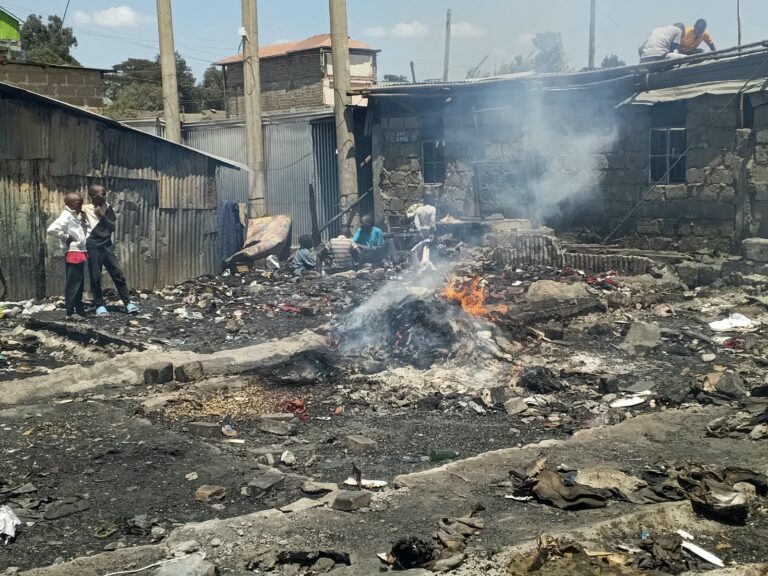
Residents of Elgeyo Marakwet gather around a collapsed homestead after a landslide swept through the area, destroying houses and farmland following days of heavy rainfall. Photo/Courtesy
By Daisy Okiring
Elgeyo Marakwet, Kenya; At 4 a.m., the ground below seemed to simply vanish. Homes perched on the rim of the Kerio Valley in Elgeyo Marakwet County gave way as a roaring mass of mud, rock, and water swept through the villages of Chesongoch and Moror. By sunrise, at least thirteen lives were lost — mothers, children, farmers — all caught in the torrent that rolled downhill after relentless night rains. Dozens more remained missing as rescuers dug through thick mud and debris.
Why does a county scarred by repeated landslides keep losing people every time the sky opens up?
The Anatomy of a Disaster
The terrain of Elgeyo Marakwet is breathtaking — lush escarpments that plunge dramatically into the Kerio Valley, dotted with small farms and tin-roofed homes. But beneath the beauty lies danger. Each rainy season, the soil saturates, cracks open, and entire hillsides collapse, sending mudslides racing through valleys.
In April 2025, residents of Keiyo South noticed a widening fissure slicing across the Nyaru–Fluorspar road — a warning that the land was shifting. Geologists say the region’s combination of deep weathered rock, intense rainfall, and human settlement makes it one of Kenya’s most unstable zones.
A 2021 investigation of the Lagam Escarpment in Kaben Location found that the scar is “not only recurrent but highly cataclysmic,” with repeated slides in 2010 and a deadly one in 2020 that claimed twenty-six lives. Another study on the Kittony area documented increasing debris and soil flows driven by rainfall variability, steep slopes, and pressure from expanding farms.

Read More: How disaster-ready are African countries? Study reveals slow but steady progress
Why This Place Remains in Peril
Climate change and intense rainfall
Over the past decade, Kenya has seen a surge in climate-related disasters — droughts, floods, and now landslides. The County Climate Change Action Plan (2023-2027) for Elgeyo Marakwet warns that the escarpment is prone to natural hazards such as soil erosion and flash floods due to irregular rainfall and steep slopes. In 2020, heavy rains across East Africa triggered massive floods and landslides, displacing thousands in Elgeyo Marakwet and neighboring West Pokot.
Human activity and deforestation
The lush slopes of Elgeyo Marakwet have been steadily cleared for farming and settlement. Trees that once held the soil together were cut for timber and charcoal. Farmers pushed higher up the escarpment, cultivating land too steep to sustain crops safely. A 2021 study linked recurrent landslides to deforestation of the Embobut forest and destructive farming practices such as slash-and-burn.
“It was a narrow escape for me… I only have God to thank for sending me a warning,” said a student survivor of the Chesegon landslide.
When the rain came that night, his family’s home crumbled within minutes. They fled barefoot through darkness as mud swallowed the path behind them.

Infrastructure failure and poor enforcement
Cracks on rural roads and collapsing bridges are early signs of slope failure — warnings often ignored. In May 2025, parts of the Keiyo North access road caved in, isolating entire villages. Without proper land-use enforcement or risk mapping, minor infrastructure damage often signals coming catastrophe.
Environmental scientist Allan Korir describes the physics simply:
“The escarpment is very steep. When water hits the low-lying areas, it drops its load — boulders and soil — and if there is any settlement in the way, that’s just tragedy.”
Read More: Mazingira Day: Ruto unveils plan to produce 2 billion tree seedlings annually
Lives Buried in Mud
When twelve families in Emsoo Ward watched their farms disappear in October 2025, the losses went far beyond soil and crops. For many, those small plots were their only livelihood.
“I have been using the proceeds from the farm to pay for my medical expenses… I don’t know how I will move on,” said an elderly farmer now living in a temporary shelter.
In the latest disaster, homes were buried, roads washed away, and communication lines severed. Rescue teams — backed by military helicopters — combed through the rubble, slowed by blocked roads and unending rain. Beyond the immediate tragedy lies a slower crisis: displacement. Families forced from their homes rely on relatives or aid agencies as they wait for relocation. Schools in the affected areas remain closed, and thousands are living in makeshift camps.
Assistant County Commissioner Edmund Nyaga confirmed the devastation:
“It is with heavy hearts that we confirm the loss of Kipkoech and Kiprop Suter in this unfortunate landslide.”

A County on Edge
Landslides are not new to Elgeyo Marakwet. Between 1998 and 2017, an estimated 4.8 million people in Kenya were affected by slides, causing over 18,000 deaths. In the highlands, 92 percent of incidents resulted in property destruction and displacement. In Elgeyo Marakwet alone, more than 50,000 households live in high-risk areas, with about 4,000 considered extremely vulnerable.
The County Government says it has mapped dangerous zones and developed early-warning plans. Yet residents argue that official alerts often come too late. “By the time we hear the warning on radio, the road is already gone,” said one local youth leader.
Landslide Statistics in Perspective
| Statistic | Figure | Source/Period |
|---|---|---|
| Households in high-risk zones | 50,000+ | Elgeyo Marakwet County Report, 2024 |
| Households in extreme danger | 4,000 | County Risk Mapping Study, 2023 |
| Nationally affected population | 4.8 million | 1998–2017 (WHO data) |
| Reported fatalities | 18,000+ | 1998–2017 (WHO data) |
| Fatalities in 2020 Lagam Escarpment slide | 26 | Study on recurrent landslides, 2021 |
| Incidents causing property loss | 92% | Laikipia Journal of Environment, 2022 |
The Human Question
In the highland villages of Keiyo and Marakwet, every dark cloud now brings fear. Mothers wake their children when rain intensifies, ready to flee if the earth begins to move. Survivors speak of sleepless nights and recurring trauma.
The question that remains is painfully simple: Can Kenya’s systems catch up with a landscape that is already slipping? Each landslide reopens old wounds, each recovery effort tests a nation’s resilience.
Standing before what used to be his maize field, now buried under a thick layer of mud, a community elder summed it up quietly:
“We are not just losing our land. We are losing our lives, piece by piece.


About the Author