

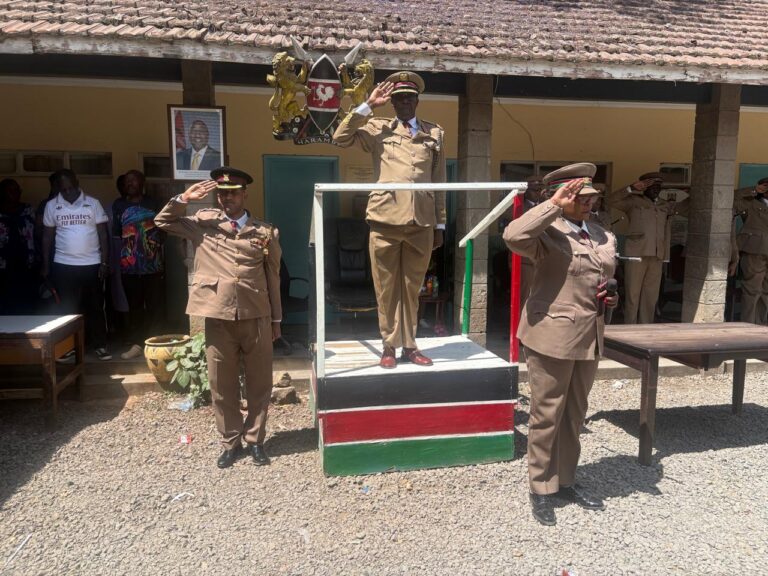
Embattled Deputy Inspector General of Police Eliud Lagat. Photo/The Star
By Newsflash Team
Pressure is escalating on Deputy Inspector-General of Police Eliud Lagat to resign following allegations that a complaint he lodged led to the arrest and subsequent death of teacher Albert Ojwang in police custody.
Public outrage continues to grow, with citizens, lawmakers, opposition leaders, civil society organizations, and foreign missions demanding that Lagat step aside—or be suspended—to ensure impartial investigations proceed without obstruction.
Ojwang, aged 31, died within hours of being arrested from his home in Homa Bay last Saturday, sparking national protests and widespread condemnation. Critics argue that Lagat’s continued stay in office undermines the credibility of the investigation, especially since he initiated the complaint that led to Ojwang’s detention.
Interior CS Kipchumba Murkomen, Inspector-General Douglas Kanja, DCI Director Mohamed Amin, and IPOA Deputy Chair Ann Wanjiku faced intense questioning by senators. Homa Bay Senator Moses Kajwang questioned why Lagat was still holding office despite being directly linked to the case.
“You cannot be both the complainant and an authority in the ongoing probe. He should be recording a statement at a police station,” Kajwang asserted.
Murang’a Senator Joe Nyutu questioned the unusual speed of Ojwang’s arrest and the lack of transparency around it. “Is Lagat too vital that the police service would collapse without him?” he posed.
Tampered CCTV and Senate fury
Senators were left stunned when IPOA revealed that CCTV footage from Nairobi’s Central Police Station—where Ojwang was held—had been tampered with. IG Kanja appeared evasive in his responses, frequently deflecting questions to IPOA, drawing sharp criticism from legislators.
Kakamega Senator Boni Khalwale called out Kanja’s deflection: “How can the IG shift all responsibility to IPOA?” Meanwhile, Siaya Senator Oburu Oginga urged that Lagat’s role be scrutinized, saying he was unlikely to be a neutral actor in the case.
Read more:Ruto orders full investigation into Albert Ojwang’s death
President William Ruto, who rarely criticizes police conduct, issued a firm statement condemning the police’s “actions and omissions” and emphasized the need to eliminate unprofessional behaviour within the National Police Service. He urged full cooperation with IPOA and a credible investigation.
Diplomatic pressure
Close to Parliament, four rights activists—Julius Ogogoh, Khelef Khalifa, Francis Auma, and Peter Agoro—filed a petition at Milimani Law Courts to privately prosecute Lagat. They demanded his suspension, barring from the case, and prevention from contacting witnesses. They criticized the police for suspending only junior officers, calling it a cover-up.
Mr Ogogoh emphasized in an affidavit that criminal charges—not just internal measures—were necessary due to Lagat’s seniority. They also questioned the absence of an OB number linked to the original complaint and urged IPOA to summon Lagat and all officers involved.
Independent Medico-Legal Unit director Wangechi Grace said postmortem results confirmed Ojwang was tortured and murdered. “Justice cannot be served while the key complainant remains in power,” she said.
KHRC’s Davis Malombe called for the police spokesperson Michael Muchiri to be questioned for prematurely declaring Ojwang died from self-harm. IPOA confirmed that five officers participated in the arrest: Sergeants Sigei and Wesley Kirui, and Constables Kinyoni, Mwanze, and Rabudo.
Read more:Ojwang: Protests erupt in Nairobi as KNCHR, IPOA demand action
The U.S. Embassy and UK High Commission joined the outcry, urging swift and transparent investigations. “Accountability and the rule of law are pillars of democracy,” stated the UK mission.
In Mombasa, Haki Yetu’s Peter Kazungu called for Lagat’s immediate resignation and linked Ojwang’s killing to broader police brutality, citing unresolved deaths during last year’s Gen Z-led tax protests. “There will be no justice until Lagat steps down,” Kazungu said.
The activists connected Ojwang’s death to historic injustices like the Wagalla Massacre and post-election violence. Khalfan Mweupe decried the normalization of custodial deaths, urging teachers’ unions to speak out.
Opposition leaders Rigathi Gachagua, Kalonzo Musyoka, Justin Muturi, and Eugene Wamalwa jointly issued a 24-hour ultimatum for Lagat’s arrest. They criticized the DPP’s seven-day investigation window as a delay tactic and called for the immediate release of CCTV footage from Ojwang’s detention to his hospital transfer.


About the Author





2 thoughts on “Why is Eliud Lagat still in office?”
Comments are closed.