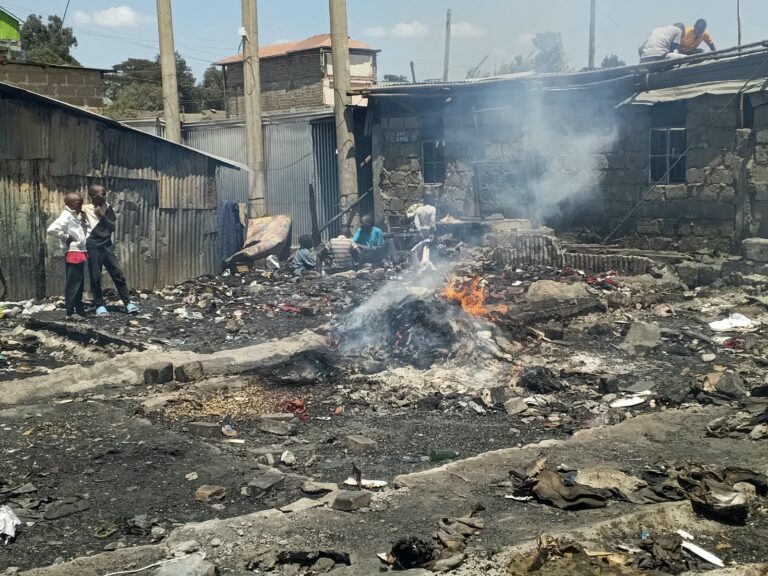
An aerial view of Kagoto Primary School and residentials so much exposed to quarry pollution. Phoyo/Ruth Nganga
By Ruth Ng’ang’a
It’s a sunny afternoon at Kiamaina Constituency in Bahati Sub-county, 9 km northwest of Nakuru City.
Donkeys pulling carts with empty jerrycans stream into a nearby Kagoto borehole to fetch water.
Some of the loaded donkeys seem drained—they walk slowly under the scorching sun as the riders enjoy the trip while seated on the carts.
Along the Nakuru–Nyahururu highway is Karsan Ramji and Sons Limited quarry, in close proximity to a residential area. About 300 meters away is Kagoto Primary School. Several empty lorries enter the quarry and exit fully loaded with ballast.
A few meters from the quarry is an old, wooden, dusty fence. A small wooden gate stands wide open. An elderly woman rests under an avocado tree, listening to a radio. It is 55-year-old Virginia Njeri (not her real name).
Njeri and her husband have lived here for three decades, but ten years ago, she started experiencing persistent coughing. Local health officials attribute a worrying increase in chest complication cases in the area to prolonged exposure to dust pollution.
“I live with my husband and children, though they are grown-ups. My entire family has developed the same problem as me,” said Njeri.
Njeri, who lives next to the quarry, says the operations have negatively affected both their quality of life and the environment. Their houses have developed cracks on the walls, and the land has been degraded by blasting tremors. She is constantly worried about health issues brought about by dust and air pollution.
“When the quarry is blasted, most of the time we run outside because our houses shake as if they can fall. We feel insecure, without peace and comfort in our own houses,” she says.

The situation is so serious that Njeri can no longer harvest as she did before. Quarry activities have degraded the soil, resulting in reduced farm yields.
Some years back, government officials visited the area and promised to terminate the quarry operations, but it never happened. Now, all the nearby residents have decided to live with the situation.
“We have demonstrated three times, but no one has listened to our plea or taken responsibility for our cracked homes. The quarry owner doesn’t care,” Njeri said.
Rising cases of illnesses among locals
A stone’s throw away from Njeri’s homestead lives 30-year-old John (not his real name), who resides with his parents. He has been ailing from chest congestion and headaches for 20 years. Hospital documents show John has visited several hospitals and been diagnosed with anxiety and acute bronchitis, which cause him severe discomfort.
His body is physically weak, and he says the illness has robbed him of his youth, as he cannot engage in activities like other young people.
“I have been in and out of hospital for so many years. My parents have used a large sum of money to settle my medical bills, but unfortunately, my health is still deteriorating,” he said.
The initiative aims to monitor air quality, identify hotspots, and inform strategies to combat pollution, ultimately promoting a cleaner environment and public health.
Read more: Keroche chides Kihika for ‘mocking’ Nakuru residents
The sensors will track air pollution levels, providing data to guide actions toward a healthier environment. The initiative aims to monitor air quality, identify hotspots, and inform strategies to combat pollution—ultimately promoting a cleaner environment and public health.

Through the integration of cutting-edge forecasting technology with community-driven environmental monitoring, the RESPIRA Air Quality Monitoring (RESPIRA-AQM) project seeks to increase Nakuru’s resilience against the effects of air pollution and climate change.
According to Alicia Olago, Senior Programme Manager at Sensors-AFRICA, pollution cannot be seen in the air, but the wind carries with it small particles of different kinds depending on the environment.
Curbing air pollution
In order to address the growing issue of air pollution, Respira has installed 20 air sensor monitoring systems in partnership with Nakuru County. These systems combine artificial intelligence, satellite data, and on-the-ground sensors.
These systems combine artificial intelligence, satellite data, and on-the-ground sensors.
The project has placed sensors in predetermined areas, chosen in collaboration with community members. Temperature, humidity, and particulate matter are all measured by each sensor. The information is fed into an AI model.
Nakuru City Manager Gitau Thabaja lauded RESPIRA for the move to help improve the city’s air quality. He also called on the people of Nakuru to embrace greening the environment to help with carbon sequestration.
“I wish people could embrace walking rather than using their vehicles. If possible, those who own vehicles should service them regularly to keep them in good condition,” Gitau said.
Read more: County seeks share of Lake Nakuru National Park tourism revenue
Mr. Gitau added that to promote innovative artificial intelligence (AI) and data science techniques for air pollution monitoring and forecasting, an air sensor was installed at Nakuru’s Meteorological Department to efficiently anticipate, assess, and address air quality concerns.
“We have identified control areas for sensor installation at different places and occupations according to daily activities—like Nyayo Garden, which is a green space, and Wakulima Market—to find out the activities that contribute more to pollution,” he said.
The Breathe Cities Program’s local sensors are supported by partners Bloomberg Philanthropies, C40 Cities, and the Clean Air Fund. It was introduced on September 11, 2024, to enhance public health by lowering air pollution in member cities by 30% by 2030. With the help of the Flanders International Climate Action Programme, the government of Flanders is funding the project.


About the Author