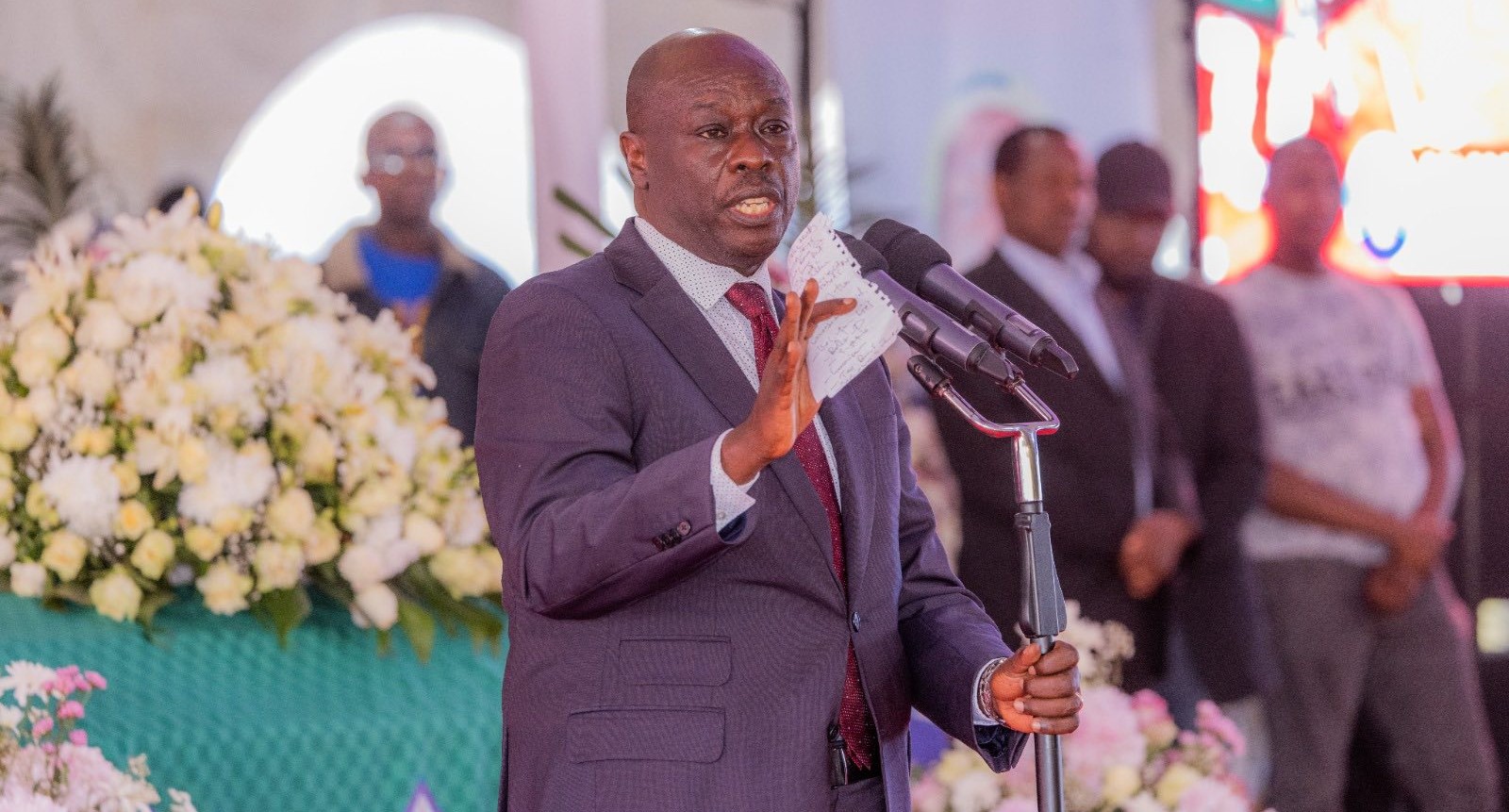
DCP party leader Rigathi Gachagua in Murang’a on Saturday, 3/1/2026. Photo/Rigathi Gachagua/Facebook
By Newsflash Writer
Former Deputy President Rigathi Gachagua has openly differed with Wiper Patriotic Front (WPF) leader Kalonzo Musyoka over when the United Opposition should unveil its presidential candidate for the 2027 General Election.
Gachagua’s remarks contrast sharply with Kalonzo’s position. On Monday, Kalonzo announced that the United Opposition had resolved to unveil its presidential candidate by March to prepare for a direct contest with President William Ruto.
Speaking in Kigumo, Murang’a County, on Saturday, December 3, Gachagua dismissed claims that the opposition would name its presidential flag bearer by March, insisting the move would be premature and would expose the candidate to state pressure.
He made the remarks during the burial of Embakasi North MP James Gakuya’s mother, Alice Wangari.
Read more: Gachagua mourns MP Wanjiku Muhia’s father
Gachagua, wo is also the Democracy for the Citizens Party (DCP) leader, said the opposition would be better served by waiting until later in the election year to unveil its candidate, warning that an early announcement would invite intimidation and harassment from the Kenya Kwanza administration.
“We shall have one candidate to face Kasongo [President William Ruto]. I want to ask for patience. Don’t be in a hurry. The election is still far away,” Gachagua said. “If we announce our presidential candidate right now, he will be intimidated and harassed by Ruto. We can’t do that. We are not fools.”
He urged supporters to remain calm, arguing that secrecy and timing were critical in shielding the opposition’s eventual flag bearer from what he termed “state infiltration.”
Lessons from the 2002 election
To support his position, Gachagua pointed to the 2002 General Election, when the National Rainbow Coalition (NARC) delayed announcing its candidate until shortly before polling day. He recalled that Mwai Kibaki was unveiled as NARC’s presidential candidate on October 14, 2002—just over two months before the December 27 election—before going on to defeat Uhuru Kenyatta, who had the backing of then-President Daniel arap Moi.
“The election was only two months and 13 days away when Kibaki was announced,” Gachagua said, suggesting that a late endorsement helped the opposition avoid internal sabotage and external interference while maintaining unity until the final stretch.
Kalonzo pushes for early declaration
However, Kalonzo argued that an early declaration would demonstrate seriousness and cohesion, framing the coalition as a “government-in-waiting” united by shared values rather than individual ambition. He said opposition leaders had agreed on presenting a single candidate and would not delay preparations, citing growing public demand for change.
Read more: Why Kalonzo’s 2027 presidential bid is crippling
He explained that the decision to name the flag bearer by April 2026 was driven by what he described as the “fierce urgency of now,” saying Kenya could no longer endure prolonged political uncertainty. “The United Opposition is not just a coalition. It is your Government-in-Waiting,” Kalonzo said, adding that the alliance was grounded in constitutionalism, economic justice, integrity in public office, and the protection of fundamental rights.
The divergent views highlight an early strategic debate within the opposition as it charts its path toward the 2027 presidential race


About the Author