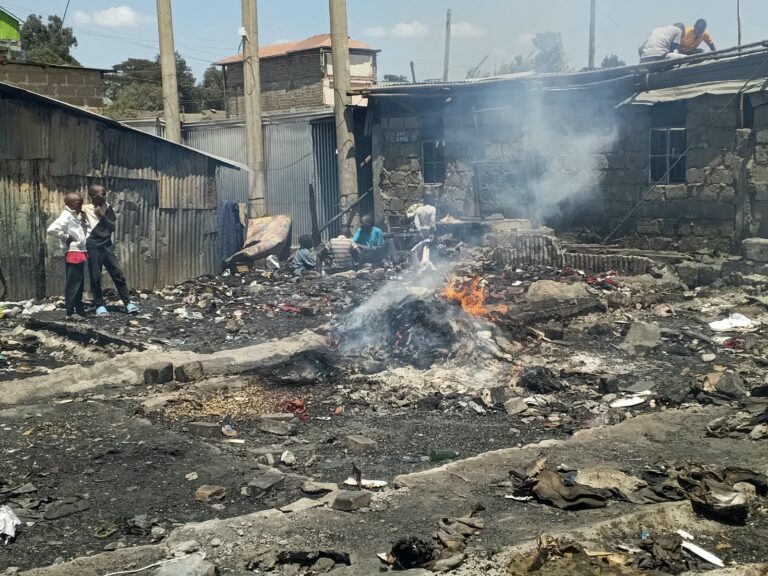
Ogiek families stand by the remains of their demolished homes in the Mau Forest, June 2020. Credit: AFP
By Daisy Okiring
August 28, 2025 | Nairobi, Kenya
At dawn in June 2025, the Ogiek community of Mariashoni in Kenya’s Mau Forest Complex woke to the roar of bulldozers and the crackle of flames. Wooden huts, some passed down for generations, were razed within hours. Mothers clutched their children as they fled, fathers carried what little belongings they could salvage, and elders stood frozen as the homes of their ancestors turned to ash.
“We were born here, our parents are buried here, and now we are told we do not belong,” recalls 72-year-old Ogiek elder, Kiplangat ole Rono, his voice trembling. “How can you erase a people by burning their homes in the name of saving trees?”
The eviction was part of a government-led conservation effort meant to restore the Mau, Kenya’s largest water tower. But for the Ogiek — hunter-gatherers who have lived in the Mau for centuries — it was another chapter in a long, painful history of dispossession.
This is not just the story of a forest. It is the story of a people whose very existence is tied to Kenya’s largest water tower — a place that sustains more than 10 million lives across East Africa. Yet for the Ogiek, indigenous custodians of Mau for centuries, each eviction order turns heritage into ash and belonging into exile.
The Beggining of Evictions
At dawn in Kenya’s Sasimwani area, the Ogiek people watch bulldozers mark the land where their ancestors are buried, their homes once stood, and their culture still breathes. For many, it is a painful replay of history. In 2023, more than 700 Ogiek families were evicted from the Mau Forest in the name of conservation. Barely two years later, in May 2025, President William Ruto handed over a land title deed for part of the Maasai Mau Forest to Narok County, a move that the community says deepens their dispossession.
The alarm has now spread beyond Kenya’s borders. A United Nations expert recently called on Nairobi to halt all land demarcation in the Mau Forest, warning that it violates the rights of the Ogiek and ignores the African Court on Human and Peoples’ Rights’ 2022 ruling that recognized their ancestral claims. Yet, as government-backed land demarcation continues, Ogiek families remain in limbo — landless, homeless, and unheard.
Read More: COP fatigue: Why Africa must lead its own climate agenda
The Mau Forest: Kenya’s water tower
The Mau Forest Complex, spanning 400,000 hectares, is not just a forest. It is the lifeblood of Kenya. More than 12 rivers originate here, feeding Lake Victoria, Lake Nakuru, Lake Natron, and even the Nile. At least 10 million people in Kenya, Tanzania, and Egypt depend on these waters for drinking, farming, fishing, and hydroelectric power.
According to the Kenya Forest Service (KFS), the Mau has lost nearly over 40 percent of its forest cover since the 1980s, mainly due to logging, farming, and settlements. This decline has accelerated climate stress, reducing rainfall in the Rift Valley and drying up rivers critical to agriculture.
“Kenya cannot survive without the Mau,” said the late environmentalist Wangari Maathai, who campaigned fiercely for its protection. “To destroy it is to sign a death certificate for millions downstream.”

Who are the Ogiek?
The Ogiek, whose name means “caretakers of all plants and wild animals,” are among Africa’s last remaining forest hunter-gatherer communities. Traditionally, they lived by hunting antelopes, foraging wild fruits, and above all, beekeeping — the forest providing hollowed trees for hives and nectar-rich flowers for bees.
But since colonial times, the Ogiek have faced systematic evictions. In 1932, the British declared the Mau a “Crown Land,” branding the Ogiek squatters. Independence in 1963 did little to change their fate. Government after government labeled them “encroachers,” issuing logging concessions to politically connected elites while displacing the indigenous custodians of the forest.
“The Ogiek are not the destroyers of Mau — they are its protectors,” said George Natembeya, former Rift Valley Regional Commissioner, in a 2019 interview.
Read More: The hunger paradox: Why africa feeds the world but can’t feed itself
Evictions in the name of conservation
The most brutal evictions took place in 2009, 2018, and 2020. In the June 2020 operation alone, more than 300 Ogiek families were expelled from Mariashoni and Nessuit. Schools and churches were not spared. The Kenya National Commission on Human Rights (KNCHR) condemned the demolitions as “inhumane and a violation of dignity.”
The government defended the actions as necessary. “We are not targeting any community. We are saving the Mau for all Kenyans,” said Environment Cabinet Secretary Keriako Tobiko at the time.
Yet the evictions sparked international outrage. In 2017, the African Court on Human and Peoples’ Rights ruled in favor of the Ogiek, declaring that Kenya had violated their land and cultural rights. It ordered restitution. Eight years later, implementation remains elusive.

The human toll of displacement
Behind the statistics are shattered lives. After the 2020 eviction, thousands of Ogiek were left in makeshift camps along muddy roadsides, exposed to rain and cold. Humanitarian agencies reported rising cases of pneumonia, malaria, and hunger.
Children dropped out of school, women walked longer distances for firewood and water, and elders lamented the erosion of culture.
“Without the forest, we lose our identity,” said Daniel Kobei, Executive Director of the Ogiek Peoples’ Development Program (OPDP). “The Ogiek are dying not just physically, but spiritually.”
The community’s displacement also worsens poverty. Many Ogiek now work as casual laborers in farms or towns, struggling to adapt to livelihoods outside the forest. According to OPDP, over 70% of Ogiek households live below the poverty line.

Mau destruction, climate crisis, and Kenya’s food security
The Mau’s degradation has far-reaching effects beyond the Ogiek. Studies show that loss of forest cover has reduced rainfall in the Rift Valley by up to 25% over the last 30 years, crippling maize and wheat production. Rivers like Mara and Sondu have dried seasonally, threatening millions who rely on fishing and irrigation.
“Water towers like the Mau are not just Kenya’s heritage, they are Africa’s lifelines,” said former UN Environment Chief Achim Steiner. “Their destruction accelerates climate change, fuels conflict over scarce resources, and deepens poverty.”
Promises versus reality
Kenya’s government has repeatedly pledged to protect the Mau while respecting indigenous rights. President William Ruto, during his 2022 campaign, promised “a just resolution” for the Ogiek. Yet little has changed.
Amnesty International notes that while illegal logging by cartels continues, evictions disproportionately target vulnerable communities. A 2023 Senate committee report found that politically connected individuals had acquired over 35,000 hectares of Mau land illegally — dwarfing the small clearings occupied by the Ogiek.
“The tragedy is that the poor are punished while the powerful plunder,” said Senator Ledama ole Kina of Narok.
Read More: How Europe’s 2040 climate target could redefine the global carbon economy
Global attention, local silence
International bodies have urged Kenya to honor the 2017 African Court ruling. In 2022, the UN Special Rapporteur on Indigenous Rights, José Francisco Cali Tzay, warned: “The Ogiek’s survival as a people is at stake. Conservation cannot be an excuse for dispossession.”
Yet at the local level, silence prevails. “We are treated as if we do not exist,” said Ogiek elder, Rebecca Chepkemoi. “Politicians only remember us during elections.”
The next generation: voices of Ogiek youth
Among the Ogiek youth, there is both despair and determination. Many young people are caught between preserving ancestral identity and seeking modern opportunities.
“I am studying environmental science because I want to prove that Ogiek are the best conservationists,” said 22-year-old student, Dorcas Chepkoech. “If we are given back our land, we can show Kenya how to live with the forest, not against it.”
Others fear cultural extinction. “Our children are growing up without knowing the songs, the honey rituals, the hunting dances,” said 30-year-old teacher, Samuel Kirui. “When the forest goes, our soul goes too.”

When the forests cry
The story of the Ogiek and the Mau is not just about trees and rivers. It is about justice, memory, and the survival of a people whose fate mirrors the planet’s. As Kenya struggles to balance conservation with human rights, the Ogiek stand as a reminder that indigenous knowledge is not an obstacle but a solution.
“When the forest cries, the world should listen,” said former Chief Justice Willy Mutunga in a 2021 forum on land rights. “Because in that cry is not just the voice of the Ogiek, but the echo of our collective future.”


About the Author