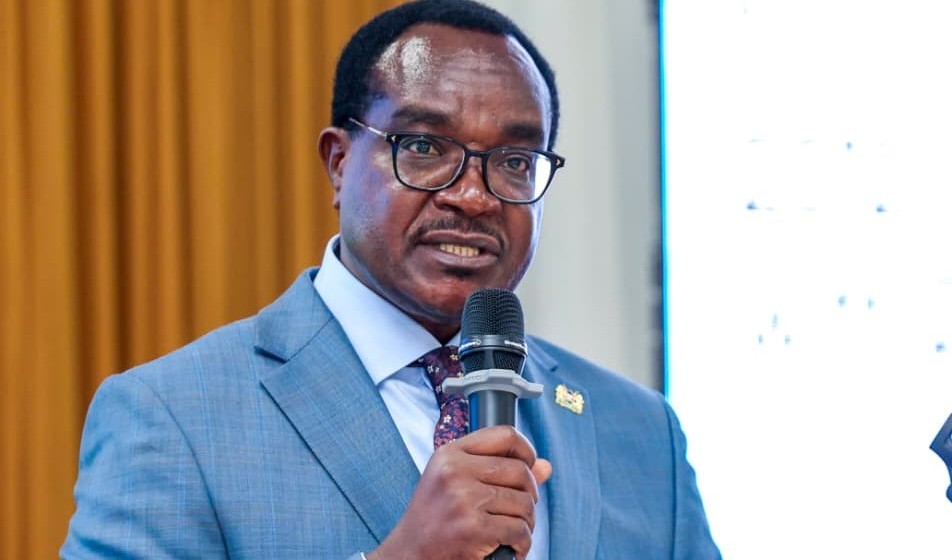
Education CS Julius Ogamba addressing MPs in Naivasha on January 28, 2026. Photo/MoE
By Newsflash Writer
Education Cabinet Secretary Julius Ogamba has announced that the government will gazette a harmonised school fees framework for senior schools as part of wider efforts to ensure equity, access, and smooth implementation of the Competency-Based Education (CBE) system.
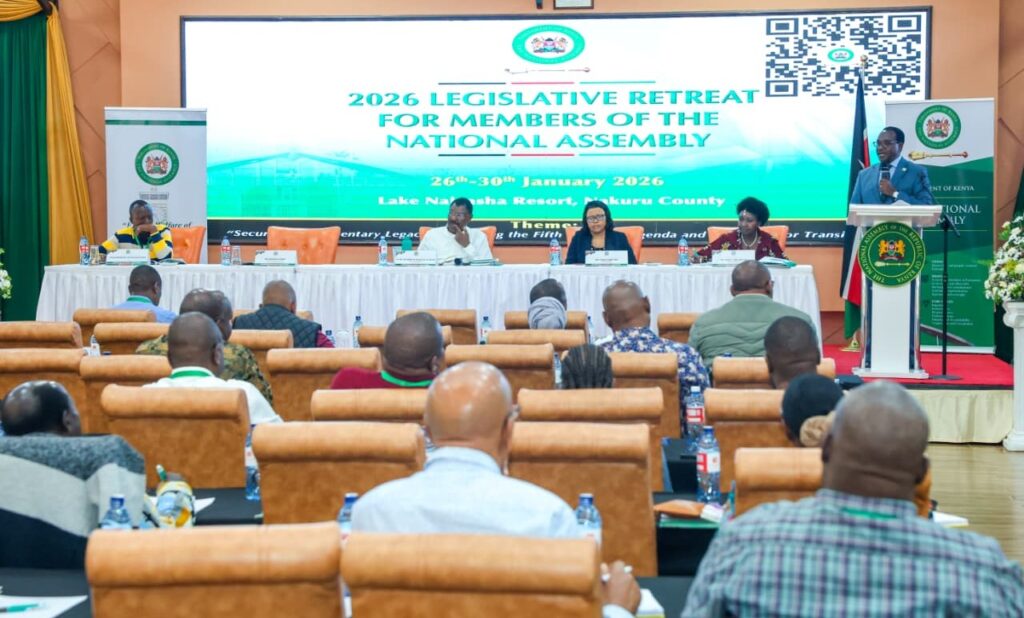
Speaking during the 2026 Legislative Retreat in Naivasha on Wednesday, January 28, 2026, Ogamba updated Members of Parliament on the progress of the transition from Junior School to Senior School, financing structures, infrastructure readiness, and teacher preparedness. His address placed strong emphasis on aligning school charges with constitutional guarantees of free and compulsory basic education.
Push for harmonised school fees
Ogamba clarified that clustering of senior schools into categories C1 to C4 is strictly administrative and does not signal any change in the approved fee structure. He stressed that the forthcoming harmonised fees framework is meant to eliminate confusion among parents and ensure uniform implementation of government policy across all public senior schools.
“There has been no increase in approved school fees. The clustering is purely structural for management and curriculum pathways, not a basis for additional charges,” Ogamba told legislators.
Read more: Ruto to principals: Admit all Grade 10 learners unconditionally
He added that amendments to the Basic Education Act are underway to strengthen enforcement mechanisms and hold education officers accountable where schools impose unauthorized levies. The move comes amid concerns from parents over inconsistent fee demands during the first transition of learners into senior school under the CBE system.
The CS reaffirmed that the government remains committed to Article 53 of the Constitution, which guarantees every child the right to free and compulsory basic education. Current annual capitation rates stand at Ksh 1,420 for Free Primary Education, Ksh 15,042 for Free Junior School Education, and Ksh 22,244 for Free Secondary and Senior School Education.
Transition under CBE
Ogamba told Parliament that the pioneer cohort of CBE learners — who sat the Kenya Junior School Education Assessment (KJSEA) in November 2025 — has largely transitioned successfully into senior school. A total of 1,130,556 learners completed the assessment, with results released on December 11, 2025.
He explained that placement and revision windows led to a shift in reporting dates from January 16 to January 21, 2026, describing the adjustment as expected given the scale and novelty of the exercise.
Read more: Gov’t extends Grade 10 reporting to Wednesday, January 21
As of January 22, transition rates stood at 92 per cent, rising to 96 per cent by midday January 27. The improvement followed a presidential directive requiring all schools to admit placed learners without conditions related to fees or uniforms.
Placement into senior school pathways was based on a weighted formula comprising KPSEA (20 per cent), KJSEA (60 per cent), and School-Based Assessments (20 per cent). Learners were distributed across three tracks: STEM (52 per cent), Social Sciences (38 per cent), and Arts and Sports Science (10 per cent).
Senior schools have been organized into four clusters — 263 C1 schools, 706 C2 schools, 1,409 C3 schools, and 7,162 C4 schools nationwide.
Funding and infrastructure
Despite allocating Ksh 702.7 billion to the education sector in the 2025/2026 financial year — representing 28 per cent of the national budget — Ogamba acknowledged a funding deficit of Ksh 48.3 billion. He nevertheless assured MPs that financing of basic education remains a top government priority.
On infrastructure, he reported that pressure from the 100 per cent transition policy has been eased through the construction of 23,000 Grade 9 classrooms over the past two years. Of these, 18,288 were built by the Ministry of Education and 4,712 through NG-CDF support.
Senior schools currently have capacity to host 2.2 million learners, which Ogamba said is adequate for the current cohort.
Read more: Lecturers defy CS Ogamba’s order to return to work, demand billions in unpaid dues
In addition, 1,600 new laboratories will be built in 1,452 schools with support from the World Bank and other development partners.
Textbook distribution has reached 57.58 per cent as of January 27 and is expected to hit 100 per cent by the first week of February, with a target of one textbook per learner per core subject.
To support effective delivery of CBE, the government has recruited 100,000 teachers over the past three years. Nationwide retooling has covered 229,292 primary school teachers, 84,461 junior school teachers, and 83,139 senior school teachers.
Ogamba said the Ministry remains focused on ensuring that the transition to senior school is equitable, well-funded, and fully compliant with policy — with harmonised school fees forming a key pillar of that assurance.


About the Author