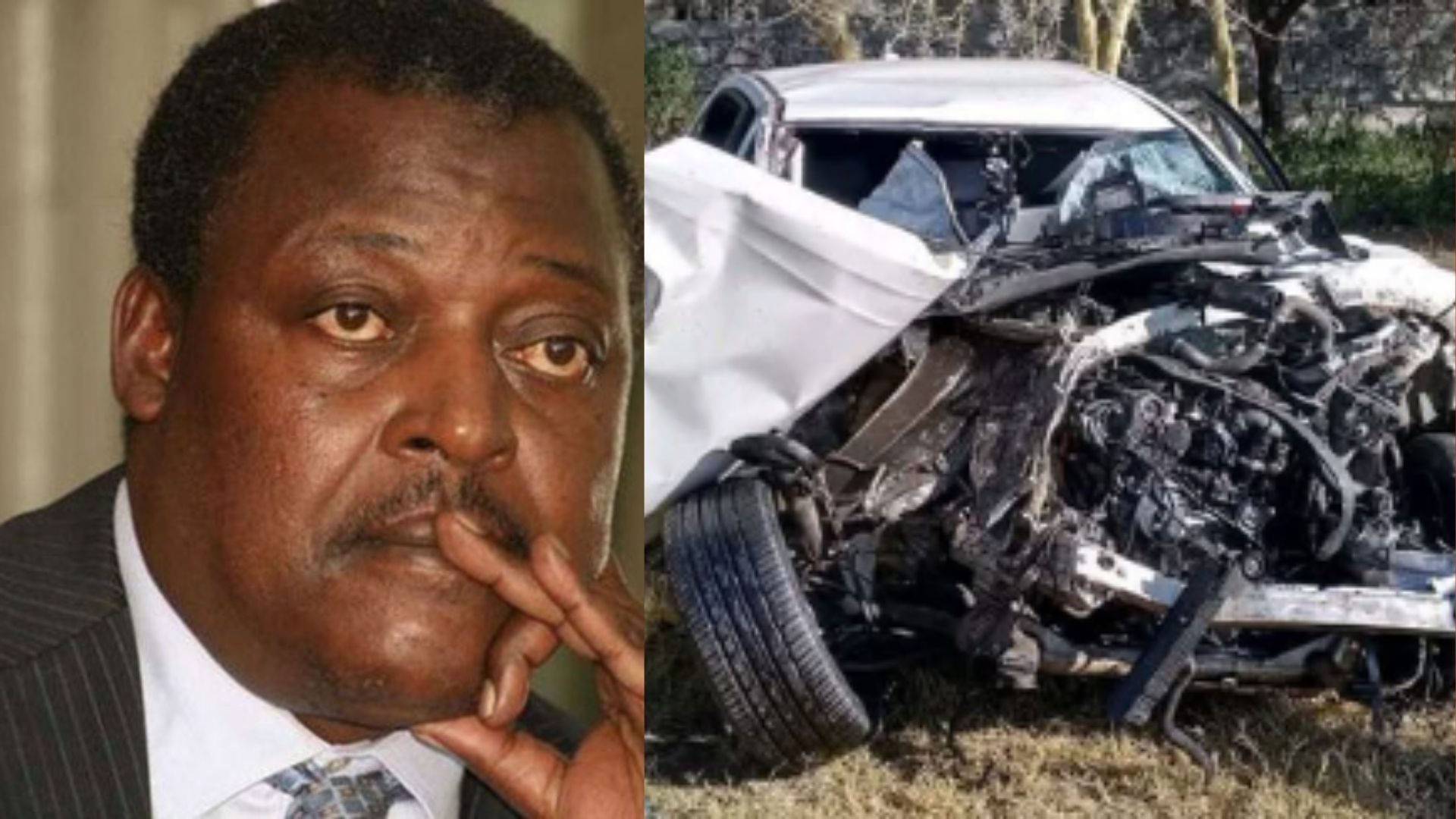
A collage of former Lugari MP Cyrus Jirongo and his ill fated Mercedez Benz vehicle. Photo/Handout
By Newsflash Team
An independent accident forensic audit commissioned by associates of prominent businessman and politician Cyrus Jirongo has raised serious doubts about the official police account of the fatal road crash on the Nairobi–Nakuru highway early Saturday.
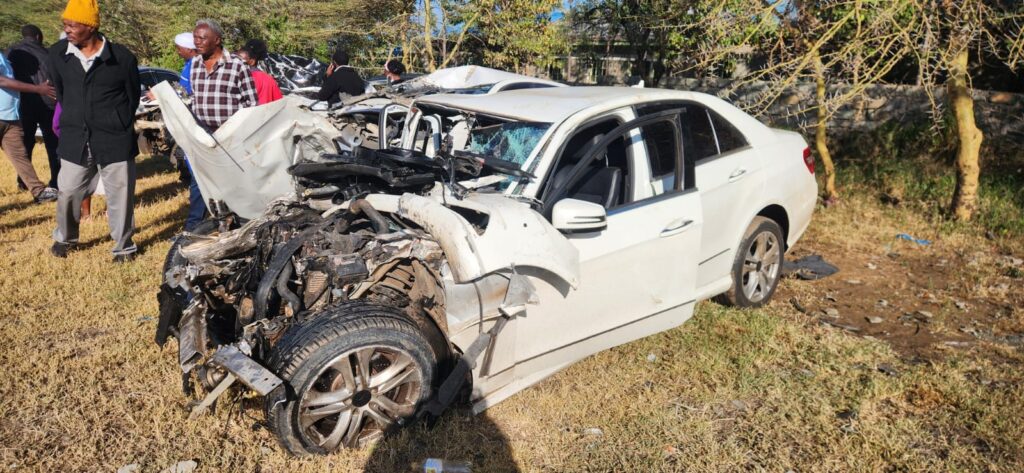
Police initially reported that Jirongo’s Mercedes-Benz E350 was involved in a head-on collision with a bus near the Gilgil junction. According to that account, the impact was severe, leaving the luxury saloon badly damaged at the front. Jirongo was pronounced dead at the scene, bringing to an abrupt end the life of one of Kenya’s most influential political and business figures.
Traffic officers from Gilgil station consistently maintained that the crash was a high-speed, head-on collision involving vehicles travelling in opposite directions. The bus driver, Titus Kamau, was briefly held before being released as “routine” investigations began.
Kamau told police he believed Jirongo’s vehicle was stationary on the opposite side of the road. He claimed that when he attempted to swerve, the bus struck the Mercedes head-on.
However, a separate and technically detailed crash analysis prepared by independent investigators tells a very different story. Drawing on an expanded collection of scene photographs and vehicle damage assessments, the audit suggests the crash involved multiple impacts, directly contradicting the police’s head-on collision narrative.
Doubts from a close ally
Vihiga Senator George Khaniri, a close friend of Jirongo and among the last people to speak to him before his death, says the circumstances surrounding the crash raise troubling questions.
“I met him at 7am at Karen Oasis. He was seated with National Assembly Speaker Moses Wetang’ula and Redman Matala. They were relaxed and having a good time. I went in, finished my business and left,” Khaniri says.
Later that night, Khaniri says he called Jirongo at 10.50pm, teasing him about still being out despite an important meeting scheduled for the next day.
Read more: The life and times of Cyrus Jirongo
“He told me he was done and heading to Naivasha. He assured me he was fine and said we would meet the following day,” Khaniri recalls.
He later learned that shortly after that call, Jirongo left the venue and headed towards his home in Gilgil. At 3.23am, Khaniri received a distress call from Jirongo’s wife asking him to rush to Naivasha following a serious accident.
“This was very unusual. There was no reason for Jirongo to be travelling so late. The meeting we had planned was extremely important, and he was not the kind of person to take reckless risks,” Khaniri says.
He adds that Jirongo rarely drank alcohol and often chose to pull over and rest if he felt tired. “He had done that all his life. Why would he suddenly, at his age, decide to drive deep into the night?” he poses.
Khaniri hints that Jirongo’s death may not have been accidental. “He was a man of the people and an international businessman. Recently, he had been involved in difficult mineral deals in the DRC and other countries. He may have posed a threat to some interests,” he says, adding that they had shared lunch together at Jirongo’s home only days earlier.
Family raises unanswered questions
Jirongo’s caretaker, Joseph, who lived within his compound, says events on Friday night do not align with claims that his employer was travelling to Naivasha.
He says he prepared supper and called Jirongo around 9pm to inform him that dinner was ready. “He told me he was on his way,” Joseph says.
At 10pm, Joseph called again to say he was going to bed and had left the meal on the table. “He told me to sleep and said he would be home shortly. He never mentioned going to Naivasha,” Joseph explains, noting that Jirongo usually informed him whenever he planned to stay away overnight.
Jirongo’s son, Jake, says the family is struggling with many unresolved questions. “We will meet as a family later and form a committee to address the issues surrounding his death,” he said, after spending part of Wednesday at his father’s offices.
Forensic findings challenge police version
The independently commissioned forensic traffic crash audit is written in highly technical, evidence-based language and systematically dismantles the initial police report.
Central to its findings is what investigators term the “Primary Impact – Rear Left Quarter.” According to the report, there was severe deformation on the rear-left side of the Mercedes, including an inward-shattered tail lamp, a torn fuel flap and clear intrusion around the rear wheel.
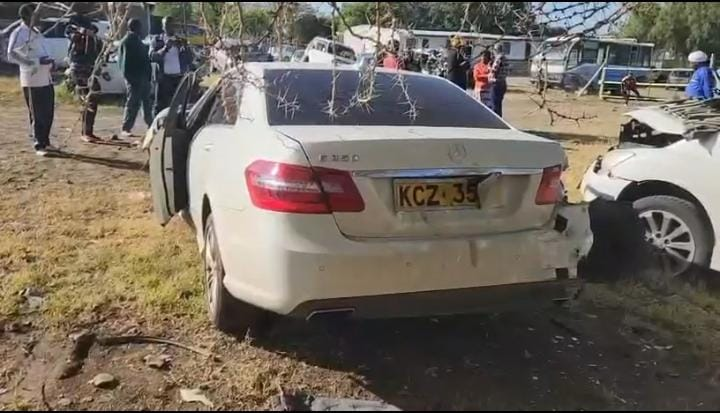
“The boot lid is not telescoped centrally,” the report notes, a critical observation indicating the crushing force originated from the side or rear, not the front.
Read more: Jirongo: Popular politician who never became Mulembe ‘kingpin’
Investigators conclude that the Mercedes was struck on the rear-left quarter by a heavier vehicle, with damage patterns consistent with an impact from a bus or truck. This sharply contradicts the police account, which focuses almost exclusively on front-end damage and makes no reference to rear-quarter intrusion.
The forensic team classifies the extensive frontal destruction as a “Secondary Impact – Catastrophic Frontal Collision,” describing it as the “Terminal Event,” marked by an asymmetrical collapse of the engine block.


About the Author