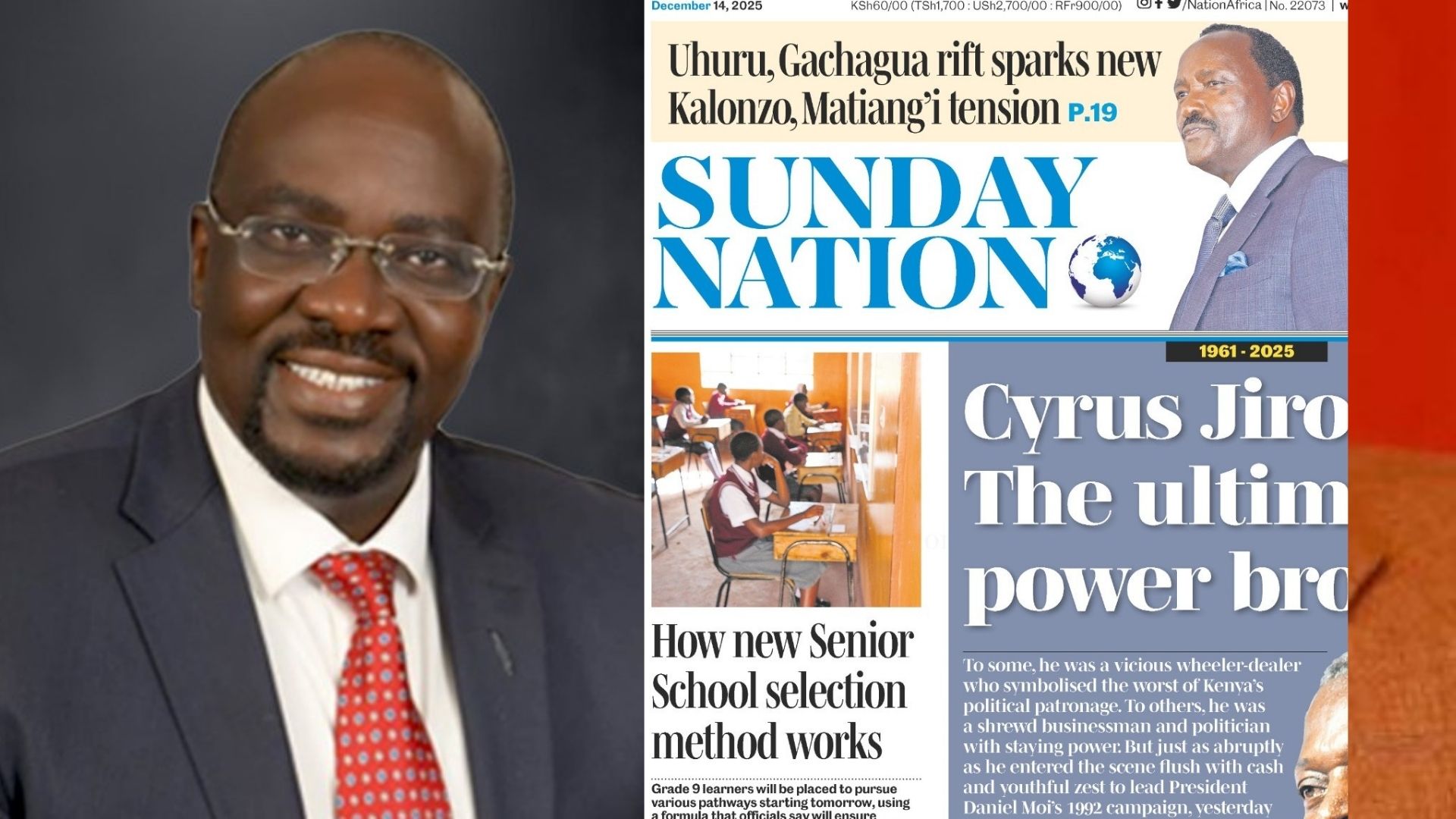
A collage of Prof Peter Kagwanja and the Sunday Nation front page. Photo/Handout
By Newsflash Reporter
Prof Peter Kagwanja has ended a 12-year run as a political columnist with the Sunday Nation, drawing the curtain on one of the newspaper’s longest-serving opinion voices amid what sources describe as an ongoing reorganisation at Nation Media Group.
Kagwanja announced his departure in a sign-off column published on Sunday, December 14, 2025, titled Bidding farewell to my readers after 12 years, but my pen won’t run dry. He revealed that he joined the Nation Media Group in August 2013 and has since authored 712 columns—more than 600 of them appearing in the Nation and The EastAfrican—amounting to nearly a million words.
“There are no eternal cocktails,” Kagwanja wrote, reflecting on what he described as an “eventful intellectual odyssey” spanning just over 12 years and four months. “This article is my last as a columnist.”
A decade of ideas and debate
In his farewell, Kagwanja traced his decision to become a columnist to Kenya’s tradition of intellectual engagement in politics, arguing that while the country’s first liberation was won through armed struggle, the second was secured “through the barrel of the pen,” culminating in the 2010 Constitution.
He positioned the role of a columnist as central to democratic life, warning that “democracy without knowledge is a dangerous cesspit” and describing public intellectuals as frontline defenders of freedom. Kagwanja recalled that in early 2013, shortly after the end of former President Mwai Kibaki’s tenure, he briefly considered elective politics before opting to remain an independent public intellectual.
Read more: Kenya, US seal health deal amid data privacy concerns
That choice, he said, was influenced by the ideas of Italian philosopher Antonio Gramsci on the “organic intellectual”—a thinker embedded in society rather than power. Later in 2013, then Sunday Nation editor Eric Obino invited him to take over a 600-word column previously written by Dr Mukhisa Kituyi, who had left to join the United Nations Conference on Trade and Development.
At the time, Kagwanja was an adjunct professor at the University of Nairobi and chief executive of the Africa Policy Institute, completing what he described as a “trinity” of academia, policy research and media engagement.
Independence, clashes and controversy
Kagwanja said his years at the Sunday Nation reshaped his writing, pushing him to communicate complex ideas to broader audiences without abandoning academic rigour. While opinion writing offered freedom of expression, he said he deliberately avoided “deep personal indulgence,” instead grounding his arguments in data and facts.
He also underscored the importance of editorial independence, recounting moments of tension with fellow columnists and editors.
Read more: Gachagua: “I coordinated Ruto’s secret meeting with RSF leader”
Among the controversies he cited were disagreements with legal scholar Makau Mutua and concerns raised by the paper’s public editor at the time over disclosures related to his political engagements.
His commentary on foreign policy, particularly Somalia and the Greater Horn of Africa, often provoked sharp reactions. Kagwanja recalled sparring publicly with Ethiopian Prime Minister Abiy Ahmed’s administration after publishing an article in 2019 that introduced the concept of a “Cushitic Alliance,” which he argued posed risks to regional stability. The analysis drew criticism from Ethiopian officials but later, he noted, appeared prescient following the outbreak of Ethiopia’s civil war in 2020.
“Intellectuals are not always politically correct,” he wrote, contrasting scholarly candour with diplomatic language.
A farewell amid newsroom changes
Kagwanja’s exit comes barely a week after another high-profile departure at Nation Media Group. Prof Austin Bukenya, a long-time contributor to Saturday Nation’s Literary Discourse, also published a farewell note to readers last weekend.
Sources told Newsflash that the departures are part of a broader reorganisation at the Kimathi Street-based media house, though the company has not publicly detailed the changes.
In his farewell, Kagwanja confirmed that he has since formally joined partisan politics, serving as Deputy Party Leader of the People’s Liberation Party. Still, he insisted that writing will remain central to his public life. “The barrel of the pen will never run dry,” he said, thanking a succession of editors and his readers for more than a decade of engagement.
Biographical note
Kagwanja currently serves as President and Chief Executive Officer of the Africa Policy Institute (API) and is an adjunct scholar at the University of Nairobi and the National Defence University–Kenya. Between 2007 and 2013, Kagwanja advised the Government of Kenya on reforms and strategy, offering intellectual leadership that shaped the 2010 Constitution and later contributed to the formulation of Kenya’s Foreign Policy in 2014.
Read more: Sudan protests to Kenya over Ruto-RSF link
The scholar is also a Special Adviser to the Intergovernmental Authority on Development (IGAD) and is frequently consulted by African governments, United Nations agencies, the European Union, and key international partners, including the United Kingdom, the United States, Japan, and China. He sits on the International Advisory Board of the China-Africa Institute (CAI) and serves as co-chair of the Academic Committee of the China-Africa Cooperation Network, alongside roles in several other organisations and advisory bodies.


About the Author