

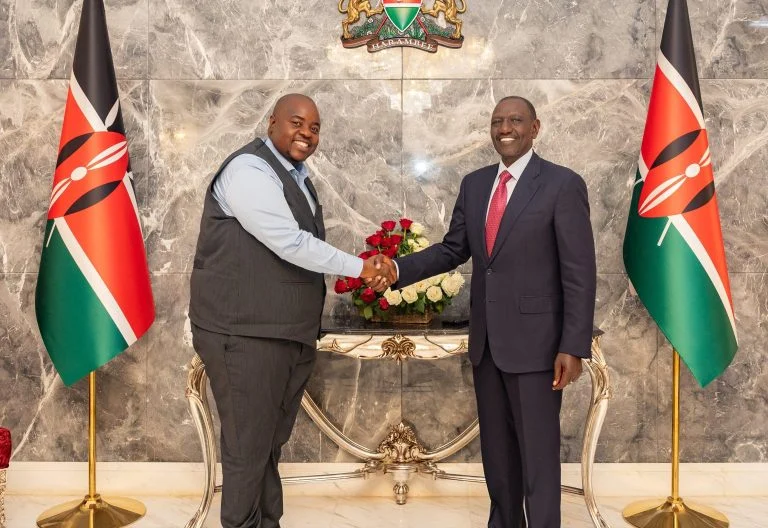
Kenya’s President William (left) and Rapid Support Forces (RSF) Commander Mohamed Hamdan Dagalo ("Hemedti"). Photo/PCS
By Newsflash Writer
Kenya’s Parliament is facing mounting pressure to respond to a formal diplomatic protest from Sudan, which accuses President William Ruto of fueling conflict in the country by allegedly backing the Rapid Support Forces (RSF)—a powerful paramilitary group notorious for human rights abuses.
A senior official in Parliament, speaking anonymously due to the sensitivity of the issue, confirmed receipt of the protest letter dated March 14, 2025. The letter was sent by Commander Malik Agar, Vice President of Sudan’s Transitional Sovereign Council (TSC), and is currently under review.
“This is a highly delicate issue that will be handled through diplomatic channels via the Ministry of Foreign Affairs,” the official stated. “MPs have been instructed not to comment publicly.”
In the letter, Agar accuses President Ruto of allowing RSF leaders to operate freely within Kenya and even hosting meetings aimed at setting up a rival administration in Sudan—an action the Sudanese government interprets as an attack on its sovereignty and a threat to regional peace.
The RSF, led by General Mohamed Hamdan Dagalo (commonly known as Hemedti), has been widely condemned by international bodies including the UN, African Union, IGAD, and the Arab League for committing atrocities such as ethnic massacres, sexual violence, and mass displacement.
Read more: Gachagua reveals Ruto’s ‘business deals’ in Sudan, DRC, Serbia
The Sudanese letter calls on Kenyan lawmakers to reject what it describes as the misuse of Kenyan soil to give legitimacy to rebel groups. “I hope your honorable Parliament will defend the ideals of Pan-Africanism and not allow Kenya to become a safe haven for elements seeking to destabilize a fellow African nation,” Agar wrote.
Sudan has already responded with economic retaliation, recently imposing a ban on key Kenyan exports like tea and coffee—products crucial to Nairobi’s regional trade. Analysts interpret the ban as a strong signal of Sudan’s diplomatic displeasure.
Internal divisions undermine RSF plans
The letter also refers to an RSF meeting held on February 22, 2025, at the Kenyatta International Convention Centre (KICC) in Nairobi. A follow-up meeting slated for mid-April was postponed indefinitely due to internal rifts within the RSF.
Reports by the Sudan Tribune reveal deep divisions between Hemedti and Sudan People’s Liberation Movement-North (SPLM-N) leader Abdul Aziz Al Hilu. The dispute centers around who should lead a proposed Sovereign Council. Al Hilu wants the council based in Kauda, South Kordofan—a region under SPLM-N control—and has demanded to chair it, a demand Hemedti’s faction has rejected.
These internal power struggles, alongside continuing RSF-led offensives, reportedly led to over 400 deaths on the same day the RSF delegation arrived in Nairobi—escalating tensions further.
Kenya’s perceived involvement in Sudan’s internal affairs has drawn regional criticism. Political analyst Prof. Peter Kagwanja argued that President Ruto’s actions have undermined Kenya’s long-standing image as an impartial peace mediator in East Africa. “Kenya has transitioned from a trusted mediator to a suspected partisan, jeopardizing our diplomatic legacy,” he said.
Leaders from neighboring countries have also weighed in. Rwanda’s President Paul Kagame and DRC’s President Felix Tshisekedi have expressed skepticism about Kenya’s regional role. Kagame has accused Kenya of personalizing the East African Community’s engagement in Congo, while Tshisekedi has shifted allegiance to the SADC and Angola, citing Kenya’s alleged sympathy for M23 rebels.
Read more:UN calls for dialogue in South Sudan
Legal expert and governance commentator David Ochami also criticized Nairobi’s strategy. “Unless Kenyan officials are driven by undisclosed financial interests, there’s no justification for this risky dalliance with the RSF,” he said. Ochami emphasized that the official peace process is happening in Addis Ababa under the African Union’s leadership, and Kenya should not be running parallel talks.
He warned that legitimizing the RSF—given its fractured leadership and violent history—is a diplomatic gamble Kenya is ill-equipped to manage. “Kenya lacks the neutrality, influence, and regional credibility required for such sensitive negotiations,” he concluded.


About the Author




3 thoughts on “Sudan protests to Kenya over Ruto-RSF link”
Comments are closed.