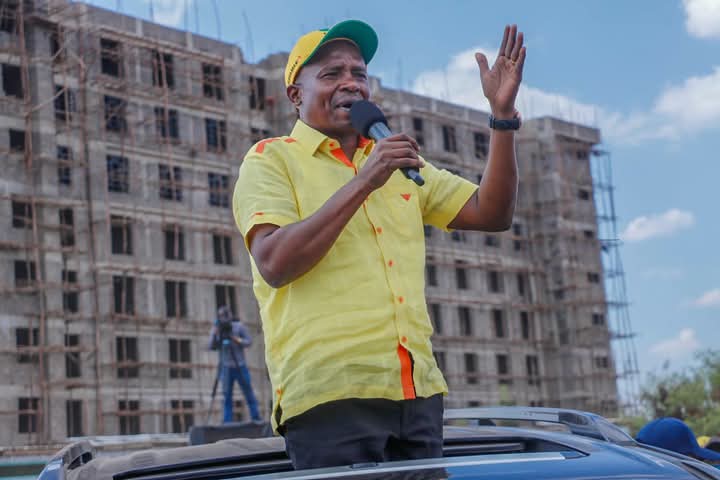
Former Lugari MP Cyrus Jirongo. Photo/Nation Media Group
By Newsflash Writer
Cyrus Jirongo embodied the archetype of the modern Kenyan politician; nationally visible, politically daring and immensely influential in his prime—yet he never succeeded in consolidating himself as Western Kenya’s undisputed political kingpin.
For decades, his name commanded attention across the country, evoking wealth, confidence and audacity. He was recognised far beyond his Lugari base, but within Western Kenya, a lingering question persisted: how could a figure so dominant on the national stage fail to fully anchor his authority at home?
In the wake of his death, that paradox has come sharply into focus. Political analysts and residents alike describe Jirongo as a leader who reached extraordinary heights but stopped short of transforming popularity into lasting regional control—earning him the label of “the king who never wore the crown.”
National reach and regional limits
Since the era of Masinde Muliro and later Michael Wamalwa, Western Kenya has struggled to produce a unifying political figure with enduring authority. Many believed Jirongo, whose rise coincided with the late President Daniel arap Moi’s rule, was best placed to fill that void. His national networks, financial muscle and political bravado set him apart from his peers.
However, while his profile grew nationally, his regional grip remained fragmented. As his influence ebbed, space opened for leaders such as Musalia Mudavadi and Moses Wetang’ula, who, though less flamboyant, steadily built durable political machines that came to define Western Kenya’s power structure.
Read more: Mulembe MPs defend Wetang’ula against ‘unwarranted attacks’
Jirongo’s death in a tragic road accident has now closed the chapter on one of Kenya’s most dramatic post-independence political careers, while reopening debate in Western Kenya about the cost of unrealised political consolidation.
In Lugari, where his grassroots support was deepest, the sense of loss was acute. “To us here in Lugari, he was our king. He led with wisdom, and it hurts that Western Kenya never fully embraced him,” said Bernadine Bwamula, a resident.
At his peak, Jirongo commanded loyalty, resources and attention in a way few regional leaders have managed since. Yet his later years illustrated a central weakness of his politics: charisma alone, without strong institutional structures, is vulnerable to shifting political tides.
Power without permanence
Jirongo’s ascent began in the early 1990s when he emerged as the youthful and flamboyant chairman of Youth for Kanu ’92 (YK’92), a formidable lobby group credited with securing President Daniel arap Moi’s re-election.
At a time when political mobilisation relied on organisation, money and audacity, Jirongo excelled. YK’92 gained notoriety for distributing newly minted Sh500 notes—then the highest denomination—so extensively that the currency itself became popularly known as “Jirongo.”
Almost overnight, he became a household name, wielding influence that stretched well beyond Western Kenya. That national clout propelled him into elective politics, where he served two terms as Lugari MP and later held a Cabinet position, reinforcing his image as a rising force within the Luhya community.
His 1997 Lugari parliamentary victory symbolised the culmination of his early ascent—a man who had helped others secure power now claiming it for himself.
Read more: The life and times of Cyrus Jirongo
Observers recall that he entered elective politics under the moniker “Healingsa CK,” at a time when Lugari was absorbing settlers from across Western Kenya into expansive agricultural schemes.
“Growing up in the late 1990s and early 2000s, we believed there was no one more powerful than Jirongo. His name alone carried authority and spread like wildfire,” said political analyst Joseph Khaemba.
His style was confrontational, populist and unapologetically bold. Whether addressing rallies or confronting rivals, Jirongo projected fearlessness and command.
Critical rupture
But his defeat in the 2002 General Election marked a critical rupture. President Mwai Kibaki’s landslide victory swept through Western Kenya, dismantling Jirongo’s foothold. Having lost his parliamentary seat, he found himself marginalised within a rapidly changing political landscape, allowing more institutionally rooted leaders to rise and eclipse him.
Despite cultivating alliances beyond ethnic boundaries, including ties with figures such as former Vihiga Senator George Khaniri, financial challenges, debt disputes and prolonged court battles steadily eroded his political capital and aura of invincibility.
Still, Jirongo refused to retreat. His later political life was marked by repeated efforts to reclaim relevance, driven by a belief that his influence—particularly in Western Kenya—had not been fully extinguished.
Read more: Climax Bus driver recounts fatal crash that killed Jirongo
His first comeback came in 2007, when he founded the Kenya African Democratic Congress (Kaddu) and successfully reclaimed the Lugari parliamentary seat. Buoyed by that success, he pursued higher office, declaring presidential ambitions ahead of the 2013 General Election before switching to the Kakamega Senate race, which he lost to Boni Khalwale.
In 2017, he made another ambitious bid for the presidency under the United Democratic Party (UDP), but the campaign failed to resonate nationally, further illustrating how the political centre had shifted away from him.
His final major attempt came in the 2022 General Election, when he aligned UDP with the Azimio la Umoja coalition and contested the Kakamega gubernatorial seat. He lost to Fernandes Barasa, bringing to an end a political journey defined by national prominence, regional fragmentation and an enduring sense of unfulfilled potential.


About the Author