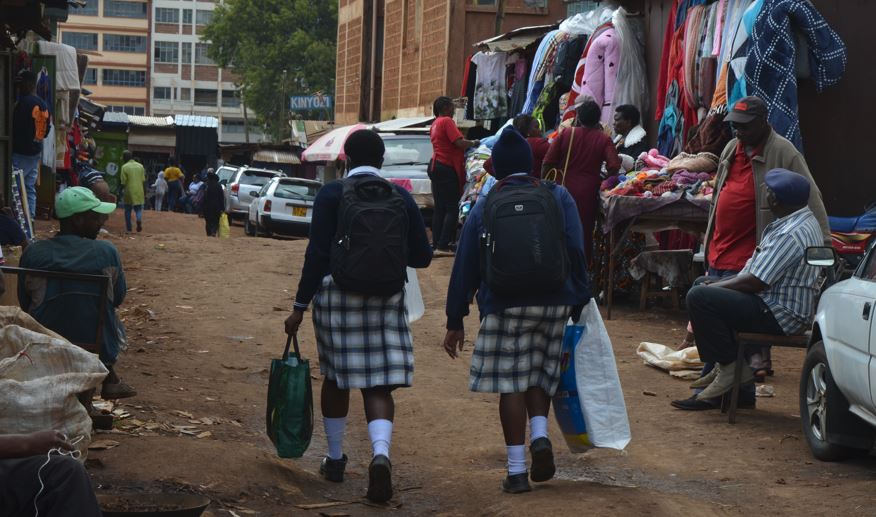
Students going back to school. Photo/Kenya News Agency
By Newsflash Reporter
As classrooms reopen this week for the 2026 academic year, Kenya’s education sector is confronting a stormy beginning to what is arguably its most ambitious transition yet.
Tensions over fees, teacher shortages and inadequate facilities are colliding with the historic rollout of senior school under the Competency-Based Education (CBE) system.
For the first time, 1.13 million pioneer learners are stepping into Grade 10, ushering in the final and most decisive phase of reforms that have been a decade in the making. Yet instead of celebration, the transition is unfolding amid placement disputes, strained infrastructure and deep anxiety among parents, teachers and school administrators. To cushion schools at reopening, the government has disbursed Sh44 billion in capitation for Term One.
Fees pressure and funding disputes
Of the released funds, Free Day Secondary (Senior School) will receive Sh26 billion, Free Day Junior School Sh14 billion, while Free Primary Education has been allocated Sh3.7 billion. Education Cabinet Secretary Julius Ogamba cautioned school heads against introducing extra charges, warning that some institutions have been levying concealed fees for meals and infrastructure.
“School heads and principals are directed to ensure prudent use of these public resources entrusted to their care for the benefit of learners, and to desist from imposing any extra levies or fees. As a Ministry, we will deal firmly with any verified cases of misappropriation of resources and the imposition of extra levies or fees,” Mr Ogamba said in a statement.
Read more: 87,000 ghost learners found in public schools
However, principals argue that financing remains the sector’s most pressing headache. They say both government capitation and parent-paid fees—last reviewed in 2014—no longer match today’s economic realities. Kenya Secondary Schools Heads Association (Kessha) chairperson Willie Kuria said the situation has been worsened by declining enrolment after one class was shifted to primary school, even as operational costs such as salaries and utilities remain unchanged.
He warned that some secondary schools could face closure due to shrinking student numbers and inadequate funding. Parents, meanwhile, are struggling to balance rising household costs with school demands. While boarding fees are capped at Sh53,554, school leaders insist the figure is outdated. Unlike the former 8-4-4 system, which allowed varied boarding fees across national, extra-county and county schools, the flat-rate model under CBE has triggered unease among stakeholders. National Parents Association chairperson Silas Obuhatsa appealed to the government to ensure no Grade 10 learner is sent home over fees.
“These are very young children. We do not want to risk their lives by sending them away. Under CBE, we want proper implementation and no learner being chased from school,” he said.
Grade 10 placement and digital strain
The transition into senior school has also exposed cracks in the placement process. More than 350,000 learners have sought placement reviews after expressing dissatisfaction with their assigned schools. Competition for top-tier C1 institutions remains intense, with schools such as Alliance High School, Kenya High School and Mang’u High School receiving over 20,000 applications for just 500 vacancies each.
Read more: Ministry flags 2,145 ghost schools in nationwide audit
To ease tensions, the Ministry of Education has opened a final revision window running from January 6 to January 9, 2026. “The revision will provide parents, guardians and learners with the opportunity to present legitimate and verifiable grounds to justify a reconsideration of the initial or revised placement,” Mr Ogamba said.
Still, the new categorisation of schools into C1, C2, C3 and C4 has sparked fears of widening inequality. While C1 schools—formerly national schools—offer all three pathways under CBE, including STEM, Social Sciences and Arts and Sports, lower-tier schools provide limited options depending on available resources.
Infrastructure gaps and teacher shortages
At the heart of the senior school rollout lies a severe infrastructure deficit. Thousands of schools lack the specialised facilities required for CBE pathways, particularly in STEM and Arts. Laboratories, workshops, ICT hubs and sports amenities are either inadequate or entirely missing, with rural and marginalised regions bearing the brunt. Recently, President William Ruto directed the Education Ministry to prioritise construction in rural areas to promote equity.
Read more: Saba Saba: Schools, businesses brace for possible disruptions
Mr Kuria also flagged acute staffing gaps as schools grapple with the expanded curriculum. “We need infrastructure to handle technical subjects that have been introduced, such as electricity, woodwork and others,” he said.
Human rights groups warn that unless urgent action is taken, the reforms could entrench disparities rather than eliminate them. Kenya Human Rights Commission deputy executive director Cornelius Oduor cautioned against the concentration of high-performing learners in well-equipped C1 schools, leaving others in poorly resourced institutions.
“The few who get into top-notch schools will continue to outperform the rest, and they are also the ones likely to secure the best university courses,” he said, urging the government to prioritise teacher recruitment in 2026. Questioning the spirit of the reforms, Mr Oduor added: “We thought CBE would remove inequalities in education, but why are so many learners now scrambling for admission into a few selected blue-chip schools?”


About the Author