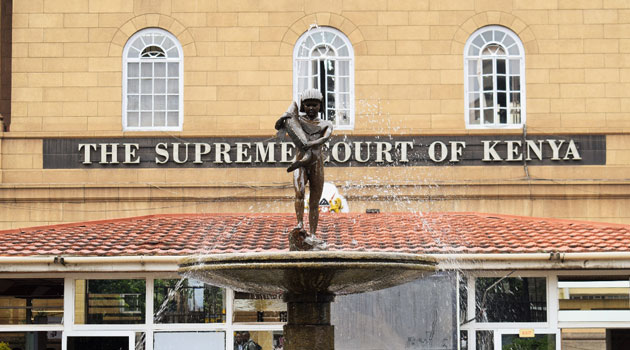
The Supreme Court of Kenya. Photo/Judiciary
By Newsflash Writer
Survivors of election-related sexual and gender-based violence (SGBV) have appealed to the Judiciary to prioritise the hearing and determination of constitutional human rights cases involving survivors, saying prolonged delays continue to deny victims justice, reparations and closure.
The appeal was made on Wednesday, July 29, 2026, during the hearing of Supreme Court Petition No. E041 of 2025, where survivors and human rights organisations urged the country’s highest court to address what they described as a long-standing pattern of exclusion of victims of conflict-related sexual violence from justice and compensation programmes.
The petition has been filed by eight survivors alongside the Coalition on Violence Against Women (COVAW), the Independent Medico-Legal Unit (IMLU), the Kenyan Section of the International Commission of Jurists (ICJ Kenya), Physicians for Human Rights (PHR), Utu Wetu Trust and the Kenya Human Rights Commission (KHRC).
According to the petitioners, nearly 13 years have elapsed since survivors first sought constitutional protection following the 2007-2008 post-election violence, yet many are still waiting for justice.
They noted that children born as a result of the violence have since turned 18 while their mothers continue pursuing legal redress through the courts.
Call for timely justice
The survivors argued that prolonged court delays have compounded their suffering and undermined their constitutional rights to equality, dignity and access to justice.
In a joint statement, they called on the Judiciary to prioritise constitutional human rights cases involving survivors of sexual and gender-based violence and address systemic delays that continue to deny victims timely justice.
The petition challenges the State’s alleged failure to prevent, investigate and prosecute widespread sexual violence committed during the 2007-2008 post-election violence, as well as its failure to provide effective remedies to survivors.
Read more: State compensates four 2007/08 PEV sexual violence survivors
The petitioners further faulted the Court of Appeal for what they termed discriminatory treatment after it awarded compensation to some survivors while denying others because the attacks were allegedly committed by civilian militias rather than State officers or because the incidents were never formally reported to the police.
They argued that creating a hierarchy of victims based on the identity of perpetrators or whether traumatised survivors reported the crimes during a national crisis violates constitutional guarantees of equal protection under the law.
Reforms and accountability sought
Beyond the individual appeal, the survivors said the case presents an opportunity for Kenya to strengthen access to justice and reform its reparations framework.
They urged the Government to end the exclusion of survivors of conflict-related sexual violence from national compensation programmes and implement survivor-centred reparations, including compensation, rehabilitation, psychosocial support, public acknowledgement and guarantees against future violations.
Read more: IMLU: Protect women human rights defenders and survivors of violence
The petitioners also called on the Presidential Working Group on the Establishment of a Framework for the Management of Claims and Compensation, chaired by Professor Makau Mutua, to expressly recognise survivors of conflict-related sexual and gender-based violence in the proposed national compensation framework.
Counsel Willis Otieno said constitutional accountability cannot depend on traumatised survivors overcoming impossible barriers to report crimes during widespread violence.
“The lack of effective remedies still continues to date. No investigations have ever commenced 13 years later. Constitutional accountability cannot be conditional on expecting traumatised survivors to perform impossible tasks while State security organs stood by,” he said.
The survivors expressed hope that the Supreme Court’s determination would not only provide justice in their case but also establish stronger legal protections for future victims of sexual and gender-based violence in Kenya.


About the Author