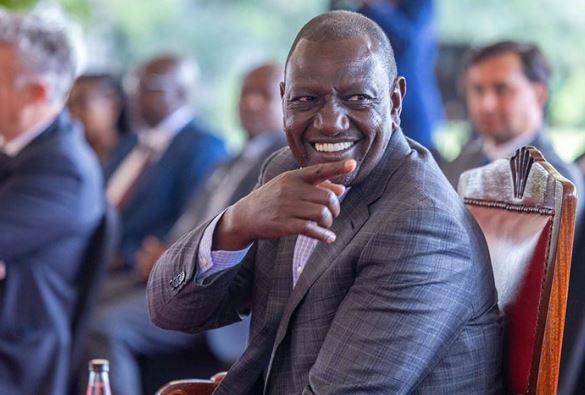
President William Ruto. Photo/Handout
By Newsflash Reporter
President William Ruto would emerge the winner if a general election were held today, according to the Infotrak end-of-year poll survey conducted between December 19 and 20, 2025.
The survey also shows that Ruto’s United Democratic Alliance (UDA) remains the most popular political party in Kenya even as economic pressures and governance concerns increasingly shape voter choices ahead of the 2027 General Election.
The nationwide survey, carried out across all 47 counties using Computer Assisted Telephone Interviews (CATI) on a representative sample of 1,000 adult Kenyans, places President Ruto clearly ahead of all potential challengers in a hypothetical presidential race held today. The poll has a margin of error of ±3.1 per cent at a 95 per cent confidence level.
Ruto leads a fragmented presidential field
According to the findings, President Ruto attracts 28 per cent of the vote, giving him a decisive lead over a fragmented opposition field. Former Interior Cabinet Secretary Fred Matiang’i follows at 13 per cent, while Wiper Party leader Kalonzo Musyoka polls 12 per cent. Embakasi East MP Babu Owino registers 7 per cent, with former Deputy President Rigathi Gachagua at 5 per cent.
Read more:Most Kenyans to skip Christmas & New Year festivities -Survey
Former Chief Justice David Maraga and People’s Liberation Party leader Martha Karua each record 2 per cent support. Homa Bay Governor Gladys Wanga and Trans Nzoia Governor George Natembeya both attract 1 per cent, while Kiharu MP Ndindi Nyoro polls 0.5 per cent. Prof George Wajackoyah and Nairobi Senator Edwin Sifuna trail at 0.2 per cent each.
The Infotrak end-year poll further shows that a significant 25 per cent of respondents remain undecided, while 4 per cent declined to disclose their preferred candidate. Analysts note that while President Ruto enjoys a clear lead at present, the high undecided vote highlights the fluidity of the race nearly two years to the 2027 General Election.
UDA maintains national lead as party loyalties shift
Beyond the presidential contest, the survey provides a detailed snapshot of political party popularity across the country. UDA emerges as the most popular party nationally, with 23 per cent of respondents saying they feel closest to it. The Orange Democratic Movement (ODM) follows at 19 per cent, while Democracy for the Citizens Party (DCP) attracts 6 per cent support. Jubilee Party stands at 5 per cent, and Wiper Patriotic Front polls 4 per cent.
A cluster of smaller parties each records 1 per cent support, including Chama Cha Mashinani, Usawa Kwa Wote Party, Maendeleo Chap Chap Party, Kenya National Congress, People’s Democratic Party, Ford-Kenya, Movement for Democracy and Growth, Thirdway Alliance, KANU, Restore and Build Kenya Party, People’s Empowerment Party and NARC.
Read more:ODM popularity surges as Gachagua’s DCP support declines-TIFA
Another 3 per cent of respondents identify with other parties such as PNU, PLP, TSP, UGM, KADU-Asili and Frontier Alliance Party. Meanwhile, 16 per cent say they do not feel close to any political party, with another 16 per cent choosing not to disclose their affiliation.
Trend data from the Infotrak survey shows that while UDA remains the dominant political party, its popularity has fluctuated over time. In August 2025, UDA stood at 16 per cent, before rising to 23 per cent in December 2025, indicating a rebound after earlier dips. By contrast, ODM’s support has remained relatively stable, underscoring a competitive but shifting party landscape.
Cost of living tops issues shaping the 2027 vote
The poll also assessed broader political formations, reflecting the growing importance of coalition politics. According to the findings, 32 per cent of respondents feel closest to the broad-based government led by President Ruto. The United Opposition formation associated with leaders such as Rigathi Gachagua, Martha Karua, Kalonzo Musyoka and Eugene Wamalwa attracts 22 per cent, while the Kenya Moja alliance linked to figures such as George Natembeya, Edwin Sifuna and Babu Owino records 17 per cent. A sizeable 29 per cent of respondents say they do not identify with any of the major political formations.
Economic issues dominate the factors likely to shape voter choice in the 2027 elections. The Infotrak end-year poll shows that the cost of living is the most influential issue, cited by 46 per cent of respondents.
Read more:UDA’s gamble to revive lost support in Mt Kenya
This is followed by anti-corruption and health services, each at 27 per cent, education at 26 per cent, and youth employment at 25 per cent. Other key concerns include leadership integrity (23 per cent), economic management (21 per cent), security (16 per cent), devolution (11 per cent) and affordable housing (3 per cent).
Overall, the survey paints a picture of a President who would secure victory if elections were held today, backed by the country’s most popular party and facing a divided opposition. However, with a quarter of voters still undecided and party loyalty increasingly issue-driven, the Infotrak end-of-year poll conducted on December 19–20, 2025, suggests that the 2027 contest will ultimately be shaped by economic performance, governance outcomes and shifting political alliances rather than party labels alone


About the Author