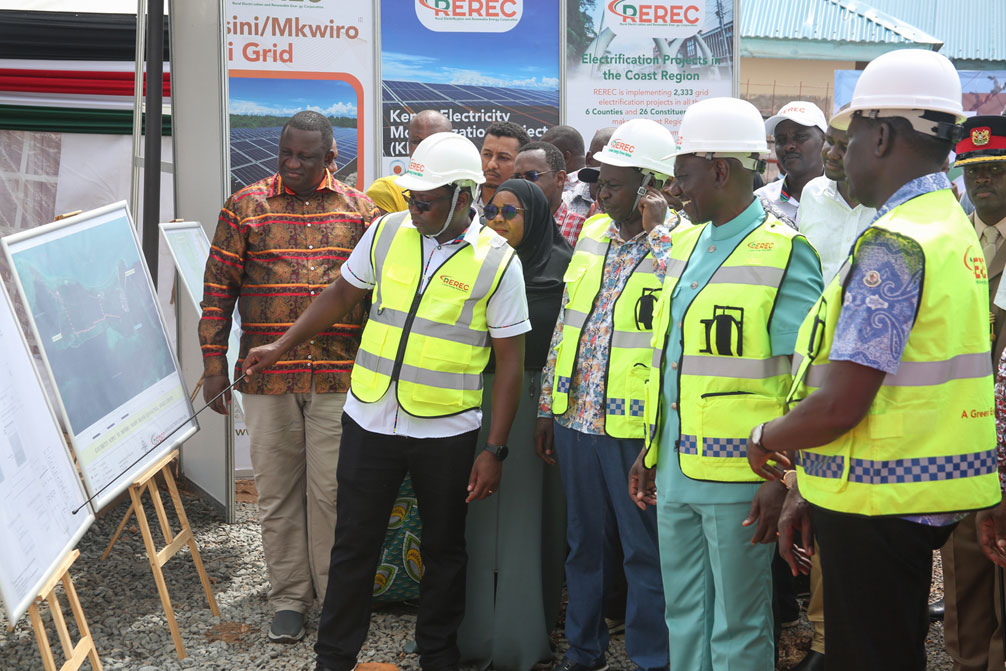
President William Ruto commissions the Wasini Island Solar Power Mini-Grid, a project implemented by the Rural Electrification and Renewable Energy Corporation (REREC) on November 2, 2023. Photo/REREC.
By Newsflash Writer
The Rural Electrification and Renewable Energy Corporation (REREC) is under scrutiny after failing to repay a Sh13.6 billion Chinese loan, despite having more than Sh2.8 billion sitting idle in an escrow account meant for loan servicing.
The Auditor-General has flagged this inaction, warning that the default could attract steep penalties and hurt Kenya’s credit standing with Chinese lenders.
The loan was secured in 2015 from the Exim Bank of China to fund the construction of a 50-megawatt solar power plant in Garissa. Though the plant has been operational since 2018 and sold 84GWh of electricity to Kenya Power for Sh675 million in the financial year ending June 2024, REREC failed to make any loan repayment from the escrow account held at KCB Bank. The only transaction recorded was a minimal bank fee of Sh1,179.
Auditor-General Nancy Gathungu revealed that the account maintained an opening balance of $17.72 million (Sh2.49 billion) on July 1, 2023, and closed at nearly the same amount on June 30, 2024. “The funds were not utilised to repay the loan as required by the financing agreement, which led to default,” she stated.
Loan default risks credit rating
REREC’s inaction not only violates the financing terms but also exposes the agency—and by extension, the Kenyan government—to potential penalties and a credit downgrade. Ms Gathungu noted that the loan agreement mandates repayment of the principal in 26 equal instalments, yet no payments have been made.
The default could have wider implications. Chinese lenders, particularly the Exim Bank of China, may impose tougher borrowing terms on Kenyan State-owned agencies in future, potentially jeopardising infrastructure financing. This comes as Kenya is seeking additional Chinese funding, including for the planned extension of the standard gauge railway (SGR) to the Uganda border.
Read more: World Bank freezes Sh97bn loan to Kenya over delayed reforms
The Garissa solar project, built by China Jiangxi Corporation for International Economic and Technical Cooperation (CJIC), covers 85 hectares and is the largest of its kind in East and Central Africa. Commissioned by former President Uhuru Kenyatta, the plant contributes about 2 percent of the national energy mix and 17.7 percent of Kenya’s solar energy supply.
Despite this, REREC has been holding idle billions in violation of Section 83 (2)(c) of the Public Finance Management Regulations, which require sound cash management practices. “At the time of the audit in November 2024, Sh2.78 billion was lying idle in the account,” said the Auditor-General.
Compounding the issue, key loan details—including the outstanding amount—were not available for audit due to confidentiality clauses in the agreement with the Chinese lender. “A loan statement to show the current status of the loan was not provided for audit review,” Ms Gathungu added.
Solar energy gains momentum amid governance concerns
While the Garissa solar plant has played a growing role in clean energy supply, governance concerns now cloud REREC’s performance. Independent power producers (IPPs) supplied 474GWh of electricity to Kenya Power in the year to June 2024—3.46 percent of the total 13,684GWh—with solar energy rising 6.8 percent from the previous year.
Read more: 58 saccos face asset freeze over Sh1bn unpaid Kuscco loans
Kenya Power projects continued growth in solar and wind energy, noting that national demand is expected to reach 2,815MW in the next four years. To meet this target, the Least Cost Power Development Plan (LCPDP) has earmarked an additional 857MW of firm capacity and 665MW of variable renewable energy—comprising 324MW from solar and 341MW from wind.
However, REREC’s loan default threatens to undermine investor and lender confidence in State-run energy initiatives. The failure to make repayments despite holding sufficient funds highlights worrying lapses in financial accountability at the agency tasked with expanding Kenya’s renewable energy footprint.


About the Author