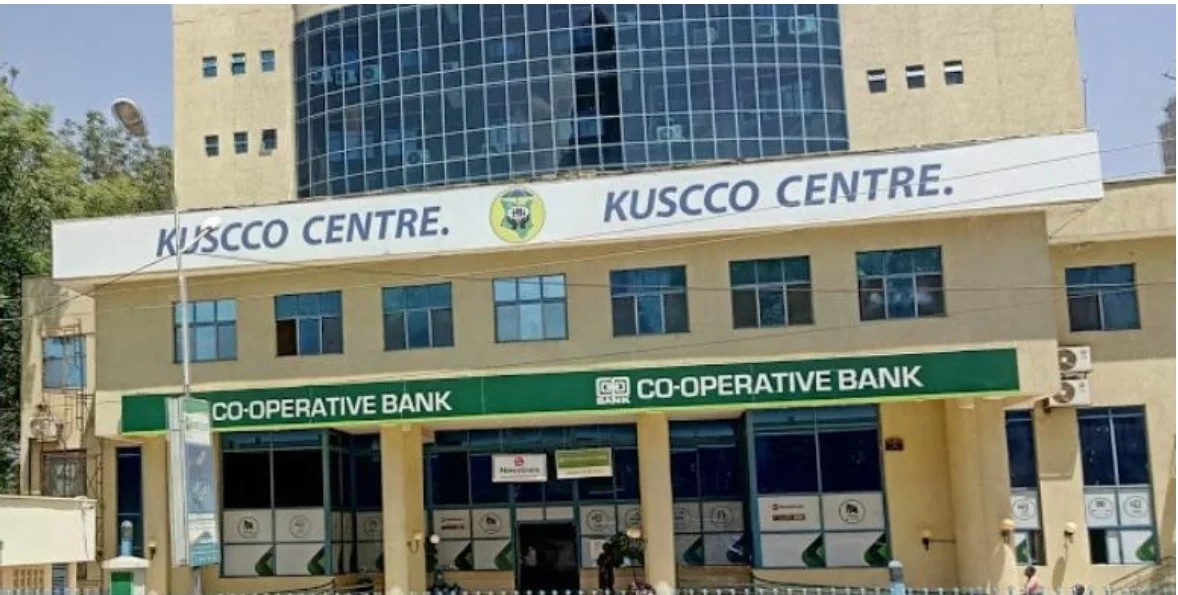
Kenya Union of Savings and Credit Co-operatives (Kuscco) headquarters in Nairobi. Photo/KUSSCO
By Newsflash Writer
Fifty-eight savings and credit co-operative societies (saccos) are staring at possible account freezes and property auctions as the government moves to recover Sh1.36 billion owed to the Kenya Union of Savings & Credit Co-operatives (Kuscco), which is reeling from a massive financial scandal.
The saccos took the loans over a 23-year period ending in 2024 and failed to repay. This comes as the State tries to rescue Kuscco following a Sh13.3 billion fraud that led to the arrest of four senior officials and a lawyer.
The defaulted loans were secured against deposits worth Sh368.39 million, leaving a shortfall of Sh987.86 million. The government has issued urgent repayment notices to cover the deficit.
Top defaulters include Kencom Sacco (Sh377.5 million), Nacico Sacco and its affiliate Nacico Investment Co-op (Sh358.01 million), and Maseno University Sacco (Sh106.43 million).
Commissioner for Co-operative Development David Obonyo has sent demand letters to the defaulting saccos. Kuscco intends to use the recovered amounts to partly pay other saccos whose funds are trapped within the union.
“It has come to the attention of this office that your sacco owes Kuscco an outstanding loan,” reads a letter dated June 27, 2025. “You are hereby required to settle the outstanding loan balance with immediate effect. If full settlement is not feasible, submit a written plan on how you intend to pay within 14 days to both this office and Kuscco.”
The affected saccos may have to forfeit their Sh368.39 million deposits and raise additional money to clear the balances, or risk account freezes and other surcharges.
Dividends halted as members brace for losses
Saccos that defaulted on Kuscco loans have been barred from declaring and paying dividends—a decision likely to rattle thousands of members. Several large saccos have begun setting aside provisions in anticipation of major losses from their Kuscco investments.
The crisis stems from deep-rooted corruption and financial mismanagement at Kuscco, including forged financial records, executive theft, illicit withdrawals, bribery, and the awarding of contracts to companies linked to senior officials. These schemes were concealed through fraudulent financial statements that created the illusion of profits.
Read more: When gold turns poison: Artisanal mining in Western Kenya
The scandal has left Kuscco insolvent by Sh12.5 billion, with Sh13.3 billion missing and a portion of the Sh24.8 billion collected from 247 saccos at serious risk.
Kuscco now aims to recover 70 percent of the Sh8.8 billion principal invested by saccos over the next three years, with the newly appointed nine-member board given a target of recouping at least Sh6.2 billion to restore some stability.
Besides the top three defaulters, others include Stegro (Sh68.58 million), Umowa (Sh49.07 million), Kakamega County Maendeleo (Sh44.93 million), Sonygar (Sh43.79 million), Migori Teachers (Sh35.76 million), Malindi Biashara (Sh35.05 million) and Lamu Teachers (Sh23.92 million). The highest defaults are in the western region (Sh325.04 million), followed by Rift Valley (Sh95.82 million), Mount Kenya (Sh80.42 million), and the Coast (Sh77.36 million).
PwC forensic audit lays bare massive fraud
Kuscco’s collapse was hastened by years of unchecked financial misconduct. A forensic audit conducted by PricewaterhouseCoopers (PwC) revealed that the organisation’s liabilities stand at Sh17.7 billion against assets of just Sh5.2 billion.
The audit exposed widespread manipulation of records, illegal withdrawals, and other forms of executive malpractice. PwC investigators combed through emails, computer logs, M-Pesa transactions and internal documents, implicating 23 top officials.
Read more: Maendeleo Ya Wanawake urged to empower women in grassroots
Those in the spotlight include former managing director George Ototo, finance manager George Owino, and board chairman George Magutu.
The audit found that between 2018 and 2023, Sh206 million was siphoned through alleged cash replenishments at Kuscco’s Fosa outlets. False commissions as high as three percent enabled executives to withdraw Sh1.6 billion, but only Sh1.1 billion reached intended recipients. Additionally, Sh9.3 billion in phantom profits was generated through understated expenses and exaggerated revenues.
Mr Ototo, Mr Magutu and Mr Owino have since been charged with theft, falsifying documents and money laundering.
Kuscco offloads assets
Apart from chasing defaulters, Kuscco has launched a sweeping asset disposal campaign. It is auctioning land and houses tied to mortgage defaulters under its housing subsidiary and is scouting for a buyer for a 60 percent stake in its insurance arm, Kuscco Mutual Assurance.
Auctioned properties are scattered across the country, including Kitengela, Kiserian, Kajiado, Nyayo Estate, Kisumu, Thika, Machakos, Webuye, Bungoma, Kisaju, Lukenya and Syokimau. In Kitengela, houses are selling for Sh9.5 million each, according to auction documents.
To cushion smaller saccos from collapse, Kuscco disbursed Sh132.22 million by February—equivalent to their principal deposits. Additionally, it has sold over 32 vehicles and is continuing to dispose of other non-core assets.
Kuscco has also reduced its workforce drastically, from 246 employees to just 87, and closed multiple branches including those in Kitengela, Thika, Nyeri, Meru, Eldoret, Kericho, Kisii and Kisumu, as part of an aggressive cost-cutting and recovery plan.


About the Author