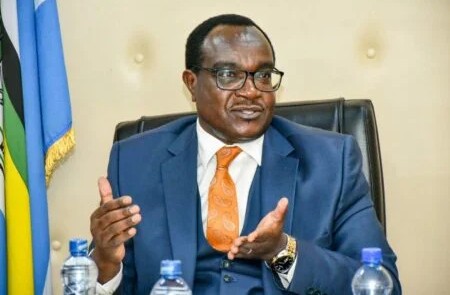
Education Cabinet Secretary Julius Ogamba. Photo/Handout
By Newsflash Correspondent
As schools reopen on Monday, principals across Kenya warn they are drowning in mounting debts that threaten to cripple the shortest yet most crucial term of the academic calendar.
The Kenya Secondary Schools Heads Association (Kessha) revealed that institutions are owed up to Sh5,506 per learner due to capitation shortfalls. In Term Two, schools were supposed to receive 30 per cent of the yearly allocation, amounting to Sh6,673 per student. Instead, only Sh3,471 was released, leaving a deficit of Sh3,202.
In Term One, the expected Sh11,122 per learner was trimmed to Sh8,818, creating an additional gap of Sh2,304. “Altogether, the government owes us nearly Sh18 billion from the first two terms. For Third Term, schools should receive 20 per cent of the Sh22,000 capitation. We expect the funds to hit accounts on Monday as schools reopen,” said Kessha national chairman Willy Kuria.
The final term spans just nine weeks, with the Kenya Primary School Education Assessment (KPSEA) scheduled for October 24–29 and the Kenya Certificate of Secondary Education (KCSE) exams running from November 3–21. Kuria, who also heads Murang’a High School, warned that smooth operations would be impossible without urgent release of billions in delayed capitation. He noted that many schools closed early last term because they had run out of funds.
Schools gasping for survival
“Several schools couldn’t keep operating without money. Learners were sent home weeks before the term ended because we couldn’t feed them or pay suppliers. Day schools are most affected since they depend entirely on government capitation, unlike boarding schools which have fees to cushion them,” Kuria explained.
A Nairobi principal, who sought anonymity, echoed the frustrations. “Why must schools beg before funds are released? My institution closed early as we couldn’t run operations. We are expected to feed students, prepare candidates, pay suppliers and utilities without any money. It’s impossible,” he said.
Read more: Shock as schools receive Sh87 as capitation
Another head in Nakuru complained about severe delays, while a Bungoma principal revealed the Education Ministry ordered schools to deduct Sh1,500 per learner from capitation for infrastructure projects. “This money is meant for daily running—chalk, electricity, and meals. Now they want us to build? With 1,500 students, that’s Sh2.25 million gone from an already overstretched budget. It’s unbearable,” he lamented.
Education Cabinet Secretary Julius Ogamba admitted the disbursement delays but said the ministry was working on fast-tracking the release. In June, he told Parliament that schools were battling debts of Sh64 billion. “We can’t resolve it instantly. Schools are still not receiving full allocations. Only half of this year’s funds have been released,” he explained.
Looming exam disruptions
Kenya Union of Post-Primary Education Teachers (Kuppet) Deputy Secretary General Moses Nthurima warned of looming chaos. “This is dangerous, particularly as this is the shortest term with critical exams ahead. Without funds, schools may shut early again, disrupting preparations for national tests,” he said. Nthurima cautioned that outstanding debts from previous terms remain unresolved, with the government only “sprinkling money here and there.” He hinted that parents may eventually be forced to shoulder extra costs to sustain schools.
Readd more: Kenya Forgotten Schools: Education in arid regions
Education Stakeholders Association of Kenya CEO Ndung’u Wangenye urged the government to clear arrears before reopening. “Delays will derail exam logistics and demoralise teachers. Results of these tests are critical for placement. Candidates must not be punished because of unpaid exam fees,” he warned. He insisted no learner should miss exams due to financial gaps.
The Elimu Bora Working Group added its voice, terming the situation a “systematic collapse” of public education. Policy advisor Boaz Waruku accused the government of deliberately underfunding schools, forcing them into illegal levies and reliance on parents. “Since 2003, primary schools receive only Sh1,420 per child annually, and junior secondary Sh15,042—far below what’s needed. This is deliberate defunding that pushes schools into exploitation or closure,” Waruku said, warning that without urgent reforms, the credibility of public education is at stake.


About the Author