

Young Kenyans at Jomo Kenyatta International Airport, many departing for postgraduate studies and work opportunities abroad. Photo/Courtesy
By Daisy Okiring
Nairobi, Kenya — August 21, 2025
Why are Kenya’s most ambitious minds queuing at embassies instead of building the country they call home? From newly graduated nurses boarding flights to the United Kingdom, to software developers relocating to Canada and Australia, Kenya is experiencing a silent but profound exodus. The country’s most talented youth—those who should be driving innovation, economic growth, and governance reforms—are increasingly choosing to leave, chasing opportunities abroad.
A 2023 World Bank report revealed that nearly 30 percent of educated Kenyan youth aspire to migrate permanently. The reality is already visible: over 4,000 Kenyan nurses and healthcare workers left for the UK and Middle East between 2020 and 2023, while Canada reported a sharp increase in Kenyan student visa approvals, with Kenya ranking among the top 10 source countries for international students.
As President William Ruto admitted in 2024: “We cannot keep training doctors and engineers for export while our hospitals lack staff and our industries lack innovators.” Reasearch shows that Kenya’s brain drain is not a matter of youthful restlessness—it is a crisis of trust in the state. A generation that could rebuild the nation is voting with its feet, convinced that success lies beyond Jomo Kenyatta International Airport.
Kenya’s youth exodus in numbers
Kenya is not just losing people; it is losing talent at its peak. The Kenya National Bureau of Statistics estimates that more than three million Kenyans live and work abroad, a figure that has grown rapidly in the last decade. According to the Central Bank of Kenya, diaspora remittances reached 4.2 billion US dollars in 2023, making them the country’s largest source of foreign exchange, surpassing traditional earners like tea and tourism.
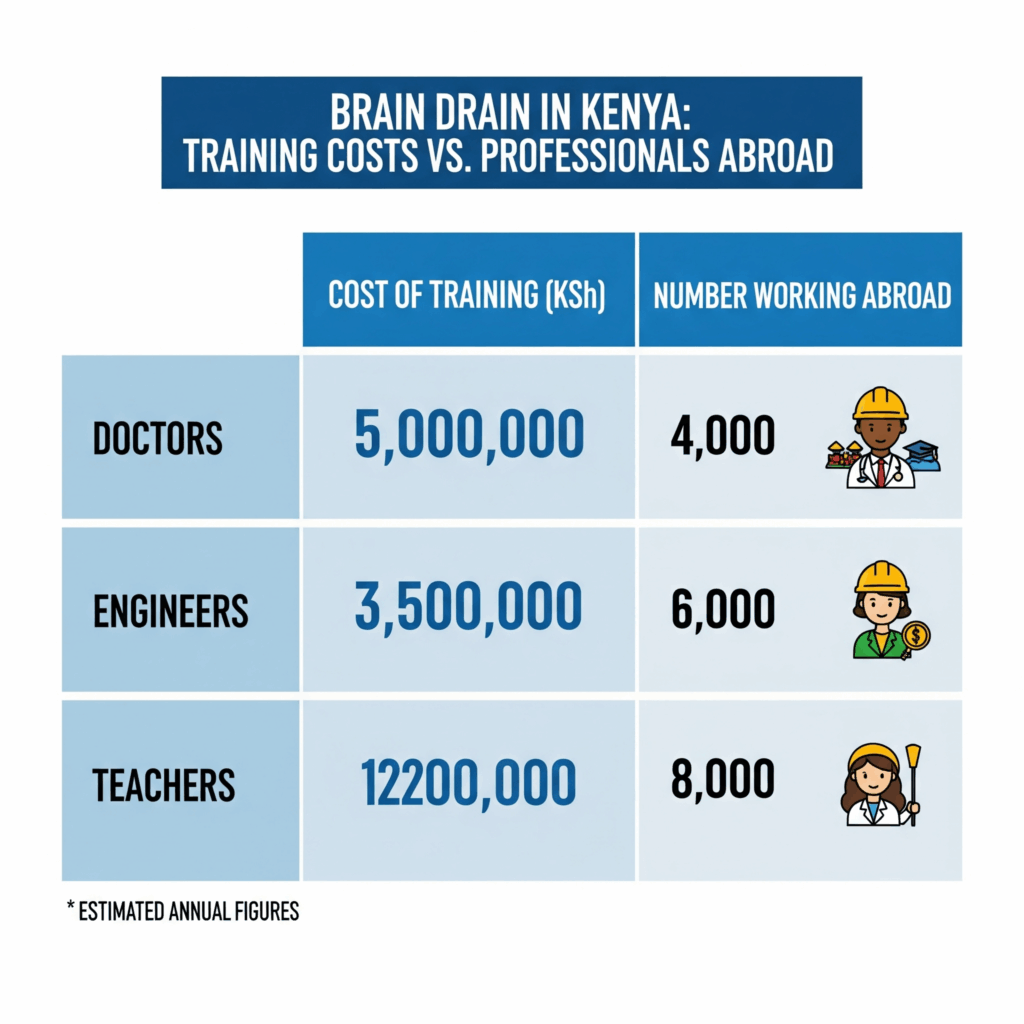
What makes the numbers troubling is the age profile of those leaving. A study by the Ministry of Labour revealed that 70 percent of Kenyan migrants are aged between 18 and 35. In the health sector alone, the Kenya Medical Practitioners and Dentists Council reported that nearly 20 percent of doctors trained in Kenya are practicing abroad, leaving local hospitals understaffed and overstretched.
Read More: The Israel-Iran conflict is no longer regional—It’s global
Opposition leader Raila Odinga captured the urgency of the issue when he remarked in a 2022 address: “If our young people find hope abroad and despair at home, then we have failed as a nation.”

Why are Kenyan youth leaving?
The decision to migrate is rarely simple, but for Kenyan youth, the drivers are clear. The first is unemployment and underemployment. Kenya produces over 800,000 graduates annually, yet only about 100,000 formal jobs are created each year. Many young professionals are forced into informal, low-paying work. This has fueled disillusionment among highly educated youth who feel their qualifications have little value in the local market.
Second, poor working conditions and low pay have driven professionals abroad. Healthcare workers have been particularly vocal. In 2023, doctors went on strike demanding fair pay and better facilities, yet many quietly pursued opportunities in the UK and the Gulf states where salaries are several times higher. The irony is glaring: Kenya’s government invests heavily in training these professionals, only to see them serve foreign health systems.
Read More: My difficult experience as a disabled learner
Third, corruption and governance failures continue to fuel discontent. Transparency International ranked Kenya 123rd out of 180 countries in its 2023 Corruption Perceptions Index. The perception among young Kenyans is that merit rarely triumphs over connections. This frustration was echoed by a young engineer interviewed by The Nation, who said: “I did everything right—studied hard, graduated, applied for jobs—but unless you know someone, you go nowhere. That is why I applied for a visa.”
Finally, global demand for skilled African workers has created opportunities abroad. Countries facing labor shortages, such as the UK, Canada, and Germany, have created streamlined visa systems to attract African talent. Kenya has become a key source country for these programs, especially in healthcare, education, and technology.

The paradox of remittances
The Kenyan government often celebrates the diaspora because remittances provide a vital financial lifeline. In 2023, Kenyans abroad sent home over 600 billion shillings, a figure that surpassed all foreign direct investment flows combined. This money supports millions of households, finances education, builds homes, and sustains small businesses.
Yet there is a paradox. While remittances boost consumption, the long-term cost of losing skilled workers is steep. The University of Nairobi estimates that it costs the country roughly 40,000 dollars to train one doctor. When that doctor leaves, the return on investment is captured by foreign countries while Kenyan hospitals grapple with staff shortages.
Former President Uhuru Kenyatta reflected on this tension during a diaspora conference in 2021 when he said: “Our greatest export should not be our young people, but our innovations and industries.”
The human face of migration
Behind the statistics are human stories that bring the exodus to life. In 2022, a group of Kenyan nurses were photographed at Jomo Kenyatta International Airport boarding a flight to the UK under a bilateral agreement. One of them, speaking to BBC Africa, explained her decision: “I love my country, but love cannot pay rent or buy medicine. In the UK, I can work with dignity and earn enough to support my family.”
Tech professionals tell similar stories. Canada reported a surge of Kenyan student visas in 2023, with many graduates transitioning into permanent residency. In a feature by Quartz Africa, a young Kenyan software developer explained: “In Kenya, opportunities come to those with connections. In Canada, they come to those with skills.”
Read More: Should Africa be compensated for a climate crisis it didn’t cause?
Even teachers, a profession once considered secure, have sought greener pastures. The Teachers Service Commission has acknowledged resignations linked to migration, particularly to Gulf countries. One teacher interviewed by The Standard said: “It was never my dream to leave, but when my government delayed salaries for months, I chose stability over patriotism.”

What does Kenya lose when its youth leave?
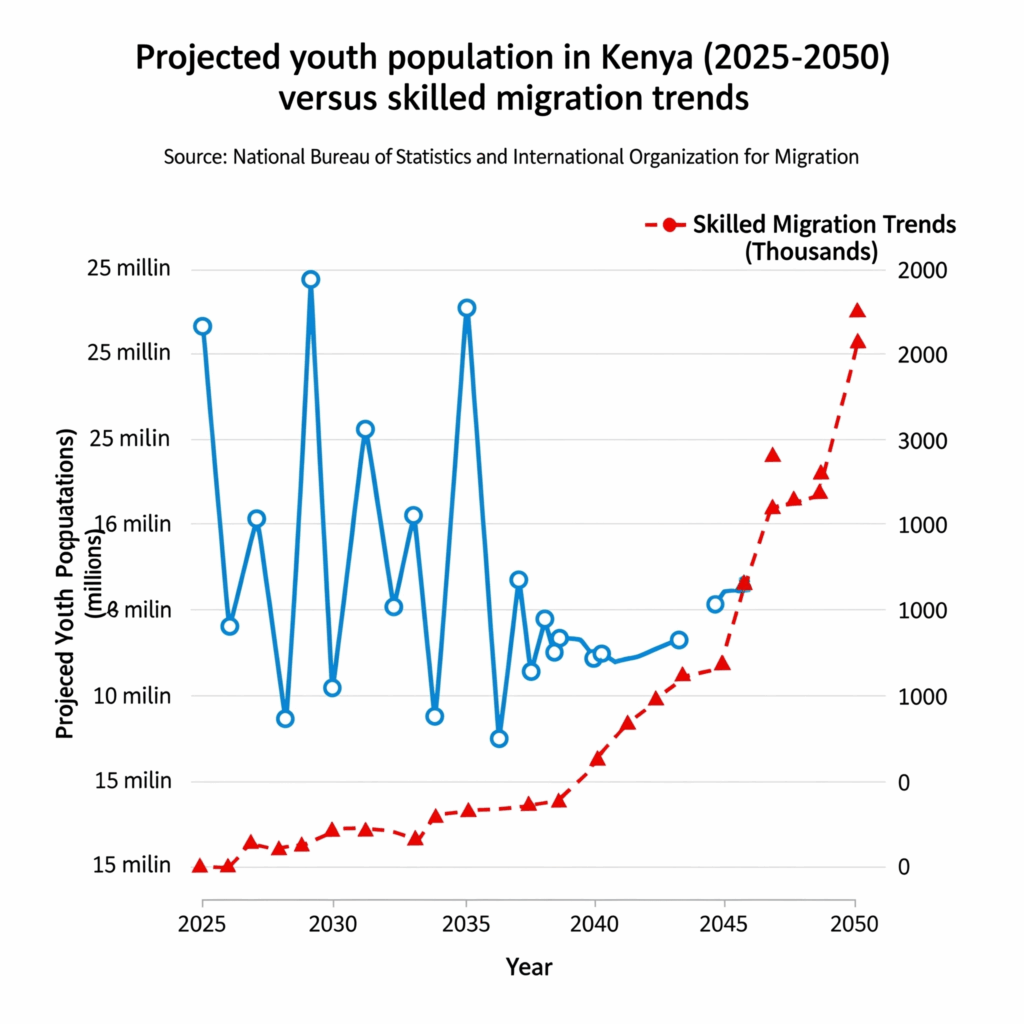
The migration of skilled young people is not just about numbers; it reshapes the nation. Hospitals lose staff, schools struggle to retain teachers, and the tech sector—the so-called “Silicon Savannah”—faces shortages of talent just as global competitors emerge. The loss of political energy is equally damaging. A disillusioned youth population that chooses to emigrate rather than demand reform at home weakens the democratic process.
Kenya’s demographic profile should be a strength. With more than 70 percent of its population under the age of 35, Kenya has long been described as having a “demographic dividend.” But without opportunities to channel this energy into productive work, the dividend risks turning into a demographic drain.
United Nations Secretary-General António Guterres has repeatedly warned about this trend, saying in 2023: “The future will belong to those who invest in their youth. Losing them is losing tomorrow.”
Can the tide be reversed?
Kenya cannot stop its youth from seeking opportunities abroad, but it can make staying attractive. This requires more than political speeches. It demands job creation on a scale that matches the number of graduates entering the market each year. President Ruto has promised to create one million jobs annually, but delivery has so far fallen short.
Equally, improving working conditions in critical sectors like healthcare and education must become a national priority. Doctors and teachers cannot be expected to stay when salaries are delayed and facilities crumble. Combating corruption is also essential, because young people will not remain in a system where connections outweigh merit.
Finally, Kenya should rethink how it engages with its diaspora. Instead of viewing them only as remittance senders, the government could create programs that attract skilled Kenyans back home, offering incentives for investment and entrepreneurship. Other countries, such as India and China, have successfully turned diaspora engagement into engines of development, and Kenya can learn from these models.
The future hangs in the balance
Kenya stands at a crossroads. Its youth are not just leaving for greener pastures—they are leaving because they feel unheard, undervalued, and underutilized at home. Unless urgent reforms are made, Kenya risks becoming a nation that exports its best minds while importing foreign aid and second-hand opportunities.
The exodus of youth is not just a migration story; it is a mirror reflecting Kenya’s governance failures, economic struggles, and untapped potential. Newsflash through comprehensive research uncovers that Kenya’s “Great Exodus” is both a tragedy and a warning: if the nation’s young people continue to find hope abroad and despair at home, the dream of national renewal may remain permanently deferred.


About the Author


