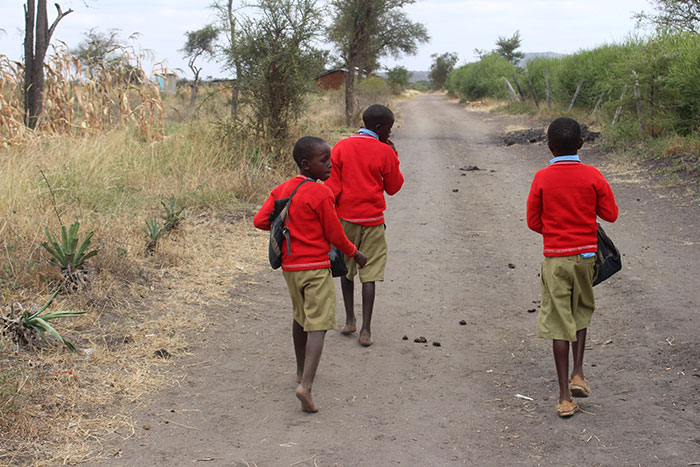
Pupils walk to school in a Kenyan rural area. Photo/Handout
By Newsflash Writer
An audit by the Office of the Auditor-General has uncovered massive fraud involving 33 phantom schools that received billions of shillings in the last four years—despite public schools across the country struggling with a funding deficit of Sh117 billion.
Auditor-General Nancy Gathungu’s special audit report on capitation and infrastructure grants, submitted to the Public Accounts Committee (PAC) of the National Assembly, paints a disturbing picture of systemic theft and mismanagement in Kenya’s education sector.
Justus Okumu, Director of Audit, told the committee that Sh3.7 billion had been illegally disbursed to non-existent schools, while genuine institutions remain on the verge of collapse due to underfunding.
“The real crisis in public schools is underfunding. The Ministry of Education prepares budgets that are often scaled down, forcing schools to shelve or delay critical activities,” Okumu explained. He added that while these ghost schools appeared in official systems, auditors could not physically locate them on the ground.
The fraudulent activity, which occurred between the 2020/21 and 2023/24 financial years, has unfolded even as schools face a cash crunch: secondary schools are underfunded by Sh71 billion, junior schools by Sh31.98 billion, primary schools by Sh14 billion, and special needs secondary schools by Sh67.1 million.
Capitation model and oversight under fire
The audit sharply criticised the current capitation model, describing it as inequitable and unable to accommodate the diverse needs of learners. “The allocation per learner does not reflect the realities on the ground,” the report said. The PAC has since instructed the Auditor-General’s office to provide detailed information on the ghost schools that benefited from the fraudulent payments.
The report also raised concern over poor financial monitoring. It cited three secondary schools that shared a single bank account while receiving capitation worth Sh103.3 million—violating basic financial accountability, which requires separate accounts for tuition and operational funds.
Read more: Onjiko Boys banned from school games for three years
PAC chairperson and Butere MP Tindi Mwale said the committee had summoned Basic Education Principal Secretary Julius Bitok for further explanation. “We’ve officially written to the Ministry of Education, asking officials to appear before the committee and provide answers,” he said.
The audit further flagged ghost students in 723 of the 1,039 schools sampled, revealed through discrepancies between enrolment numbers and data in the National Education Management Information System (Nemis).
Widespread data irregularities
Of the Sh3.7 billion in questionable capitation, secondary schools accounted for Sh3.5 billion, junior secondary Sh30.8 million, and primary schools Sh79.4 million. Among 83 sampled institutions, 33 were found to be non-existent—raising questions about data manipulation in Nemis and irregular book supply deals.
Funyula MP Wilberforce Oundo claimed Nemis was being misused to marginalize certain regions. “In many cases, Nemis figures don’t match the number of students actually in schools,” he said. “We demand to know which ghost schools received these funds and which official authorised it. They must be held accountable.”
Chepalungu MP Victor Koech Mandazi accused the ministry of operating like a business. “They are still funding unregistered schools, yet many others are waiting for registration,” he said.
Read more: School principals vow to charge parents additional fees despite court ban
The audit also shows that 14 schools received Sh16.7 million in capitation despite not being listed by County Directors of Education—who were also unaware of their existence. Six schools that had closed due to government action still received Sh889,348, though four of them reportedly had the funds intact in their accounts.
In another irregularity, 13 schools that received Sh11.02 million had name discrepancies between what was in Nemis and in capitation data. The report also found 14 schools listed with creation dates that came after the disbursement of funds. One of them received Sh6.4 million even before it was officially created in the system.
Lastly, the audit uncovered major inconsistencies across data systems used by the State Department for Basic Education, Teachers Service Commission, Kenya National Examinations Council, and Kenya Primary School Education Assessment in 32 counties—further pointing to widespread administrative failure.


About the Author