

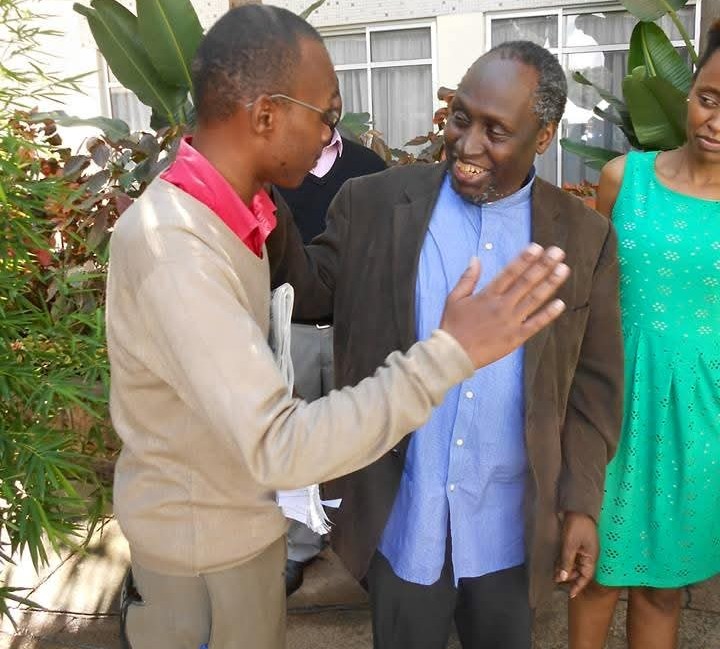
The writer (left) chats with Prof Ngugi wa Thiong’o at Nairobi’s Sarova Panafric Hotel on 3 June, 2015. Partly hidden is Ngugi’s daughter, Wanjiku wa Ngugi. Photo/Newsflash
By Wanderi Kamau
Since beginning my journalism career at the Taifa Leo newsdesk as a Correspondent on 9th April 2013, I had clearly demonstrated my love for literature.
It wasn’t just a passing interest—it was something deeply ingrained in me.
Words had always felt like sacred tools; I was drawn to stories, metaphors, proverbs, and the rich tapestry of African oral traditions long before I ever filed my first news story.
That love for literature naturally drew me closer to my then News Editor, Juma Namlola, himself an accomplished author and literary scholar.
Under his editorial guidance, I found not only mentorship but also camaraderie. We spoke a shared language—of characters, of themes, of linguistic beauty.
In those early days, I began contributing to the newspaper’s Lugha na Fasihi (Language and Literature) section, a special corner of the paper that gave me a literary playground with no boundaries. I could explore, critique, and celebrate literature freely, and it was through this platform that my identity as a literary journalist began to truly take form.
But my passion for literature had been ignited long before I walked into the newsroom. Growing up in Nyandarua County, as a pupil at Kihingo Primary School in Ndaragwa constituency, I had fallen in love with the works of the late Prof Ngũgĩ wa Thiong’o.
His stories stirred something in me—an awakening, perhaps, of cultural pride and the power of language in shaping who we are. His books were not just novels; they were mirrors of society, bold conversations on identity, freedom, and justice.
Indeed, my love for Ngũgĩ grew so strong that I unofficially dropped my English baptismal name, Anthony, and fully embraced my Gĩkũyũ heritage as Wanderi wa Kamau. This identity—this name—became my signature.
From high school through my undergraduate and postgraduate studies, and into the newsroom, I remained Wanderi Kamau. It was a quiet rebellion, an homage to the literary titan who had taught us that names matter—that language is the soul of a people.
A moment at Panafric
One day in mid-2015, that literary devotion led me to a moment I will never forget.
Having reviewed some of Namlola’s Kiswahili novels—Kula kwa Mheshimiwa (A Time for Politicians to Eat) and Kinamasi Jangwani (Oasis in the Desert)—I had proven myself as both a reader and a critic. So, when we learned that Ngũgĩ would be in Nairobi, Namlola promptly dispatched me to cover his press conference at the iconic Sarova Panafric Hotel.
At the time, I was assigned to cover the education beat for Taifa Leo. From the Nation Media Group, I was joined by the late Ian Mbuti, a dear colleague and then reporter for Nation’s Kiswahili radio station, Q FM—which has since been closed. We were both brimming with anticipation.
Ngũgĩ arrived at the Panafric press conference on June 3, 2015, accompanied by nearly all his children. He carried with him the presence of a scholar but moved with the ease and warmth of a village elder. He interacted freely with everyone—journalists, hotel staff, and fans alike—listening more than he spoke, smiling often.
Read more:Kenya’s celebrated author Ngugi wa Thiong’o passes on
After the press conference concluded, I stood still for a moment, overwhelmed by the reality that the man I had admired for decades was right there before me. I gathered my courage and walked toward him. I greeted him and introduced myself.
When I mentioned that I worked for a Kiswahili newspaper, his eyes lit up.
“You have a bright future. I was a reporter at the Nation in the 1960s. So, you are on the right trajectory,”he told me.
I will never forget those words. Coming from him, it felt like a blessing passed from one generation of storytellers to another. Then, with nervous boldness, I asked him the question that had long lingered in literary circles:
What did he feel about not having won the Nobel Prize for Literature, despite his global acclaim?
He looked at me with calm assurance and said,
“I have already won the Nobel! I get enough contentment from the impacts of my works in the society.”
That became the subject of my story on Taifa Leo and our website, Swahilihub.com.
The humility, wisdom, and defiance in that answer encapsulated everything Ngũgĩ stood for. He had already been immortalized in the hearts and minds of readers—what more could a writer ask for?
A lifelong literary pilgrimage
Despite his global stature, Ngũgĩ was remarkably down-to-earth. That June 2015 visit to Kenya marked only his second return after nearly 25 years in exile, having fled during the late Daniel arap Moi’s repressive KANU regime. And yet, he carried no bitterness—only passion for storytelling and change.
Even back in high school at St Mary’s Boys Secondary School, my admiration for him was so visible that a teacher once threatened to send me out of class, accusing me of having “immersed myself into Gikuyu traditionalism.”
“Don’t you have an English name?” she snapped.
She would later understand that my inspiration came from none other than Ngũgĩ himself.
After my undergraduate studies in 2012, I had a chance to teach literature at Spotlight Secondary School in Nakuru. One of the required texts was Ngũgĩ’s The River Between. Teaching it was not a task; it was a privilege. I guided students through the rivers of colonial tension and traditional pride, hoping they, too, would see the world through Ngũgĩ’s eyes. Those classroom moments were sacred—an extension of my long literary journey with a man I had never imagined meeting in person.
Read more:Kenyan activists detained in Tanzania after Karua row
In many ways, I have been a “literary disciple” of Ngũgĩ. My home library is filled with nearly all his works—a personal shrine to a man whose words shaped my path. His books are not just read—they are revisited, pondered upon, and passed on.
Ngũgĩ lived an eventful life. He exits the world gallantly, leaving behind ageless works that generations will read. As we say in literature, writers never die. They are immortalized by their stories.
To the Ngũgĩ family, may you find courage during this difficult time.
And to you, Papa Ngũgĩ,
Please pass my regards to Chinua Achebe, Ken Walibora, Elechi Amadi, Ayi Kwei Armah, Peter Abrahams, and Philip Ochieng’.
The fire you lit in us still burns—and always will.


About the Author


2 thoughts on “Wanderi Kamau: My rare encounter with Ngũgĩ wa Thiong’o”
Comments are closed.