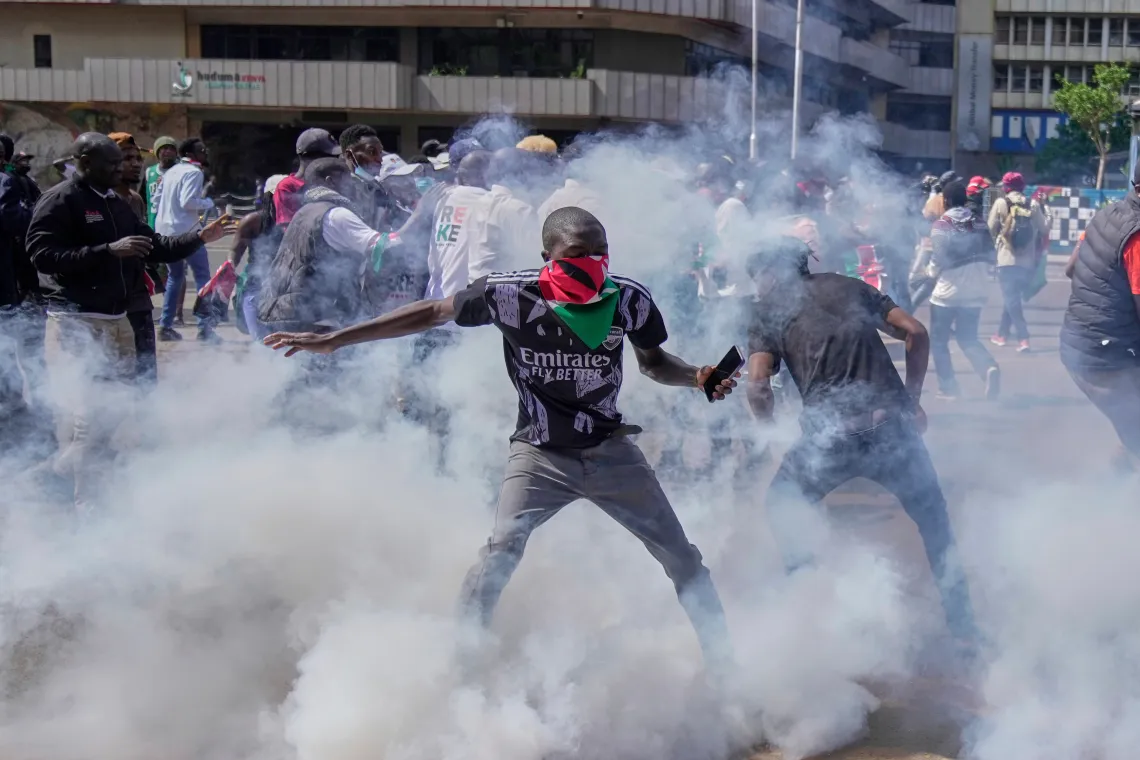
A Kenyan protester on June 25, 2025. Photo/ AP
By Newsflash Reporter
A majority of Kenyans believe the national government and President William Ruto bear the greatest responsibility for violence witnessed during demonstrations and protests, a new survey by Trends and Insights for Africa (TIFA) has found.
According to the TIFA National Survey released on Wednesday, September 9, 42 per cent of Kenyans blame the National Government or the President for violence that occurs during protests.
The finding comes against the backdrop of a series of demonstrations that have rocked Kenya since 2022, with protests being triggered by different political, economic and social grievances.
The protests reached a peak during the countrywide anti-Finance Bill demonstrations in 2024, when thousands of Kenyans took to the streets to oppose proposed tax measures.
TIFA, however, focused its question specifically on responsibility for violence during demonstrations and protests, rather than responsibility for organising the protests themselves.
The police emerged as the second-most blamed group, with 24 per cent of respondents holding them responsible for violence during demonstrations.
Local politicians were blamed by 12 per cent, while nine per cent pointed the finger at protesters and demonstrators.
A further six per cent blamed jobless youth and Gen-Z, while four per cent were not sure.
The survey noted that if the police are considered part of the national government, the combined share attributing responsibility to the State rises to 66 per cent. Among supporters of the Broad-Based Government (BBG), 53 per cent blamed the national government or police, compared with 76 per cent among BBG opponents.
Strong support for peaceful protests
Despite concerns over violence, the survey established that Kenyans overwhelmingly support the right to hold peaceful demonstrations.
TIFA found that 82 per cent of respondents support peaceful and lawful public demonstrations, compared with 16 per cent who oppose them and two per cent who were undecided or did not respond.
Read more:Why most Kenyans have not registered as voters – TIFA
The research described this as “strong support for peaceful protests”, indicating that demonstrations remain widely regarded as a legitimate means of public expression.
Support for peaceful protests cut across political divisions, with 79 per cent of BBG supporters and 86 per cent of opponents backing such demonstrations.
The findings suggest that while Kenyans largely support their constitutional right to demonstrate, they are sharply divided over how violence accompanying some protests should be attributed.
The issue remains politically sensitive as the country heads towards the 2027 General Election, amid heightened political activity and public concerns over the economy.
Economic gloom fuels public discontent
The poll also paints a bleak picture of Kenyans’ economic outlook, with two-thirds reporting that their personal or family economic situation has worsened since the 2022 General Election.
TIFA found that 65 per cent said their economic circumstances had deteriorated, while only 12 per cent reported an improvement. The survey said the persistent economic pressure was yet to translate into stronger household confidence.
Read more:TIFA: More Kenyans struggling financially under Ruto’s government
The economic concerns are closely linked to growing pessimism about the country’s overall direction.
The survey found that 76 per cent of Kenyans believe the country is headed in the wrong direction, the highest level recorded during TIFA’s tracking period.
Only 15 per cent believe Kenya is moving in the right direction, while the remaining respondents were either neutral or did not provide an answer.
TIFA described the trend as “Public pessimism deepens”, noting that dissatisfaction had risen from 68 per cent in November 2025 to 76 per cent in June 2026.
The survey further established that economic hardship plays a major role in shaping perceptions of the country’s direction. Among those who felt Kenya was moving in the wrong direction, 75 per cent also reported that their personal or family economic situation had worsened since 2022.
The TIFA survey was conducted between June 13 and 22, 2026 through face-to-face household interviews with 2,048 randomly selected Kenyan adults aged 18 and above across all 47 counties.


About the Author