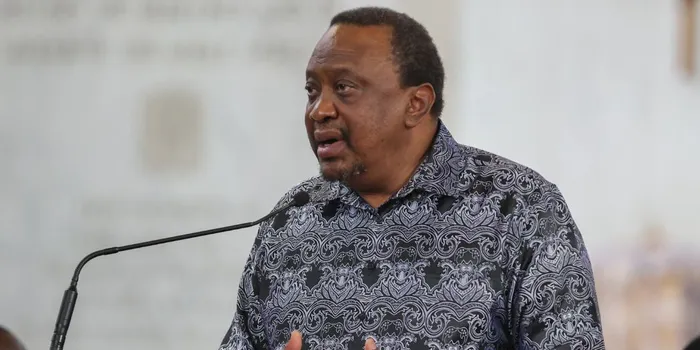
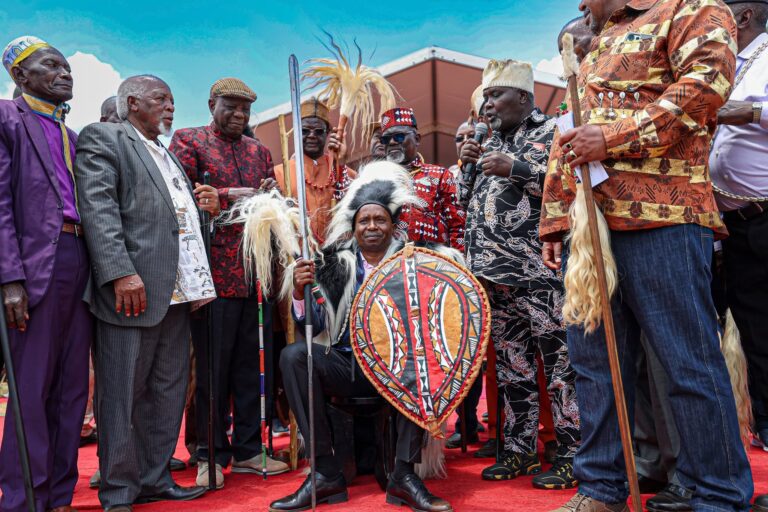
President William Ruto addressing his supporters in Gatunga market, Tharaka Nithi County on Friday, 4 April 2025. Photo/X/William Ruto
By Wanderi Kamau
Despite pulling large crowds during his multi-county tour of the Mt Kenya region, President William Ruto’s visit is increasingly being described as a political misfire.
From the heckling of his key allies to the launching of underwhelming projects, Ruto’s four-day tour failed to shore up his political capital in a region that once formed the bedrock of his electoral victory.
Mobilized crowds, little excitement
On the surface, the tour appeared successful, with sizeable crowds turning up in Laikipia, Nyeri, Murang’a, Embu, and Tharaka Nithi. However, insiders and observers argue the turnouts were heavily mobilized through logistical and financial efforts.
“It was clear the crowds were organized. Buses were used to ferry supporters from various constituencies, especially in Laikipia and Nyeri,” said a Nyeri-based political analyst, Peter Wambugu. “The energy was missing. People came out for allowances, not out of political passion.”
Despite the visible presence, the reception was lukewarm, and in several stops, openly hostile.
Heckling of allies
President Ruto’s most trusted Mt Kenya allies — Majority Leader Kimani Ichung’wah, Nyandarua Woman Rep Faith Gitau, and Laikipia East MP Mwangi Kiunjuri — all faced jeers from the public. Ichung’wah was booed in Nyandarua, Embu, and Tharaka Nithi. Gitau’s speech in Ol Kalou was cut short as the crowd chanted her down. Kiunjuri too was drowned out in Murang’a, exposing a shifting tide against Ruto’s loyalists.
Read more:Ichung’wah heckled in Nyandarua
In Embu, Governor Cecily Mbarire, a staunch Ruto defender, also faced heckling. The mood on the ground seemed to reflect deep disillusionment with the political leadership closely associated with the President.
Low-impact projects, unpresidential optics
The optics of launching small-scale projects such as classrooms in Laikipia — largely funded through the NG-CDF — did little to elevate Ruto’s image. Analysts criticized the President for engaging in “unpresidential” functions.
“These are not presidential projects,” said political commentator Martha Kihiu. “When a Head of State launches a classroom built using a constituency fund, it raises questions about the purpose of such a tour.”
Even the much-hyped Last Mile connectivity project failed to dazzle the crowds, as the public’s focus shifted to simmering political tensions within Ruto’s inner circle.
The Gachagua factor
The most symbolic moment of political rebellion came from Nyeri Governor Mutahi Kahiga, who days after welcoming Ruto, declared that Mt Kenya had its own “real owner” and that the President should not claim to be the region’s kingpin.
“We came out to receive the President’s goodies, and we got them. But Mt Kenya has its owner,” Kahiga told residents. His message was widely interpreted as a declaration of allegiance to Deputy President Rigathi Gachagua.
The open defiance from Kahiga — once seen as a Ruto ally — underscored a larger issue: Mt Kenya remains loyal to its own, and the attempts to dislodge Gachagua as the regional figurehead have not succeeded.
Weakness and apprehension
The arrest of Manyatta MP Gitonga Mukunji, a close Gachagua ally, during the President’s tour in Embu further signaled panic within Ruto’s team. The move was seen as an attempt to silence dissenting voices.

Additionally, the summoning of Githunguri MP Gathoni wa Mucomba on Saturday, 5 April, by Kiambu police over alleged incitement painted a picture of a government on edge.
“It feels like the administration is in overdrive trying to manage Mt Kenya politically, and it’s not working,” said analyst David Maina. “Every move appears reactive.”
Missing key players
Notably absent during the tour were some of Ruto’s former Mt Kenya heavyweights in the Tanga Tanga movement: Moses Kuria, Ndindi Nyoro, and sacked Public Service Cabinet Secretary Justin Muturi. Their silence and absence spoke volumes.
Muturi, who was recently sacked as CS, later slammed Ruto as “irredeemably corrupt,” and “unfit to be President” in an interview on NTV. His public condemnation was both shocking and timely, reinforcing the growing rift between Ruto and the region’s senior political actors.
Read more:Why Mt Kenya is ‘angry’ with Kimani Ichung’wa
“The sacking of Muturi was poorly timed. It shows the President is alienating more Mt Kenya allies instead of consolidating support,” noted Wambugu.
Internal divisions
Sources within UDA revealed that not all Mt Kenya leaders supported the timing of the tour. Some believed the ground was not ready and warned against rushing into the region amid growing discontent.
“There were serious divisions,” said a senior party official who requested anonymity. “Some felt we needed to cool tensions first and engage more with local leaders before going public.”
Instead, the tour proceeded, only to expose cracks within the political establishment that Ruto heavily relies on to retain support in 2027.
A warning sign for 2027?
While Ruto remains the President and commands state machinery, the reception in Mt Kenya shows that incumbency alone may not guarantee loyalty.
The region, long known for its political restlessness and pride in self-leadership, is signaling that it may not be easily swayed by rhetoric or small-scale development projects.
Read more:Why Mt Kenya is gone from Ruto’s political grip
Unless the President recalibrates his political approach and mends fences with key leaders like Gachagua and other Mt Kenya stalwarts, the tour may have done more harm than good.
As one observer put it: “Crowds can be hired, but political loyalty is earned. And in Mt Kenya, that loyalty is slowly slipping.


About the Author