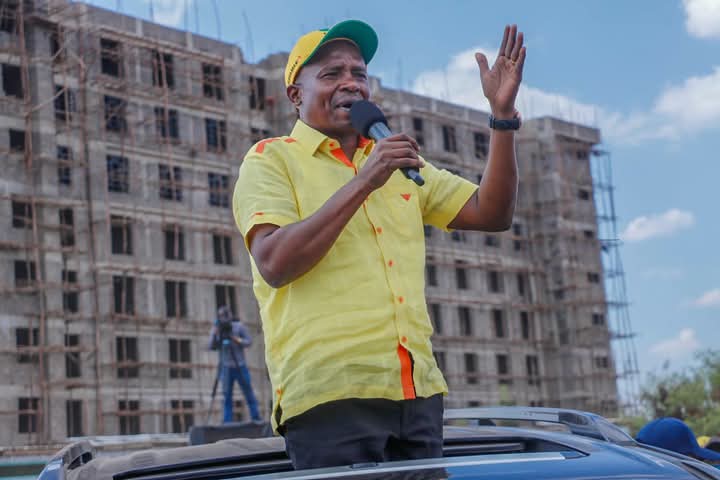
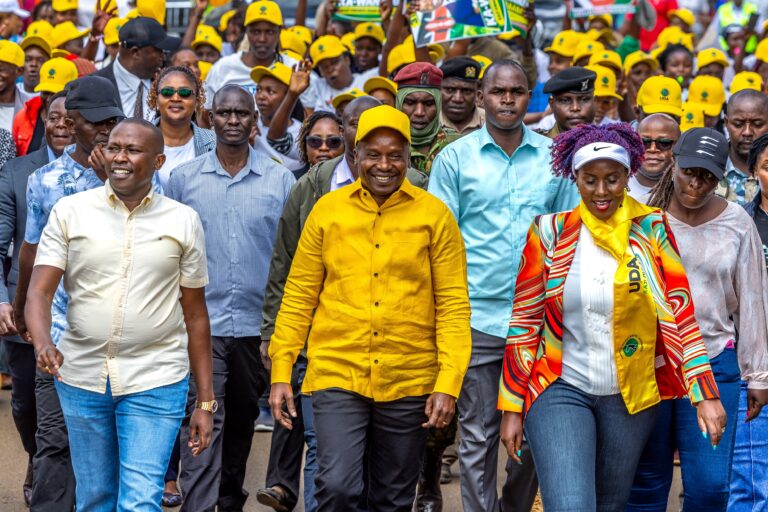
Moses Kuria, the immediate former Senior Advisor in the Presidential Council of Economic Advisors. Photo/The Standard
By Newsflash Team
The decision by Moses Kuria to resign as Senior Advisor in President William Ruto’s Council of Economic Advisors on Tuesday, 8 July, did not come as a surprise to many.
To insiders within Kenya Kwanza and to close watchers of Mt Kenya politics, Kuria’s exit was not abrupt, but strategic.
With Ruto’s popularity in Mt Kenya continuing to wane, political analysts say that it was expected the President would, at some point, allow Kuria to “resign” and redeploy him to the region’s volatile political arena to take on former Deputy President Rigathi Gachagua—now viewed as a major disruptor of Ruto’s administration.
According to sources who spoke to the Newsflash political desk, Kuria’s resignation was sanctioned by Ruto to free him up for an all-out political duel with Gachagua, who has emerged as a popular figure in Mt Kenya and an outspoken critic of the Ruto administration’s alleged betrayal of the region.
Ruto has been trying to recapture the region politically, after falling out with Gachagua, following his dramatic impeachment last year.
“The resignation of Kuria was a matter of when,” a well-placed source said. “Without any government responsibility on his baggage, Kuria will be free to face Gachagua politically, as the three CSs have failed to make an impact.”
Read more:Kuria ‘comforts’ Gachagua over Mwiki church attack
The trio being referred to includes Cabinet Secretaries William Kabogo (ICT), Lee Kinyanjui (Trade and Industrialization), and Mutahi Kagwe (Agriculture)—all appointees believed to have been elevated to Cabinet to counterbalance Gachagua’s influence.
However, despite their positions, none have managed to neutralize Gachagua’s growing sway in the region. Instead, Gachagua has used growing public discontent—especially over the economy and recent civil unrest—as fodder to assert himself as the authentic voice of Mt Kenya.
Another reason being fronted as a trigger of his resignation is a feeling of “unimportance” in Ruto’s regime, after being ‘demoted’ to the position of an advisor from the powerful portfolios of Cabinet Secretary for Industrialization and Public Service, respectively
Looming political showdown
Kuria has recently been vocal in his attacks on Gachagua, publicly blaming him and other Mt Kenya Kenya Kwanza leaders for the economic and political suffering of the region’s residents. In a scathing message posted on June 26, 2025, Kuria took aim at Gachagua, referring to their joint role in leading Mt Kenya into what he termed an abyss.
“My good friend Rigathi Gachagua. Yourself, Ichungwa, Ndindi, Mbarire, Linturi and myself lied to Kikuyus to abandon Uhuru Kenyatta. Did we do that only to convert them into suicide bombers destroying our very own properties and businesses? 70 Kikuyu lives lost yesterday alone!!!! You know this is not right, brother. Stop it!!!!!” Kuria posted.
Kuria has since declared that he will be on the ballot in 2027 as a presidential candidate, suggesting that his resignation is also part of a broader ambition—one that includes reinventing himself as a reformist alternative to both Gachagua and Ruto.
Read more: Questions as Kuria resigns as Ruto’s Economic Advisor
Gachagua, however, has dismissed Kuria’s presidential ambitions as state-sponsored distraction. He has repeatedly labelled Kuria a “Ruto political project,” arguing that the former Trade Cabinet Secretary was being used to fragment Mt Kenya politically ahead of 2027. Kuria leads the Chama Cha Kazi (CCK) party, which Gachagua now paints as part of a proxy political war sponsored from the State House.
In Gachagua’s view, Kuria is not acting alone. He has also labelled The Service Party (TSP), led by Laikipia East MP Mwangi Kiunjuri, and Tujibebe Wakenya Party, led by ICT CS Kabogo, as Ruto-affiliated vehicles aimed at eating into his Mt Kenya support. Gachagua himself leads the Democracy for the Citizens Party (DCP), and he has cast suspicion on moves by Kiharu MP Ndindi Nyoro, alleging that he too is a Ruto project being primed to launch a state-funded party.
By framing all his political rivals as “Ruto’s puppets,” Gachagua is trying to consolidate the narrative that he alone stands with the people of Mt Kenya—against both the government and what he sees as compromised local leaders.
Reading the mood on the ground
Beyond internal party intrigues, some political analysts believe Kuria’s resignation reflects a deeper reading of the shifting political tide in the Mt Kenya region.
The recent Saba Saba anniversary protests, which rocked the country and left a trail of destruction and death—including in traditional Ruto strongholds like Nyeri, Kirinyaga, and Meru—are seen as a turning point. For many in Mt Kenya, the protests marked a public and symbolic rejection of the current administration.
Read more: Hard times? Moses Kuria’s property faces auction
“The political mood in Mt Kenya is totally anti-Ruto. The clear indication was the widespread protests witnessed in Mt Kenya. That was a final red card to the William Ruto-led administration,” said political analyst Kiprotich Mutai.
“Kuria is gearing to return to elective politics in 2027. He wants to align with the people as early as possible. That could be his push,” says Mutai.


About the Author