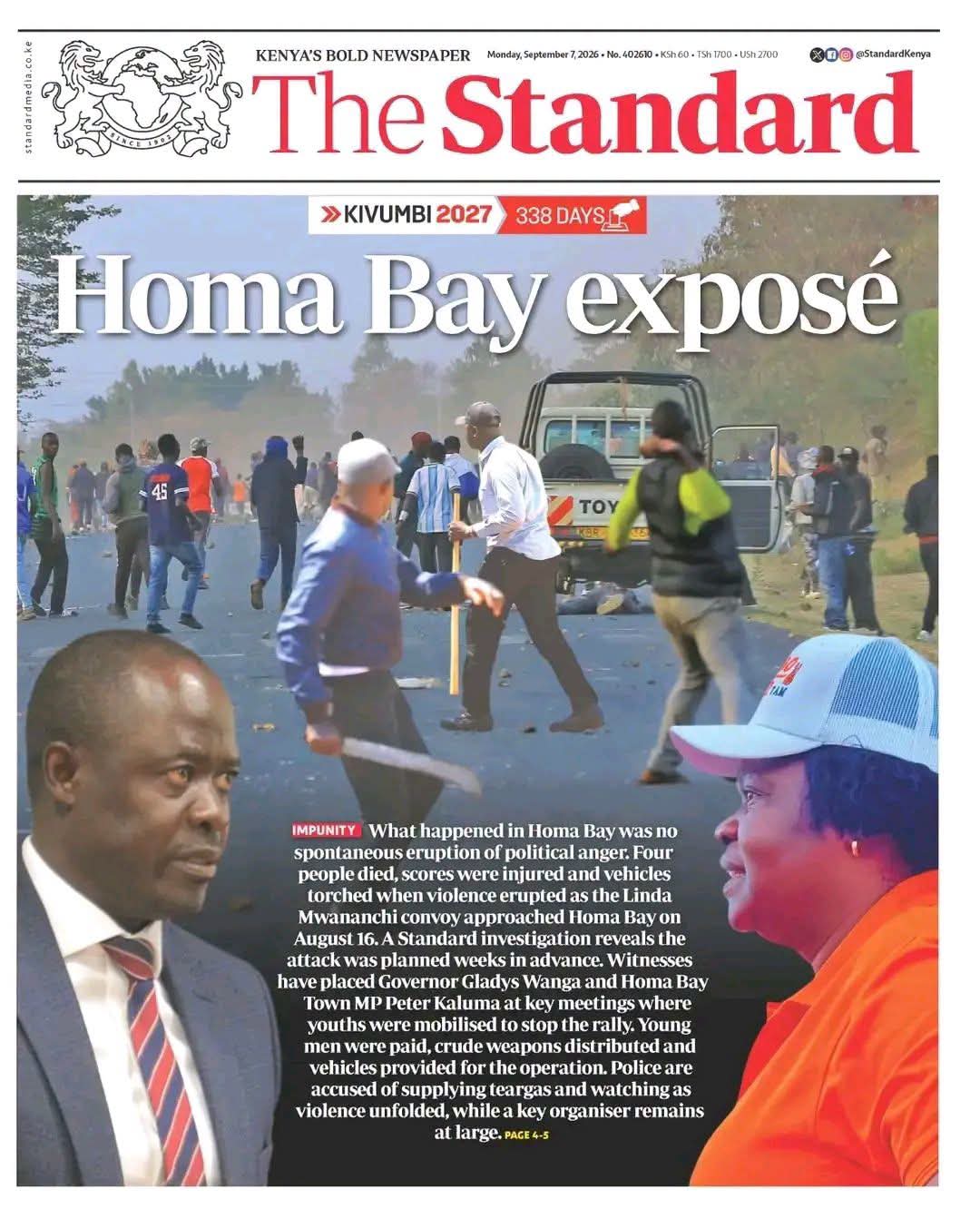
The Standard newspaper’s cover story on Monday, September 7, 2026. Photo/The Standard
By Newsflash Reporter
Homa Bay Governor Gladys Wanga has lodged a formal complaint with the Media Council of Kenya (MCK), accusing KTN and The Standard newspaper of biased, defamatory and unverified reporting over the violence that rocked a Linda Mwananchi rally in Homa Bay on August 16, 2026.
Wanga’s complaint follows an investigative report aired by KTN on Sunday, September 6, titled Homa Bay: Bloody Hands, and an investigative article published by The Standard on Monday, September 7, titled Homa Bay Expose.
The reports placed Wanga among prominent leaders allegedly at the centre of sponsoring, organising and financing violence targeting the Linda Mwananchi faction during the rally. The confrontation reportedly left two people dead and several others injured, including journalists covering the event.
Other leaders mentioned in connection with the violence include Homa Bay Town MP Peter Kaluma, ODM youth leader Abdi Sebo and Henry Ochieng’, an ODM youth leader from Homa Bay.
Wanga, however, has strongly denied any involvement in the violence, saying the reports had portrayed her and her administration unfairly and relied on allegations that had not been independently verified.
Wanga challenges reports
In a letter dated September 7 and addressed to the MCK, Wanga said her objection was not to legitimate media scrutiny but to what she described as sensational and prejudicial reporting.
“My concern is not with legitimate media scrutiny: I welcome accountability and open public discourse,” Wanga said.
She accused KTN and The Standard of violating basic journalistic standards by presenting what she termed fabricated and unverified allegations as facts, thereby creating what she described as a false impression of her role in the events.
Read more: Standard Group editor Alex Kiprotich found safe after night abduction
Wanga particularly took issue with a front-page photograph published by The Standard showing an armed individual wielding a machete.
According to the governor, the individual was Nicholas Odhiambo Onyando, whom she identified as a Siaya County employee working as a revenue officer in Akala.
She argued that the presence of an armed person from a neighbouring county at the scene demonstrated that “external agents” were involved in the violence.
Wanga said using the photograph to implicate her office or county administration amounted to a distortion of the circumstances surrounding the confrontation.
She also accused KTN of failing to adequately and fairly present her administration’s response to the allegations in its broadcast, effectively denying her what she described as the right of reply.
Governor seeks MCK action
Wanga said her position regarding the August 16 incident had remained consistent, insisting that she condemned violence and intimidation in all forms.
She further maintained that every Kenyan has a constitutional right to visit Homa Bay and participate in peaceful assembly, while calling for an impartial and evidence-based investigation to establish what happened.
In her complaint, Wanga cited Sections 6 and 45 of the Media Council Act, No. 46 of 2013, arguing that the MCK has a statutory responsibility to enforce the Code of Conduct for the Practice of Journalism.
She accused the two media outlets of breaching standards relating to accuracy and fairness, the right of reply and accountability in reporting.
Read more:Kenyan editors demand probe into Alex Kiprotich abduction
According to Wanga, serious allegations should have been independently verified before publication, while her administration’s response should have been given adequate prominence.
She also argued that prejudicial material should not have been aired or published while official investigations into the incident were ongoing.
The governor has asked the MCK to review the KTN broadcast and The Standard report against the journalism code and take appropriate action.
Among her demands are an immediate and prominent retraction, an unconditional apology and disciplinary action against the media organisations if the Council establishes that journalistic standards were breached.
Wanga said public debate on sensitive matters should be based on truth and evidence rather than what she termed speculative character assassination.


About the Author