

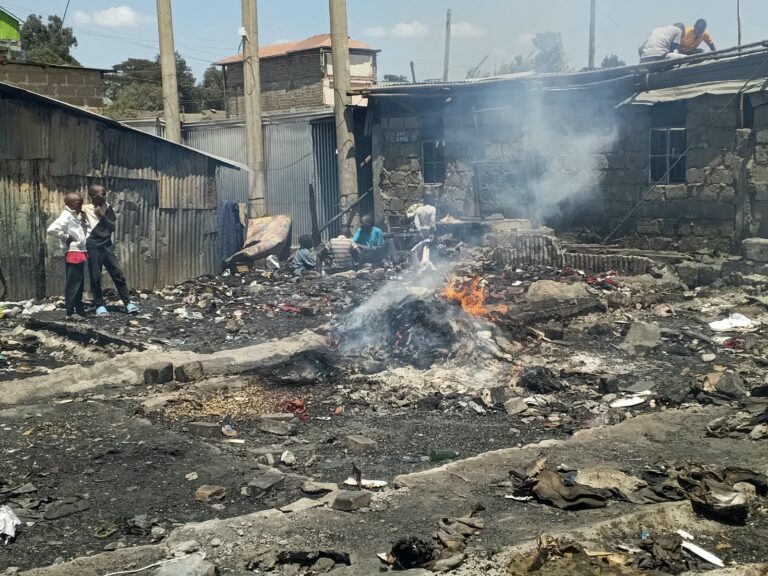
Tightly packed tin-roofed houses dominate Remba Island, where over 5,000 residents share less than a square kilometer of land in the middle of Lake Victoria. Photo/Courtesy
By Daisy Okiring
At first glance, Remba Island looks like a floating sheet of rusty rooftops.
Just 1 kilometer long and less than half as wide, this speck in Lake Victoria is packed wall-to-wall with makeshift houses, shanties, and shops. There are no cars, no paved roads, and barely enough space to breathe. Over 5,000 people live here—but to most Kenyans, Remba doesn’t exist.
Children laugh barefoot on narrow paths. Fishermen haul in the night’s catch. But underneath the bustle lies a grim truth: Remba is a place cut off—not just by water, but by policy, resources, and recognition.
“We are Kenyans, but we are forgotten,” says Moses Otieno, a 33-year-old fisherman and community elder. “When people talk about the government, we ask—where is it?”
An island without infrastructure
Remba Island lies near the Kenya-Uganda border, technically within Homa Bay County. Yet the lack of roads means getting here requires a two-hour boat ride from Mbita, often on unsafe vessels with no life jackets. There is no reliable electricity, no running water, and just one health facility—an understocked dispensary with no qualified doctor.
According to a 2023 report by the Kenya Medical Research Institute (KEMRI), over 70% of households on Remba lack access to clean water, relying instead on untreated lake water, which poses significant health risks. Open defecation is still common due to the severe shortage of toilets.
The island’s population has exploded due to booming fishing activity. “We came here for the fish, but there are too many people and not enough of anything else,” says Jane Achieng, a mother of five who sells smoked fish. “Even charcoal is expensive.”
Surviving the sex-for fish economy
The Nile perch business that sustains Remba has a dark underside. Known locally as “jaboya”, the sex-for-fish economy forces many women to trade sex for access to fish from boat owners—fueling high HIV prevalence rates.
In 2021, a study published in BMC Public Health found that HIV prevalence on Remba is estimated at 24%, nearly four times the national average of 6%. Young girls as young as 14 are caught in this cycle, with little access to reproductive health services or protection.
Read more: Nations clash over timeline for crucial UN Climate Report
“Girls drop out of school and get pregnant by fishermen,” says a local teacher who requested anonymity. “There are no career dreams here. Just survival.”

Efforts by NGOs like LVCT Health have made some progress through awareness campaigns and condom distribution, but the remote nature of the island continues to undermine long-term impact.
The unseen cost of catching fish
Remba thrives economically, but its inhabitants remain destitute. Fish harvested here ends up in Kisumu, Nairobi, or even Europe—yet very little value is retained locally.
According to Kenya’s Ministry of Agriculture, Lake Victoria contributed over KSh 12 billion to the country’s economy in 2023.

But on Remba, most residents earn less than KSh 300 per day, often spent immediately on food, kerosene, and boat rental fees.
Fishermen are also vulnerable to lake banditry and unpredictable weather. Drownings are common. “When you go out at night, you pray to come back,” says Otieno, whose brother died in a storm last year. “There’s no Coast Guard here. Just the lake.”
Children left behind
Education on the island is fragile. Remba Primary School, the only institution, often runs without enough teachers, books, or classrooms. The Kenya National Union of Teachers (KNUT) has called Remba one of the “least served” school zones in the country.
“Some of our pupils come hungry and sleep in class. Others disappear during the fishing season to help their parents,” says headteacher Alice Anyango. “We do what we can with nothing.”

Secondary school is a distant dream. The nearest school is on the mainland, but few can afford the boat fare, let alone school fees.
“I wanted to be a nurse,” says 16-year-old Purity Atieno. “But now I help my mother clean fish. I don’t think I will go back [to school].”
No lights, no hospital, no future?
Nightfall on Remba is lit by kerosene lamps and the glow of solar-powered radios. Medical emergencies mean a dangerous night trip to Mbita. “We lost a baby last week due to a delay in delivery,” recalls a community health volunteer. “The mother couldn’t make it to the mainland in time.”
While county officials promised a new maternity ward in 2020, construction stalled in early 2021 due to logistical and funding issues. The half-built structure now sits overgrown with weeds.
Read more:How communities are protecting sacred environmental resources
Remba’s youth—who form over 60% of the population—feel trapped. With little hope for employment or escape, many turn to alcohol or early marriages. The island has become a pressure cooker of poverty, population, and powerlessness.
The resilience of the forgotten
Yet amidst the hardship, Remba shows remarkable strength. Women organize rotating savings groups (chamas), youths run makeshift football tournaments, and local preachers hold interdenominational services on Sundays.
“We have joy here,” insists Jane Achieng. “But it’s a joy made from scraps.”
Local activists are calling for urgent investment in clean water, education, sexual health services, and transport. “We don’t want pity,” says Otieno. “We want roads, teachers, and dignity.”
Nonprofits like Amref and the Red Cross have intermittently intervened, but long-term transformation will require consistent, government-led action.
Will Remba remain invisible?
In a nation aiming to be a middle-income economy, Remba stands as a stark reminder of Kenya’s internal inequities. It is a place where children are born, grow, and often die—without ever setting foot on a tarmac road or seeing a real hospital.
How long will Remba remain invisible?
As the sun sets over the crowded rooftops, the island begins to quiet—boats dock, mothers cook, radios hum with gospel music. Life goes on, just barely.
The people of Remba are not asking for miracles. They are asking to be seen.


About the Author




2 thoughts on “The forgotten communities of Remba Island”
Comments are closed.