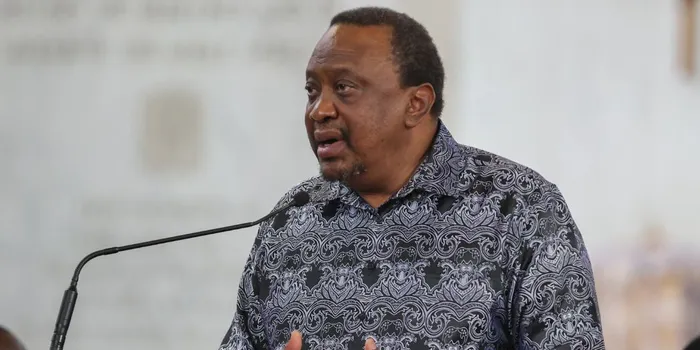
Former President Uhuru Kenyatta (left) and ODM leader Raila Odinga. Photo/BBC
By Newsflash Team
Former President Uhuru Kenyatta and ODM leader Raila Odinga are engaged in discreet negotiations ahead of the 2027 general election, though they have left their respective support bases in suspense.
Insiders reveal the duo is united in one thing: they will not support any political formation associated with former Deputy President Rigathi Gachagua. According to credible sources, both leaders fear a Gachagua-led administration would launch a revenge mission against them and are quietly working to neutralize his influence in the coming polls.
Within Gachagua’s political circle, there is mounting anxiety, with some allies now distancing themselves from him, fearing political isolation. It is now being said that Gachagua is a threat not only to President William Ruto but also to Uhuru and Raila. Ironically, the perceived threat he poses has, for now, brought together three political heavyweights—Ruto, Raila, and Uhuru—who all seek to manage or curtail his rise.
Privately, Uhuru is pushing for Raila to contest the presidency again but serve only one term, portraying himself as a Mandela-like unifier. The former president believes Raila can spearhead constitutional reforms, heal ethnic divisions, and reverse Kenya’s poor record on governance, corruption, and human rights. Uhuru is convinced that Raila is best placed to defeat Ruto and stabilize the country. If Raila exits the broad-based government and launches a presidential bid, Uhuru believes Ruto’s political goose will be cooked.
However, Raila’s candidacy is not guaranteed. Health and age concerns have been raised by his family, casting uncertainty over his sixth presidential run. Still, Uhuru has dismissed these concerns, insisting that neither age nor health disqualifies Raila from running. He cites global examples of aged but effective leaders, including within the Catholic Church. According to credible reports, pressure will mount on Raila to run as 2027 nears, with a shift from street protests to a full-scale electoral strategy.
Kalonzo’s dilemma and Mudavadi’s rising profile
Away from the Raila candidacy question, Uhuru and Raila are skeptical about backing Kalonzo Musyoka, viewing him as an easy target for Ruto. Kalonzo, sensing this lack of enthusiasm, is carving out his own political niche. Meanwhile, there are whispers that Ruto is courting Kalonzo, anticipating that Raila could abandon him.
Interestingly, sources suggest Uhuru and Raila haven’t ruled out backing Ruto, but only under stringent conditions: full inclusion in government, influence over Cabinet appointments, and the right to nominate Ruto’s running mate. In that scenario, Prime Cabinet Secretary Musalia Mudavadi emerges as a preferred deputy and potential successor.
Read more: Raila: I’ll support Ruto until 2027
Should Ruto’s popularity further decline, Uhuru and Raila could front Mudavadi for the top seat—a move reportedly supported by Kanu chairman Gideon Moi. Uhuru believes Mudavadi’s candidacy is a safe fallback if Raila steps aside and opposition parties fail to unite around a single candidate. Raila, who once picked Mudavadi as a running mate, may support him out of political loyalty and to reward the Luhya community for its backing.
Interestingly, sources reveal that in 2022, Uhuru and Raila had initially agreed to back Mudavadi for president before Raila caved to internal pressure and ran himself, losing to Ruto. Analysts now say that in the unpredictable world of Kenyan politics, Mudavadi cannot be ruled out.
Kalonzo’s perceived failure to lead the opposition effectively—despite being handed the reins—has also been noted by both Uhuru and Raila. Observers argue that if not for the Gen Z protests, Ruto’s administration would be operating without checks. It’s also clear that Raila and Uhuru do not intend to take Cabinet positions.
Jubilee’s next move and the battle for Mt Kenya
The role of Fred Matiang’i continues to emerge in succession talks. While Uhuru has a soft spot for the former Interior CS, Raila does not share the same enthusiasm. The Kenyatta and Odinga families, descendants of founding national figures, are poised to become kingmakers in 2027. Ruto, on the other hand, is shifting his campaign to rural areas after losing support in major towns, with Interior CS Kithure Kindiki leading grassroots mobilization.
Ruto’s recent publicized meeting with Uhuru at State House—where Uhuru attended as a DRC peace envoy—was widely seen as an attempt to win him over. Uhuru, however, clarified that the visit was not an endorsement. His associates say he was reluctant to attend, aware of how Ruto could manipulate the optics.
Despite being relatively quiet, Uhuru’s influence remains potent. From his Ichaweri home, he is reportedly coordinating political realignments ahead of the next election. Raila, meanwhile, is oscillating between running and supporting Ruto, leaving his supporters guessing. ODM is undergoing a massive rebrand to gear up for 2027, though Raila’s inner circle remains divided—some urging him to back Ruto for personal gain, while others want him to mount a direct challenge.
Read more: Murathe: We’ll back Raila in ’27 if he ditches Ruto
Jubilee has already named Matiang’i as its presidential flagbearer, but internal challenges persist. The Kisii community insists that Matiang’i must vie on a home-grown party—UPA—led by Nyambega Gisesa, complicating Jubilee’s plans. Meanwhile, Rigathi Gachagua is pushing for Matiang’i to avoid Jubilee and join UPA to become the face of the opposition. This has angered the Kenyatta family, who are adamant about backing only Jubilee-affiliated candidates and are reportedly assembling a Sh50 billion war chest for the campaign.
There are also reports that the Kenyattas may consider fielding former Laikipia governor Nderitu Muriithi, a relative of the late President Mwai Kibaki, as Jubilee’s presidential candidate. His past role in Raila’s 2022 campaign and current chairmanship of KRA under Ruto’s administration make him a viable contender. But his true role—either as flagbearer or deputy—remains unclear. If Raila runs, Muriithi could become his running mate to counterbalance Gachagua’s Mt Kenya dominance.
As ODM and Jubilee prepare for respective rebranding exercises in September, Raila’s recent AU Commission loss to Djibouti’s candidate may explain his indecisiveness about 2027. Nonetheless, ODM remains committed to fielding a presidential candidate, with Senator Oburu Oginga confirming ongoing coalition talks.
Raila’s mixed signals
Raila continues to send mixed signals—criticizing Ruto one day, affirming ODM’s place in government the next. Internally, some allies believe the party is now too entangled with the state to wage an effective opposition.
Both Uhuru and Raila remain united in their distrust of Gachagua, viewing him as an unworthy ally. Uhuru has yet to publicly acknowledge or associate with the deputy president, despite Gachagua’s efforts to woo him. Raila, for his part, has denounced Gachagua as a divisive tribal figure, unfit for national leadership. He has even mobilized ODM lawmakers to help impeach him.
Read more: Kioni: Azimio will never forgive Raila for ‘betrayal’
Gachagua, meanwhile, appears confident, dismissing Raila’s support base as negligible. As Kalonzo, Matiang’i, Karua, and Wamalwa coalesce under the United Opposition banner, speculation grows over who will emerge as the presidential flagbearer. Yet friction looms—especially if Kalonzo, widely seen as a frontrunner, is bypassed.
Already, Kalonzo’s ties with Gachagua have caused Uhuru to pull back from him. However, the presence of Uhuru’s uncle George Muhoho at a Gema function that welcomed back the Kamba community hinted that the Kenyatta clan hasn’t completely shut the door.
Ruto, keen to fracture the opposition, is said to have offered Kalonzo the deputy slot and campaign resources in exchange for his support—offers Kalonzo has publicly rejected. He has pledged never to join what he calls a “criminal regime,” asserting his readiness to “rescue Kenya.”
Despite their history, Raila is unlikely to back Kalonzo for the top seat. If Kalonzo refuses to join Ruto, the president may elevate Mudavadi to running mate, having concluded that Kindiki cannot deliver votes.


About the Author