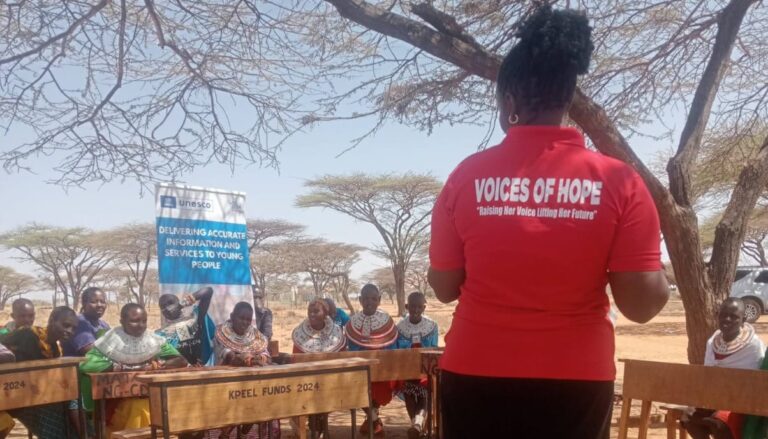
The Nguvu Change Collective team donating sanitary pads to a school. Photo/ Nguvu Change Collective
Daisy Okiring and Nguvu Collective
On 7th April every year, the World Menstrual Health Day, a sobering reality comes into sharp focus: Kenya is in the grip of a menstrual health crisis that is robbing women and girls of dignity, safety, and opportunity.
As Kenya joined the rest of the world in celebrating the day on Monday, it emerged that a staggering 46% of Kenyan women and girls report inadequate access to menstrual products, while one in three have faced or risked sexual exploitation simply because they lacked pads.
The day is dedicated to breaking taboos and spotlighting global menstrual equity.
This alarming statistic highlights the intersection of menstrual health and broader societal issues, underscoring the urgent need for action.
For the first time, these stories have been captured in a sweeping new survey conducted by the Nguvu Collective. Released on World Health Day 2025, the landmark report titled “Echoing Voices from the Grassroots on Dignified Period for All” brings to light the intimate consequences of period poverty—from stigma and trauma to serious human rights violations.
A survey that spans the nation
Conducted over five months between October 2024 and February 2025, the survey interviewed nearly 9,500 women and girls across 45 counties, with an emphasis on grassroots voices. Fifty percent of the respondents came from rural regions, where menstrual health challenges are often compounded by poverty and infrastructural neglect
The initiative was led by five Nguvu Collective Leaders and supported by the Kenya Women Parliamentary Association (KEWOPA) and 10 local partners, providing the most comprehensive picture to date of menstrual health in Kenya. The findings are stark and unsettling.
Access denied: The physical and psychological toll
Almost half (46%) of the women and girls surveyed reported that there were not enough shops selling menstrual products in their communities. For many, this means walking long distances or being forced to choose between food and pads.
But the consequences of lack of access go far beyond inconvenience. In one of the survey’s most shocking findings, 34% of respondents reported that they had either faced or were at risk of sexual harassment, exploitation, or abuse due to their inability to access menstrual products.

Of this group, 13% said the risk was frequent, while 21% had experienced it at least once.
Read more: Why are Kenyan girls still being forced into marriage?
“This menstrual survey report sheds light on the harsh realities of period poverty, breaking the silence around access, affordability, and stigma,” said Nguvu Collective Leaders Frida Karani, Harriet Afandi, Veronica Mwende, and Amina Guyo. “Every voice in this report is a call to action, demanding that menstrual equity, justice, and dignity be prioritised by our duty bearers.”
Broken promises: The government’s Sanitary Towels Programme
The study also scrutinizes the government’s Sanitary Towels Programme, which was introduced to reduce school absenteeism among girls. Yet, of those who were intended beneficiaries of this initiative:
- 41% described the supply as insufficient,
- 35% said they had not received any sanitary pads, and
- Only 23.2% reported the supply as adequate.
These findings echo the 2022 Auditor General’s report, which flagged major inefficiencies in the programme’s distribution model.

“In 2022, the Auditor General’s report on the Provision of Sanitary Towels to Girls in Public Primary Schools highlighted inefficiencies in distribution,” noted Hon. Leah Sankaire, KEWOPA Chairperson and Kajiado MP. “This research confirms that quality, affordability, and sufficiency are major concerns. The findings highlight the harsh reality that when menstrual products are out of reach, the dignity and safety of women and girls are compromised.”
Quality matters: Health and hygiene at risk
The survey revealed that affordability is just one part of the problem. Absorbency (53%), comfort (48%), and skin sensitivity (44%) were the most critical factors cited by respondents—outweighing concerns like price, eco-friendliness, or odour control.
Read more: Breaking barriers as women own land in Kenya
In low-income communities, women and girls often resort to cheap or homemade alternatives that cause irritation, infection, or worse.
“We heard stories from girls who used leaves, old mattress foam, or even cow dung in desperation,” said Veronica Mwende, who led survey efforts in Kitui and Makueni. “That’s not just unhygienic—it’s undignified.”
Stigma still silences
Beyond infrastructure and affordability lies the deeply entrenched stigma around menstruation. Many girls reported having no idea what was happening when they first got their period, having never been educated on menstrual health.

“School-based menstrual health education programmes” were cited by 58% of respondents as the most effective way to improve awareness. But such programmes are sporadic and underfunded—and in some regions, altogether absent.
“There are parts of this country where a girl’s first period is met with silence, shame, or even punishment,” Mwende added. “This cultural silence contributes to a lifelong cycle of shame and misinformation.”
A call for policy reform
With data in hand, Nguvu Collective is pushing for immediate legislative action. Central to their advocacy is the Provision of Sanitary Towels Bill, 2024, sponsored by nominated Senator Gloria Orwoba. The bill seeks to guarantee free sanitary products in schools, health centres, and correctional facilities.
“Through this pathbreaking survey, Nguvu Collective Leaders have amplified the voices of menstruating women and girls in Kenya,” said Preethi Herman, CEO of Nguvu Collective. “Passing the Provision of Sanitary Towels Bill is one strong step towards closing the period poverty gap and safeguarding the reproductive and mental health of women and girls across Kenya.”

The Collective plans to present their findings to key stakeholders, including KEWOPA, the Ministry of Health, and the Ministry of Gender, Culture, the Arts, and Heritage. Their goal is to institutionalize free access to sanitary products and push for nationwide menstrual health campaigns.
The future of menstrual equity
Nguvu’s work is not just about research—it is about change. From town hall dialogues to policy briefings, the next phase will focus on translating these statistics into action and storytelling into justice.
“We want a country where no girl has to choose between pads and books, where no woman feels she must beg or bleed in silence,” said Frida Karani. “This report gives us the evidence, the stories, and the momentum. Now, our leaders must give us the political will.”

The findings may have emerged from the grassroots, but their implications reach the highest corridors of power. For too long, menstrual health has remained peripheral in public health discourse. This report demands that it be brought to the centre.
A path forward
The findings of the Nguvu Collective survey serve as a clarion call for action. As Kenya grapples with the realities of period poverty, it is imperative that policymakers, community leaders, and advocates join forces to address these challenges head-on.
Read more: UNICEF: Children are being sexually abused in Sudan’s war
The Provision of Sanitary Towels Bill, 2024 represents a critical step forward, but it must be accompanied by comprehensive education, community engagement, and ongoing advocacy. By centering the voices of women and girls, we can create a future where menstrual equity is not just an aspiration, but a reality.
About Nguvu Collective
Nguvu Collective is a global, women-led organisation dedicated to empowering emerging leaders from marginalised communities. With active operations in Kenya, Nigeria, South Africa, and India, the Collective has supported over 500 women change leaders and contributed to 71 policy victories, improving the lives of over 200 million people.


About the Author