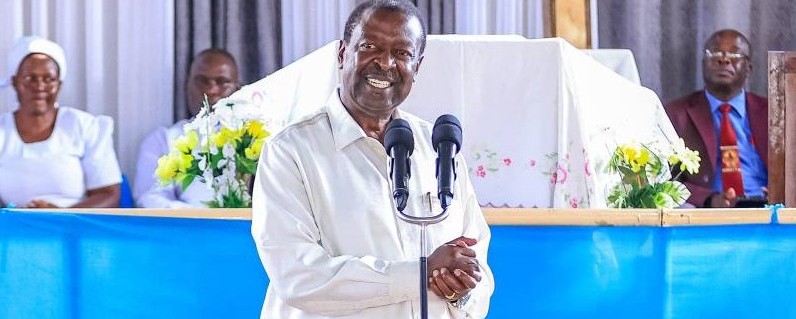
Prime Cabinet Secretary Musalia Mudavadi addresses worshippers at the Friends Quakers Church, Vokoli, Vihiga County, on Thursday, December 25, 2025, to mark Christmas Day. Photo/Musalia Mudavadi/X
By Newsflash Reporter
Prime Cabinet Secretary Musalia Mudavadi has for the second time in less than a week reiterated why Kenya needs a referendum in 2027.
Speaking during the Maragoli Cultural Festival in Vihiga County on Friday, December 26, 2025, Mudavadi said the country is at what he described as a “referendum moment,” driven by unresolved constitutional bottlenecks that could undermine the credibility of the 2027 polls.
He warned that Kenya risks plunging into a constitutional and legal crisis if urgent reforms are not undertaken ahead of the next General Election.
Mudavadi, who is also the Foreign Affairs Cabinet Secretary, had made such remarks earlier this week in an interview with journalist Alex Chamwada of the Chams Media.
Addressing residents from Western Kenya (Mulembe), Mudavadi said Kenya is already operating in constitutional non-compliance, particularly on electoral boundaries, population data, and representation. He cautioned that without corrective measures, the 2027 election could face serious legal challenges, including the possibility of being invalidated before it is conducted.
According to Mudavadi, the 2010 Constitution requires constituency boundary reviews every eight to twelve years, a deadline that lapsed in March 2024. However, he noted that a valid review cannot take place without credible census data, a requirement complicated by the nullification of the 2019 census results in Mandera, Wajir and Garissa counties.
Census, boundaries and legal deadlock
Mudavadi explained that the court-ordered mini-census for the three counties, scheduled to be conducted by January 2026, has created a legal deadlock. He argued that Kenya cannot legally rely on a “patchwork census” combining 2019 and 2026 data, warning that such an approach would fail constitutional scrutiny.
“No valid population data means no valid boundaries, and no valid boundaries mean no valid election,” he said, describing the situation as a looming constitutional storm.
Read more: Why Mudavadi’s political star is waning in Mulembe
He further pointed to Article 89(4) of the Constitution, which caps the number of constituencies at 290, despite rapid population growth in some regions. Mudavadi said this restriction denies fast-growing areas fair representation while putting sparsely populated “protected constituencies” at risk of being scrapped unless the Constitution is amended.
At the county level, he highlighted another conflict between the Constitution, which empowers the Independent Electoral and Boundaries Commission (IEBC) to create or adjust wards, and the County Governments Act, which caps wards at 1,450. This, he said, has made it impossible to create new wards to reflect population growth and bring resources closer to the people.
Devolution and power sharing
Beyond electoral concerns, Mudavadi said the proposed referendum should address broader governance and inclusivity issues identified by the National Dialogue Committee (NADCO). He argued that some reforms can only be resolved through a public vote.
Top on the list, he said, is the entrenchment of the National Government Constituencies Development Fund (NG-CDF) in the Constitution to shield it from repeated court challenges that threaten student bursaries and grassroots development. He also proposed the creation of a Senate Oversight Fund to strengthen devolution and a Ward Development Fund to empower Members of County Assembly to deliver small but critical community projects.
Read more: Mudavadi seeks global patners to sustain peace missions in Somalia, Haiti
Mudavadi further called for the formal establishment of the offices of the Prime Minister and the Leader of the Official Opposition to ensure inclusivity and a sense of national balance in government. He added that a referendum would provide an opportunity to finally resolve the long-standing two-thirds gender rule, which has remained unimplemented more than a decade after the Constitution was promulgated.
He urged Kenyans, especially the youth, to register as voters and actively participate in shaping the country’s future, warning that apathy would only weaken democracy.
Mudavadi reaffirmed his support for President William Ruto’s leadership, urging Kenyans to back the president in 2027 to steer the country through what he described as a challenging constitutional phase.
“We must embrace this referendum as a legal necessity to save our democracy,” Mudavadi said, insisting that unity and participation are the only way to secure Kenya’s electoral future.
According to political analysts, Mudavadi’s remarks indicate President Ruto’s thinking, which could reshape Kenya’s political matrix in 2027.
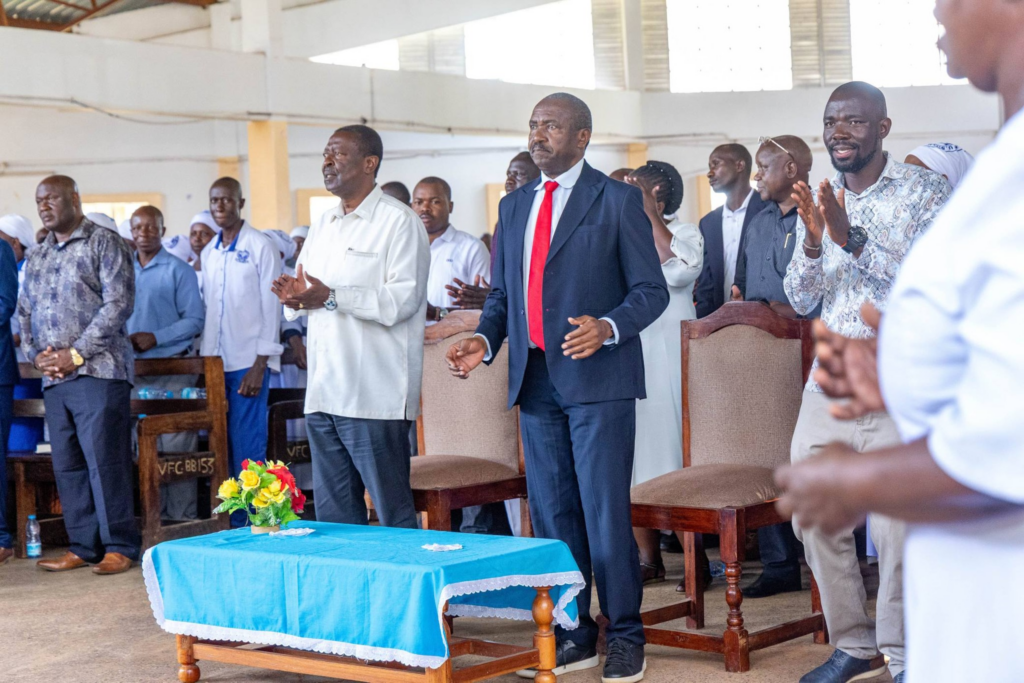
Prime Cabinet Secretary Musalia Mudavadi joins worshippers at the Friends Quakers Church, Vokoli, Vihiga County, on Thursday, December 25, 2025, to mark Christmas Day. Photo/Musalia Mudavadi/X


About the Author