
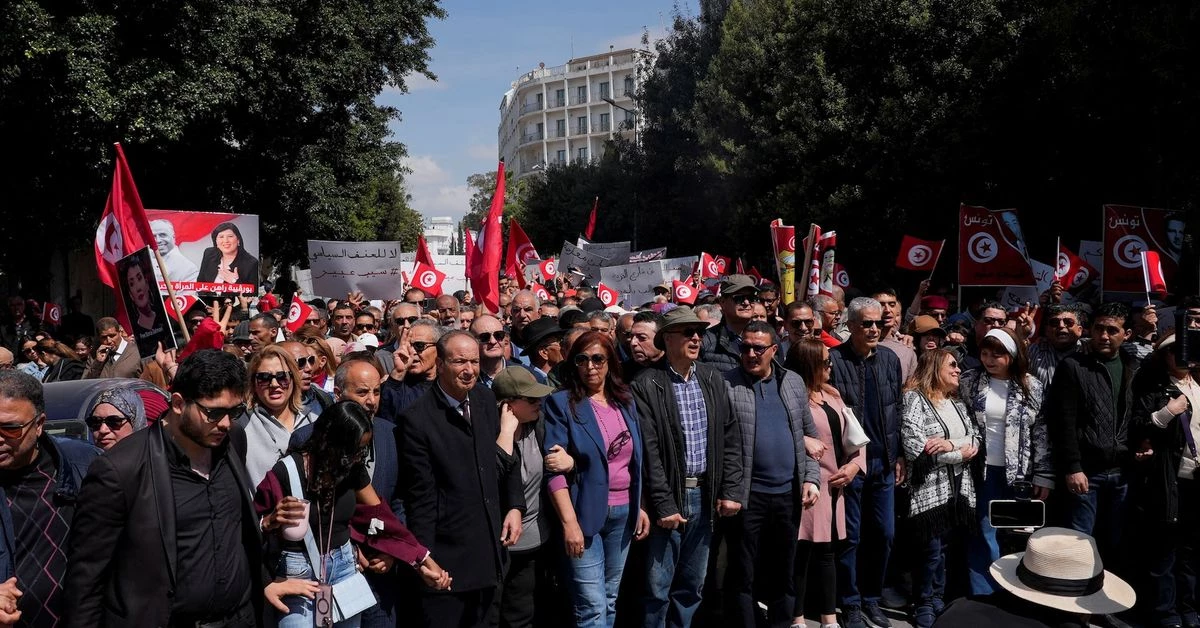
Supporters of the Free Constitutional Party, led by Abir Moussi who has been imprisoned for two years, hold a protest against Tunisian President Kais Saied in Tunis, Tunisia, on April 9, 2025. REUTERS/Jihed Abidellaoui
By Daisy Okiring
On April 9, 2025, hundreds of Tunisians took to the streets in two significant protests against President Kais Saied, demanding the release of political prisoners and expressing their discontent with what they perceive as an increasingly authoritarian regime.
The demonstrations unfolded amid a hunger strike initiated by six detained opposition figures, further amplifying the urgency of the protesters’ demands.
The rallies, organized primarily by supporters of the Free Constitutional Party, marked a pivotal moment in Tunisia’s ongoing struggle for political freedom and justice. Participants gathered in Tunis, waving banners and chanting slogans that condemned Saied’s leadership. They called for the immediate release of political prisoners, including party leader Abir Moussi, who has been in detention for two years. The protesters argue that her imprisonment is emblematic of a broader campaign against dissent and political opposition in Tunisia.
Growing opposition to Saied’s regime
The protests reflect the mounting concerns among Tunisians regarding President Saied’s consolidation of power since he assumed office. In July 2021, Saied took extraordinary steps to expand his authority, including the abrupt dissolution of the elected parliament and the suspension of the constitution. He subsequently ruled by decree, effectively sidelining the judiciary and curtailing civil liberties. These actions have led many in the opposition to label his governance as a coup, undermining the democratic gains made during the 2011 Arab Spring.
Read more: US tariffs: KNCCI to explore measures to cushion businesses
Demonstrators expressed their frustration over Saied’s tactics, which they believe are designed to stifle dissent and eliminate political pluralism. “We are here to demand our rights and the release of our leaders,” one protester shouted, capturing the sentiment of the crowd. The hunger strike by the detained politicians, which began on the same day as the protests, was described as a desperate measure to draw attention to their plight and the broader issue of political repression in the country.
International observers have also voiced concern over the authoritarian drift in Tunisia. Human rights organizations have criticized Saied’s government for its crackdown on free speech and political dissent, warning that the situation could escalate if the current trajectory continues. The protests signify a critical juncture for Tunisia, as citizens reflect on the ideals of democracy that sparked the revolution more than a decade ago.
Read more: Chaos erupts in Roysambu as Gen Z protesters clash with police
As tensions rise, the future of Tunisia’s political landscape remains uncertain. The opposition’s ability to unite and mobilize support against Saied’s regime will be crucial in determining whether the country can return to a path of democratic governance. With the hunger strike drawing attention both domestically and internationally, the coming days will likely witness intensified scrutiny of Saied’s actions and the struggles of those fighting for political freedom in Tunisia.


About the Author



2 thoughts on “Massive protests against Saied erupt in Tunisia”
Comments are closed.