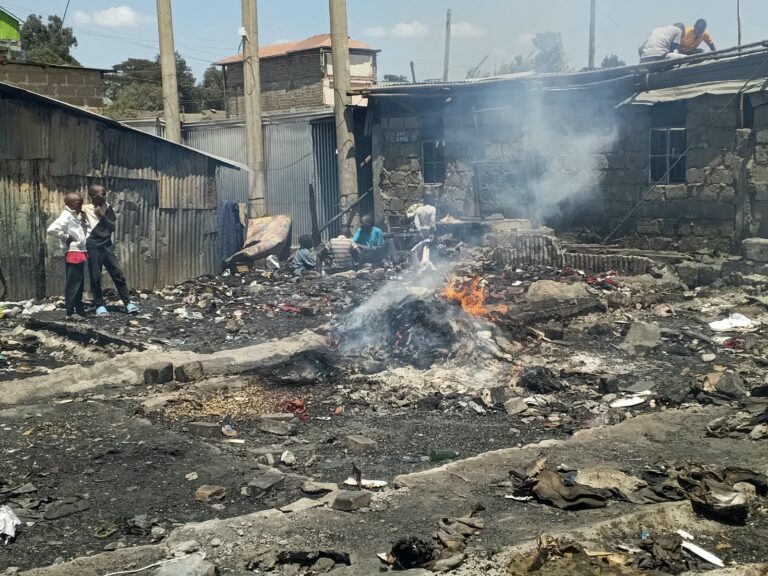
A dumpsite in Majengo, Kisumu County, posing health risks to residents. Photo/Courtesy
By Daisy Okiring
The National Environment Management Authority (Nema) has issued a strict 21-day ultimatum to all 47 counties to comply with Kenya’s new waste management regulations. The directive requires devolved units to enforce segregation of waste at the source and reorganise dumpsites in line with the Sustainable Waste Management Act, 2022.
Nema Director-General Mamo Mamo said counties must accelerate the shift toward a circular economy by ensuring households, businesses, and institutions separate organic, recyclable, and general waste before it is collected.
“Take notice that all county governments are required to, within 21 days, facilitate segregation of waste at source and in transit, reorganise dumpsites accordingly, and give effect to the law,” Mamo said in a public notice.
Circular Economy Push
The regulations require the use of colour-coded bins: green for organic waste, blue for recyclables, and black for general waste. Waste transporters are expected to carry only segregated waste, while county governments must provide infrastructure for proper collection, recycling, and disposal.
Mamo said the measures aim to build a circular economy, where waste is treated as a resource, valuables are recovered, and environmental damage is minimised.
He warned that Nema will invoke provisions of the law if counties fail to comply. This includes penalties for institutions, households, and service providers who disregard waste segregation requirements.
The new framework sets ambitious targets: 30 per cent of waste recycled, 60 per cent converted into compost, five per cent incinerated, and only five per cent sent to landfills. This approach is designed to reduce reliance on dumping sites, which have long posed health and environmental risks across the country.
Read More: Kenya’s proposed KSh 500 Billion to lower electricity costs by 2034
Penalties for Non-Compliance
The law imposes tough penalties on offenders. Households or institutions that fail to segregate waste face fines of up to Sh20,000, six months in jail, or both. Waste service providers who breach the rules risk fines of Sh50,000, imprisonment, or both.
Hazardous waste will be managed separately under the Environmental Management and Coordination Act, 1999. This category includes medical waste, agrochemicals, batteries, and industrial by-products that pose serious risks to human health and the environment.
Mamo also stressed that producers will bear extended producer responsibility (EPR). This requires manufacturers and importers to manage the entire lifecycle of their products, from packaging to disposal. Items subject to EPR include plastics, tyres, pharmaceuticals, textiles, batteries, lubricants, and electronic equipment.
“This strategy ensures manufacturers are accountable for pollution caused by their products and supports recovery, recycling, and safe disposal,” Mamo said.
Read More: Why irrigation is Kenya’s lifeline for climate resilience and growth
County Role and Next Steps
Since the Act came into force in July 2022, counties were given two years to align their systems in consultation with the national government and the public. Each county is required to establish a material recovery facility for sorting, composting, and recycling waste.
In addition, counties must designate separate reception areas for organic waste, recyclables, residual waste, and unrecoverable waste. Residual waste will be transported to long-term storage facilities or sanitary landfills to ensure environmentally safe disposal.
Nema has already issued two reminders — in December 2023 and again in June 2024 — directing county governments to reorganise existing dumpsites. Many counties have been slow to comply, prompting the current 21-day deadline.
Mamo reaffirmed Nema’s commitment to environmental sustainability, warning that strict enforcement will follow if counties ignore the directive.
“Segregating waste makes recycling and reuse easier. Much less ends up in landfills, and more value is recovered for the economy,” he said.
The authority says these steps are essential to ensuring a clean, healthy, and sustainable environment for present and future generations.


About the Author