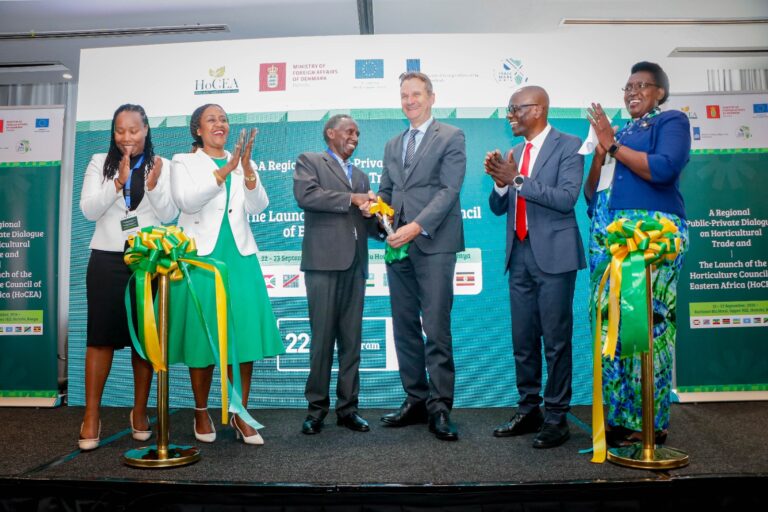
Agriculture Cabinet Secretary Mutahi Kagwe (third right) leads other leaders in cutting the ribbon during the launch of De Heus Animal Feed factory in Athi River, Machakos, on 18/02/2026. Photo/Newsflash
By Wanderi Kamau
Kenya has commissioned one of Africa’s largest animal feed manufacturing facilities in Athi River, in a move the government says will help double national milk production, enhance feed standards, and strengthen the country’s position as a regional livestock powerhouse.
The KSh3 billion facility by De Heus Animal Nutrition was officially launched on Wednesday, February 18, 2026, by Agriculture and Livestock Development Cabinet Secretary Mutahi Kagwe, who described the investment as part of a broader structural transformation of Kenya’s livestock sector.
“Today is not just about commissioning a factory. It is about transforming Kenya’s livestock economy,” said CS Kagwe. “We will not achieve this by merely increasing the number of cows. We will achieve it by increasing productivity per cow. The future of Kenya’s dairy and meat sector lies in efficiency, nutrition, genetics, animal health, and most critically, quality feed.”
The government has set a target of doubling annual milk production from 5.2 billion litres to 10 billion litres while positioning Kenya to become a net exporter of live animals and meat.
Push for higher feed standards
The commissioning comes amid growing scrutiny of Kenya’s animal feed industry, where farmers have raised concerns about inconsistent formulations, fluctuating performance, and over-diluted products that undermine productivity.
Feed accounts for between 60 and 70 percent of livestock production costs, making quality and consistency a major factor in farm profitability.

CS Kagwe announced that the government will strengthen enforcement measures and introduce a feed quality index to protect farmers from substandard products.
Read more: De Heus to open KSh 3 billion animal feed factory in Athi River
“Over-diluted feed and substandard formulations designed to maximize profits at the expense of productivity will not be tolerated. Farmers must get value for their money,” he said.
He noted that Kenya’s ambitions to access export markets for milk powder, meat, and live animals depend heavily on strict feed standards and improved animal health.
The Athi River factory, built at a cost of KSh3 billion, has an annual production capacity of 240,000 metric tonnes. It incorporates laboratory testing of raw materials, standardized formulation processes, automated production systems, and batch verification to ensure consistent quality.
According to company officials, the facility focuses exclusively on animal nutrition while providing farmers with technical support, knowledge transfer, and advisory services to improve productivity.

“Our investment philosophy is not merely about building factories, but about building capabilities,” said Co de Heus, Chairman of the Board. “By working closely with farmers and local partners, we share technical expertise, management insights and practical solutions, helping to unlock the full potential of Kenyan agriculture.”
The company operates more than 100 factories globally and produces approximately 16 million tonnes of feed annually.
The company’s Managing Director Wiehan Visagie said the decision to establish a local facility was driven by persistent gaps in feed reliability and declining farmer confidence.
“For too long, feed has felt like a gamble for many farmers,” he said. “Our commitment is to deliver consistent, batch-to-batch nutrition backed by laboratory testing and strict quality controls.”
Linking feed security to national reforms
The commissioning aligns with broader government reforms aimed at strengthening feed security and reducing reliance on imported raw materials.
Under the Land Commercialization Initiative, the government is unlocking public land for structured production of yellow maize and soybeans — key ingredients in animal feed — while integrating small-scale farmers through contract farming models.

Read more: AU-IBAR pushes unified feed strategy for Horn of Africa
The state is also constructing 50 dams to expand irrigation and reduce dependence on rain-fed agriculture, alongside plans to establish structured feed reserves to cushion farmers during drought periods.
“Feed security must be localized. Kenya must reduce dependence on imports of key feed ingredients,” CS Kagwe said.
Industry analysts note that the livestock sector contributes about 12 percent of Kenya’s Gross Domestic Product but continues to face productivity challenges, underscoring the need for science-based production and stronger regulatory oversight.
Jobs and regional expansion
The new facility is expected to create about 280 direct jobs, with additional employment opportunities in logistics and supply chains.
Machakos Governor Wavinya Ndeti welcomed the investment, describing it as a boost to agro-industrial growth and youth employment.

“Quality feed is the backbone of productive livestock,” she said. “When our poultry farmers get better feed, they get better yields. When our dairy farmers get better nutrition solutions, milk production increases.”
Read more: The hidden plague of microplastics in Kenya’s food chain
The project also reflects international cooperation, with the Ambassador of Kingdom of the Netherlands highlighting the partnership dimension.
“This new De Heus animal feed facility reflects confidence—confidence in Kenyan farmers, confidence in the future of agriculture, and confidence in the economy of Kenya,” he said.
With 35 outlets across the country and expansion plans targeting regional markets such as Uganda and Tanzania, the company aims to position Kenya as a regional hub for livestock feed production.
CS Kagwe said investments of this nature play a key role in strengthening rural economies and enhancing investor confidence.
“Facilities such as this create jobs, stimulate demand for raw materials, empower youth in agribusiness, strengthen rural economies, and build investor confidence in Kenya,” he said.
The Athi River plant is expected to accelerate the modernization of Kenya’s livestock value chain through a combination of policy reforms, private investment, and science-driven production, positioning the country for greater competitiveness in regional agricultural trade.


About the Author