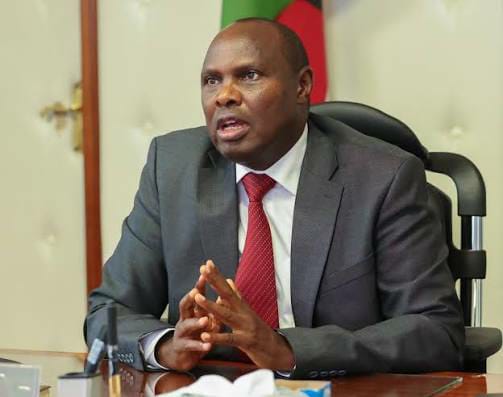
Health CS Aden Duale. Photo/Handout
By Newsflash Reporter
Kenya is edging closer to sealing an agreement that will require it to share infectious disease information with the United States in exchange for funding support.
The proposed memorandum of understanding (MoU) guarantees Kenya limited financial assistance between 2026 and 2030, while Washington will gain access to Kenyan health data for 25 years. Critics have dismissed the pact as imbalanced and a tactic by the US to bypass the World Health Organization (WHO) and other global health bodies. Under the plan, Kenya will be expected to provide physical specimens from citizens and genetic sequence data of rapidly spreading pathogens. The US must also be notified within one day of any detected infectious disease, while Kenya is obligated to identify such outbreaks within seven days. After detection and notification, Kenya will be required to execute initial response actions while consulting Washington on strategy. Failure to supply specimens or meet data-sharing obligations could prompt adjustments to US support—or even termination of the MoU. Kenya will additionally be required to align its outbreak response with standards set by the United States Food and Drug Administration.
“Kenya commits to allow the United States Food and Drug Administration’s approval or Emergency Use Authorisation of medical countermeasures to be a sufficient basis to use the medical countermeasures to respond to an outbreak in the country,” the MoU states.
A continent-wide template
This pact forms part of the America-First Global Health Strategy, which Washington describes as a framework designed to enhance US safety, prosperity and health security by preventing infectious diseases from reaching American borders. Similar MoUs are being replicated across Africa, including in Nigeria, Zambia, Mozambique, Cameroon, Tanzania, Namibia, Uganda, Ghana, Rwanda, Botswana, Lesotho, Ethiopia, Eswatini, Malawi and the Democratic Republic of Congo. The timing of these agreements coincides with growing financial and operational strain in HIV/Aids programmes following a three-month freeze in US foreign aid imposed in January. Although Washington assured African governments that life-saving programmes would continue, many affected initiatives are yet to resume fully. In return for Kenya’s health data, the US intends to finance a review of the country’s outbreak surveillance system—covering sample collection, transport, storage, testing and disposal.
Read more: High Court declares Ruto’s health taskforce unconstitutional
The US has further committed to paying salaries and benefits for epidemiologists throughout the agreement, with the number of specialists to be determined by Kenya. Additionally, the US will—subject to the availability of funds—continue to support laboratory commodities and frontline lab workers in 2026, with funding projected to decline gradually thereafter. Washington will also back frontline healthcare staff, including doctors, nurses and community health promoters. Meanwhile, Kenya will add 500 medical officers and nurses to the government payroll annually starting in 2027 through to 2030. Seasonal workers engaged in public health campaigns, such as malaria drives, will also be funded by the US. Support for sample transport, diagnostic network optimisation and laboratory accreditation will transition fully to Kenya by the end of 2027.
Government-to-government talks advance
A high-level meeting on the MoU was held two weeks ago, attended by Health Cabinet Secretary Aden Duale, National Treasury Cabinet Secretary John Mbadi, and Principal Secretaries Chris Kiptoo (National Treasury), Korir Sing’oei (Foreign Affairs) and Ouma Oluga (Medical Services). Dr Oluga revealed on LinkedIn that the officials held extensive discussions with US representatives to harmonise financial, diplomatic and policy components of the renewed health partnership.
“These talks build on months of constructive engagement since the Stop Work Order issued on January 20, 2025,” Dr Oluga said. The US delegation included Brad Smith, a senior global health adviser overseeing the restructuring of the US President’s Emergency Plan for Aids Relief (Pepfar) and grants formerly managed by the US Agency for International Development (USAID), as well as Chargé d’Affaires Susan Burns. Dr Oluga said the new arrangement enhances efficiency, sustainability and national ownership through a direct government-to-government model. He noted that his prior role assessing the impact of the Stop Work Order and the closure of USAID-backed programmes shaped his approach to building a more resilient and accountable health partnership.
Read more: How senior health officials doctored organ transplant dossier
In his own LinkedIn update, Dr Kiptoo said the discussions reinforced Kenya’s long-standing collaboration with the US in strengthening the health sector. “We appreciate the US government for its continued support in combating HIV, TB and malaria, and in advancing health system strengthening across the country,” he said. “Both countries are finalising an agreement that aligns Kenya’s health priorities with the United States’ global health objectives, strengthening a partnership that saves lives and builds a more resilient health system for our nation.”
The MoU’s companion guide notes that its purpose is “to establish an understanding between the US Department of State and partner countries that will advance US interests, save lives and help countries build resilient and durable health systems”. It further states that “to keep America safe from infectious disease threats, all countries should generally have the same vision: a surveillance and outbreak response system capable of achieving 7-1-7”. The “7-1-7” model calls for detecting infectious diseases within seven days, notifying authorities within one day, and completing early response actions within seven days. Another clause requires Kenya to exempt from tax all US government funds used in implementing the MoU, including money channelled through contractors and sub-contractors. The US also seeks access to a broad range of data sets, among them electronic medical records, health information systems, and outbreak surveillance platforms.


About the Author