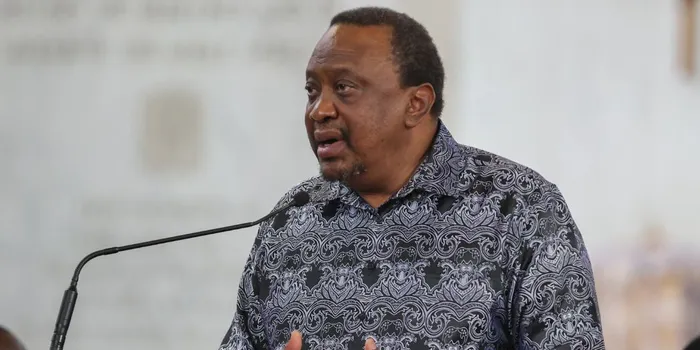
Democracy for Citizens Party (DCP) leader Rigathi Gachagua speaking during a past public meeting. Photo/Gachagua
By Newsflash Repoter
Former Deputy President and Democracy for Citizens Party (DCP) leader Rigathi Gachagua has issued a stern warning to Kenyans seeking to purchase affordable housing units in Ong’ata Rongai, Kajiado County.
Speaking during a Sunday service at St Peter’s ACK Cathedral in Rongai, Gachagua claimed that the government was illegally using a 152-acre parcel of land belonging to the Presbyterian Church of East Africa (PCEA) to construct 2,000 units under President William Ruto’s housing programme.
Gachagua alleged that the houses, marketed as part of the government’s affordable housing initiative, were in reality commercial projects built on contested land. He cautioned investors against committing their money, warning that the properties would eventually be reclaimed.
“Those houses that are being built are not affordable housing. They are commercial houses. We want to be kind to investors who want to buy those 2,000 houses in advance. Don’t waste your money,” he said.
He further vowed that if his party secured victory in the 2027 elections, his administration would move swiftly to evict buyers and hand the land back to the church. “If you bought the houses, you will incur losses because PCEA will take those houses and collect their rent,” he warned.
Read More: Matiang’i slams Ruto’s government, promises change if elected
Political Undertones and 2027 Election Promise
Gachagua used the pulpit to link the land dispute to broader political battles, positioning himself as a defender of the church’s rights. He argued that the Ruto administration’s housing agenda was undermining local priorities and ignoring pressing needs. According to him, the greatest challenge facing residents of Ong’ata Rongai, Kiserian, and Ngong was not housing but access to clean water and sanitation.
“I want to ask the government to listen to the people of Kiserian and Ngong. The challenge of the people of these areas is not houses. The challenge is water and sewerage,” he told congregants.
Read More: Senate clears Kericho Governor Mutai in second impeachment attempt
The Rongai development is part of the government’s flagship affordable housing programme, which aims to build hundreds of thousands of units nationwide. In the Gataka area near the Oloolaiser Water Plant, the project has been earmarked for studio, one-, two- and three-bedroom apartments under the Boma Yangu framework. Regional housing officials have said the project, valued at Ksh5.2 billion, would not only provide shelter but also social amenities, including boreholes and sewerage systems, to support the surrounding community.
Still, Gachagua insisted the project was a misallocation of public resources and an encroachment on church land. His remarks come at a time when political temperatures are already rising ahead of the 2027 elections, with land and housing disputes becoming recurring campaign issues.
Government Position and Growing Tensions
Government officials have defended the Rongai project, describing it as part of a national drive to ease the housing deficit and create jobs for local communities. Nairobi Metropolitan Regional Director Don Kagicha earlier stated that priority was also being given to schools in the area before full-scale construction began. He added that the housing units were designed to be affordable and accessible to ordinary Kenyans.
However, Gachagua dismissed these assurances, maintaining that the project was tainted by illegality and that investors risked financial ruin if they ignored his warnings. His remarks have stirred debate among Rongai residents, some of whom fear potential eviction if leadership changes after 2027.
The controversy underscores the high-stakes nature of Kenya’s affordable housing programme, which has faced resistance over questions of land ownership, financing, and accessibility. For Gachagua, the issue provides both a political platform and a rallying call against what he calls “misplaced government priorities.”
Whether his threats translate into electoral momentum remains to be seen, but the clash between state projects and church claims is already reshaping the debate on land use and housing policy in one of Nairobi’s fastest-growing suburbs.


About the Author