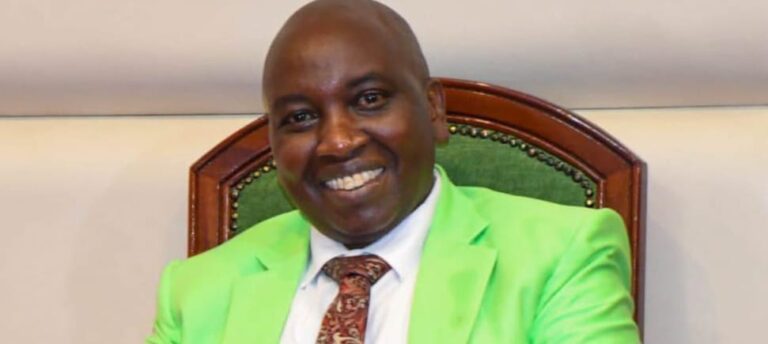
Tycoon Kamlesh Pattni. Photo/The Star
By Newsflash Writer
Paul Kamlesh Pattni remains unshaken in his passion for gold, a trade he claims is rooted in his heritage.
“Gold is in my blood,” he said in a rare interview conducted in Dubai, two months after he sparked renewed controversy by signing a gold refinery deal with the government of Niger. This came despite U.S. and U.K. sanctions accusing him of involvement in illicit gold trade.
“The sanctions were based on falsehoods and media propaganda,” said Pattni, whose name is forever linked with Kenya’s infamous Goldenberg scandal. Tracking down and securing an interview with Pattni took nearly eight years, involving intermediaries and protracted negotiations. The breakthrough came in May 2025, after multiple failed attempts dating back to 2017. Even then, the process remained delicate: initial meetings were required to establish trust and set rules for engagement.
Still bruised from the 2023 Al Jazeera documentary that tied him to controversial gold deals in Zimbabwe and Dubai, Pattni arrived late at night with two lawyers and reams of documents in tow. He insisted on a cautious, document-driven interview, avoiding direct responses and often punctuating his answers with religious phrases like “glory to God” and “I forgive you.”
Leaving Kenya and a lifelong gold calling
Asked about his quiet departure from Kenya, Pattni dismissed the suggestion. “The prophet is not respected in his hometown,” he said. “I left during the COVID-19 period and travelled once flights resumed.” He insisted his family heritage as goldsmiths naturally led him into the trade. “We don’t chase gold. It’s within us. It’s a knowledge passed down over generations.”
He explained the deal with Niger’s government, signed on April 23, as a joint venture aimed at curbing rampant gold smuggling. “Their official figures show 6–7 tonnes of gold annually, but in reality, it’s 96 tonnes, smuggled mostly through Benin. We aim to help them recover their full potential,” he said.
Pattni claimed the Niger government ran background checks before entering into the agreement. “This is a military-led government. They wouldn’t deal with a conman. The sanctions were based on fake reports and rivalries, especially from Zimbabwe.”
Details of the Niger agreement and claims of redemption
On the specifics of the deal, he said: “It’s a 50-50 partnership. They bring the raw materials — gold — and we bring capital and machinery. A refinery is already in place.” He compared the project to his previous ambitions in Kenya, stating that the goal is to turn Niger into a regional hub for gold processing.
Responding to the lingering shadow of the Goldenberg scandal, Pattni was defiant. “Goldenberg saved Kenya at a time when we had no foreign exchange. They call it a scam, but I call it salvation.” Despite a judicial commission and multiple rulings branding Goldenberg a monumental fraud, Pattni held firm that the narrative had been distorted by political enemies and international pressure.
Read more: Human rights defender slams silence of former government officials
According to him, the scandal was born of rivalries and sabotage. “Someone in the Central Bank leaked documents. Then IMF came demanding audits and found a hole — not because of Goldenberg, but because of unsecured loans to politically-linked banks.”
Asked whether he regretted being linked to what many consider the biggest financial scam in Kenya’s history, he replied, “May God forgive you for saying that. Lies repeated a thousand times don’t become truth. No single individual can wreck an economy. I’m not the Central Bank.”
Past ties
Pattni addressed his past proximity to power, saying he became President Moi’s adviser at 27 not because of credentials — he never completed his university studies in Germany — but because of business acumen. “Moi was smart. He wouldn’t just pick anyone.”
Read more:When gold turns poison: Artisanal mining in Western Kenya
He denied that former Special Branch Director James Kanyotu held shares in Goldenberg International as a proxy. “He used his own name. That proxy story was political.”
Asked about his net worth, Pattni responded evasively, pointing to his Bible: “This is my net worth. The word of God is worth trillions. I don’t boast about material wealth.”
Sanctions, ministry, and no apology
On sanctions imposed by the U.S. and U.K., Pattni confirmed they had affected his family and reputation but maintained they were administrative and rooted in misinformation. He said he had petitioned the U.S. Office of Foreign Assets Control to challenge them.
Pattni also spoke about his conversion to Christianity, adopting the name “Brother Paul.” Through his Hope International Ministry, he has preached in the Caribbean, the UK, and Africa. He recalled working with former Mungiki leader Maina Njenga to convert followers in Kenya.
Asked whether he felt the need to repent for the alleged economic harm Goldenberg caused, Pattni flatly rejected the idea. “You repent if you’ve sinned. I did no wrong. I brought good, and I was repaid with evil. Those who judged me have been judged. I forgive them. But don’t ask me to repent for lies.”


About the Author