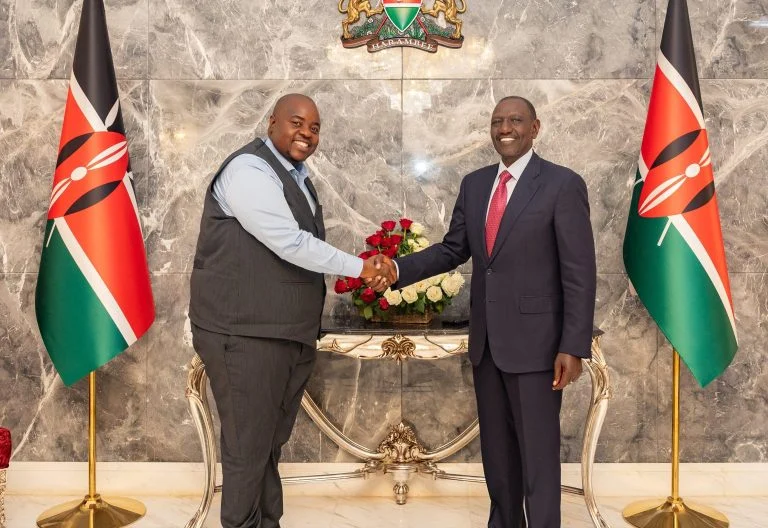
Kenya’s President William Ruto (centre), Zimbabwe’s Emmerson Mnangagwa (left) and Africa Union Commission (AUC) chairperson Mahmoud Ali Youssouf during joint SADC and EAC meeting to discuss peace restoration efforts at Eastern DRC at State House, Nairobi on August 2, 2025. Photo/PCS
By Newsflash Writer
Leaders from the East African Community (EAC) and Southern African Development Community (SADC) have agreed to unify their ongoing peace efforts for the Democratic Republic of Congo (DRC) under the African Union (AU).
The move, announced during a co-chairs’ meeting in Nairobi, aims to streamline peace initiatives, reduce redundancy, and accelerate meaningful progress.
The discussions involved Kenyan President William Ruto, Zimbabwe’s President Emmerson Mnangagwa, and a panel of appointed peace envoys. The leaders resolved to immediately merge the EAC-SADC peace structures with the AU’s mediation framework, which includes the AU Mediator and the EAC-SADC Panel of Facilitators. All actors will now report jointly to both the AU and the EAC-SADC Summit.
As part of this agreement, the AU Commission in Addis Ababa will oversee a new joint secretariat comprising officials from the AU, EAC, and SADC. This integrated body will be responsible for implementing and coordinating the unified peace efforts. Once ratified by a joint summit scheduled for next week, this merger will link the five existing regional envoys with AU’s appointed mediator for DRC, President Faure Gnassingbé of Togo. The five envoys include former heads of state Uhuru Kenyatta (Kenya), Catherine Samba-Panza (Central African Republic), Sahle-Work Zewde (Ethiopia), Olusegun Obasanjo (Nigeria), and Mokgweetsi Masisi (Botswana).
Pressure from other peace tracks
However, the Nairobi talks occurred without representation from the Congolese government, raising concerns over whether regional efforts are lagging behind other diplomatic interventions. Recently, the DRC and Rwanda—long-time rivals over eastern Congo’s instability—signed a US-mediated peace agreement. In addition, Kinshasa reached a declaration of principles with the M23 rebel group, which the DRC alleges is supported by Rwanda. The AU endorsed both efforts, and its Commission Chair Mahmoud Ali Youssouf attended the Nairobi session.
Read more: Ruto, Rubio hold discussion over DRC crisis
Qatar has also been facilitating separate peace discussions between Kinshasa and M23 in Doha, an initiative supported by both the US and the AU. President Ruto clarified that the newly merged process will not interfere with existing diplomatic tracks. “This process does not compete or conflict with the other initiatives underway in Doha and Washington,” he said. “In fact, this alignment allows all the existing peace deals—including the Washington and Doha agreements—to complement the Africa-led approach.”
Focus on humanitarian crisis and security
President Ruto stressed that eastern DRC’s worsening humanitarian and security crisis demands a unified African response. “This situation remains dire. The humanitarian and security conditions not only affect Congo and Rwanda but also threaten the broader region,” he noted. He emphasized that the region must stay actively engaged in resolving the crisis and expressed optimism that the joint peace framework would provide clarity and direction for facilitators and mediators.
Read more: Ruto, Mnangagwa intensify efforts to solve DRC conflict
Earlier, the EAC and SADC had individually launched peace initiatives dubbed the Nairobi and Luanda Processes. The Nairobi Process, led by former Kenyan President Uhuru Kenyatta, had struggled to convene consistent dialogue between the DRC government and armed groups. Meanwhile, the Luanda Process, overseen by Angolan President Joao Lourenço—now AU Chairperson—focused primarily on easing hostilities between Kinshasa and Kigali. The merger with the AU now brings these efforts under one umbrella, with hopes of delivering cohesive and impactful results.


About the Author