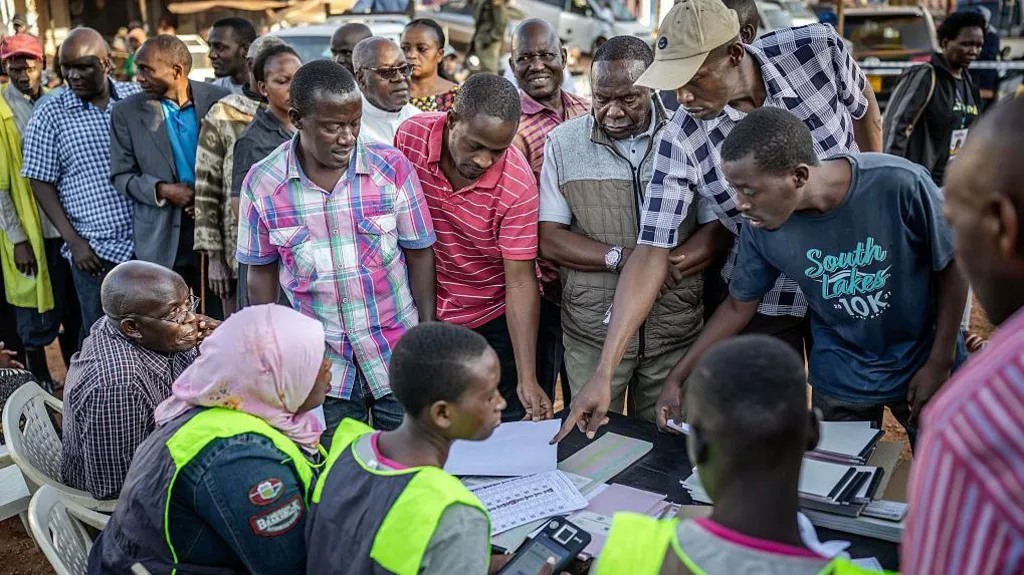
AFP via Getty Images Voters gather around a desk speaking with electoral officials in Kampala AFP via Getty Images Voters in parts of Kampala, found polling stations still not open hours after voting was due to start. Photo/AFP
Newsflash and Agencies
Vote tallying is underway in sections of Uganda following a nationwide internet shutdown, as the opposition alleges widespread irregularities in the presidential and parliamentary elections.
Presidential contender Bobi Wine claimed on social media that there was “massive ballot stuffing everywhere,” though he did not provide documentary evidence to support the assertion.
The government has yet to respond to his accusations of electoral malpractice or to his claims that “many” polling agents and supervisors affiliated with his National Unity Platform (NUP) party were abducted or chased away from polling centres.
Voting delays stretching up to four hours were reported in several areas, largely blamed on faulty biometric verification machines used to confirm voters’ identities. Some observers have linked these disruptions to the internet blackout, compounded by shortages of voting materials and the late arrival of equipment at certain polling stations.
As a result, polling centres were instructed to remain open beyond the scheduled closing time. The Electoral Commission said any voter who had joined the queue by 5:00pm local time (14:00 GMT) would still be allowed to vote. Earlier, the commission apologised for the “technical glitches” and said efforts were underway to address them.
Tight race as frustrations mount
In the presidential contest, long-serving leader Yoweri Museveni, 81, who has been in power since 1986, is seeking a seventh consecutive term. He faces his main challenge from Bobi Wine, a 43-year-old musician-turned-politician with a large youth following.
The Electoral Commission said the presidential results would be announced by 4:00pm local time (13:00 GMT) on Saturday.
On Thursday morning, observers noted growing frustration among voters waiting at polling stations in Kampala. Some voters reportedly left without casting their ballots, saying they could not wait indefinitely for the technical problems to be resolved.
Read more:Uganda orders internet shutdown ahead of Thursday elections
Electoral Commission chairperson Simon Byabakama directed officials to rely on the national voters’ register where biometric machines failed. The challenges appeared to cut across both pro-government regions and areas regarded as opposition strongholds.
“I’m angry because I haven’t voted up to now. We were supposed to start at seven, but even by eight we hadn’t started. The ballot papers aren’t even here. I don’t know what to say,” said Kaweesi Ismail, a voter in Kampala.
President Museveni himself acknowledged experiencing difficulties while voting in his home village of Rwakitura in western Mbarara. “I put my thumbprint on the machine but it did not accept it. However, my face was accepted instantly. The machine works,” he said. When asked whether he would accept the results, he replied: “This is one of the manipulations—we have to find out why, what the problem was,” adding that authorities were investigating whether the issues were deliberate.
Campaign tensions and youth concerns
The presidential race is largely seen as a two-horse contest between Museveni and Wine. Having won the previous six elections, analysts believe Museveni is likely to extend his grip on power. Wine has pledged to fight corruption and push through sweeping reforms, while Museveni maintains that he remains the country’s chief guarantor of stability and development.
The campaign period was marked by disruptions to opposition activities, with security forces accused of harassing, assaulting and detaining Wine’s supporters. Police spokesperson Kituuma Rusoke rejected these claims, instead accusing NUP supporters of provoking unrest.
Read more: “Fifth Floor” Folly: Nyanzi Luther defends Uganda’s ocean claim
Internet services were cut on Tuesday, with the Uganda Communications Commission saying the shutdown was meant to curb misinformation, fraud and incitement to violence. The move was criticised by the UN human rights office as “deeply worrying.” NUP dismissed the explanation, accusing authorities of attempting to block opposition mobilisation and the sharing of evidence of vote rigging. The party said it had deployed an offline vote-monitoring application, Bitchat, which uses Bluetooth technology to transmit images of results forms without internet access.
Museveni, a former guerrilla leader, has benefited from constitutional amendments removing age and term limits, allowing him to remain eligible for office. Wine, whose real name is Robert Kyagulanyi, lost to Museveni in the 2021 election, a result he rejected, alleging fraud. Six other candidates are also contesting the presidency.
Voters are also electing a new parliament, with 353 seats at stake. For many Ugandans, economic concerns dominate, particularly unemployment among the youth, who make up the majority of the population. Despite gradual income growth, job opportunities remain scarce, alongside ongoing worries about infrastructure, education and healthcare.
Human rights groups, including the UN and Amnesty International, say opposition supporters have faced escalating harassment, arrests and violence. Amnesty described the pre-election environment as a “brutal campaign of repression,” citing the use of tear gas, pepper spray and beatings. Separately, the head of the Electoral Commission said he had received threats warning him against declaring certain results.


About the Author