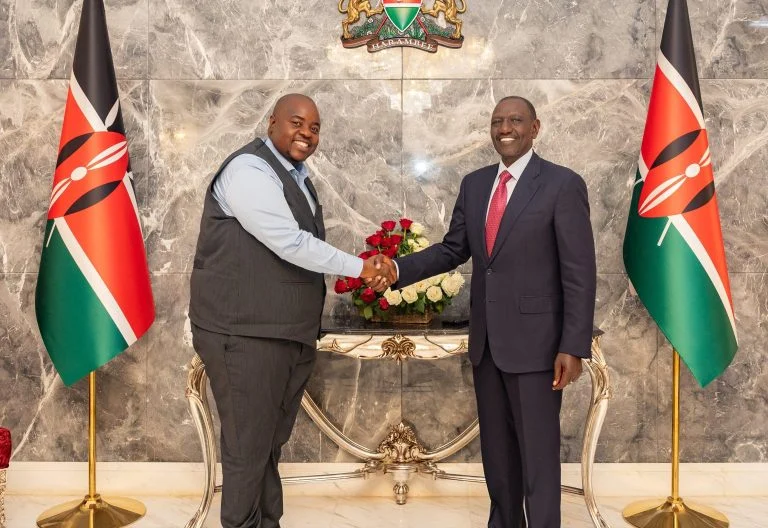
Nyanzi Martin Luther (right) in white shirt. Photo/Handout
By Lugard Johnson
KAMPALA, Uganda — The diplomatic temperature in East Africa is skyrocketing, fueled by an escalating rhetorical battle over landlocked Uganda’s access to the Indian Ocean.
The latest controversy comes from Nyanzi Martin Luther, a young but influential figure whose bizarre—yet politically potent—defense of President Yoweri Kaguta Museveni’s demand for “free” maritime access has injected a new level of surrealism into the regional standoff.
Luther, known in Uganda’s entrepreneurial circles as the Founder and CEO of Apex Media, which includes outlets such as Block FM, has publicly thrown his media weight behind the President’s assertion that the sea must be accessible to Uganda “even for free.”
The Niche Logic: Architecture vs Admiralty Law
Nyanzi’s endorsement is strategically tailored to Uganda’s vast, economically frustrated youth base. He simplified the complex international framework of transit rights into a domestic property analogy that is now being widely satirized across East Africa.
He declared:
“It is true Uganda must access the India Ocean even for free because even a flat house with five floors, the fifth floor has access to the ground, not only those ones direct to the ground.”
Read more:Museveni threatens Kenya over Indian Ocean
In this analogy, the “fifth floor” represents landlocked Uganda; the “ground” is the Indian Ocean. Coastal nations like Kenya and Tanzania become the lower floors, and their control over the sea is portrayed as an unjust economic restriction on what he frames as a shared, communal resource.
This narrative reframes the technical legal debate—governed by agreements under the EAC Treaty and the UN Convention on the Law of the Sea (UNCLOS), which grant the right of transit but not free access to sovereign ports—into a moral and political fight for equality.
Youth amplifier and geopolitical gambit
Luther’s profile as a young entrepreneur and media mogul—who has previously courted controversy by challenging traditional copyright enforcement—makes him a powerful amplifier of this message. By championing this maximalist demand, he aligns himself firmly with President Museveni’s long-standing push to dismantle the logistical and financial bottlenecks created by Uganda’s reliance on the ports of Mombasa and Dar es Salaam.
The economic reality remains that landlocked states face significant cost and time penalties. For Uganda, achieving cheaper and more secure transit is a critical national priority. However, demanding “free” access challenges the sovereignty and operational revenue of coastal nations, whose ports require massive investment and maintenance.
Regional strain and the Nairobi view
In Nairobi, where the Port of Mombasa operates, Luther’s analogy is being met with political caution and public derision. Kenyan commentators highlight the difference between the UNCLOS right to freedom of transit—where charges must not exceed those levied on the transit state’s own traffic—and an outright demand for zero fees, which is unsupported by both international law and regional cooperation principles.
Read more:Uganda drafts legislation to revive military trials for civilians
Luther’s “Fifth Floor Folly” is thus seen less as diplomacy and more as a high-stakes populist gambit designed to pressure EAC partners. Critics warn that such rhetoric risks undermining the spirit of integration the East African Community seeks to build.
The controversy over Uganda’s claims to Indian Ocean access continues to draw reactions from political figures across the region.


About the Author