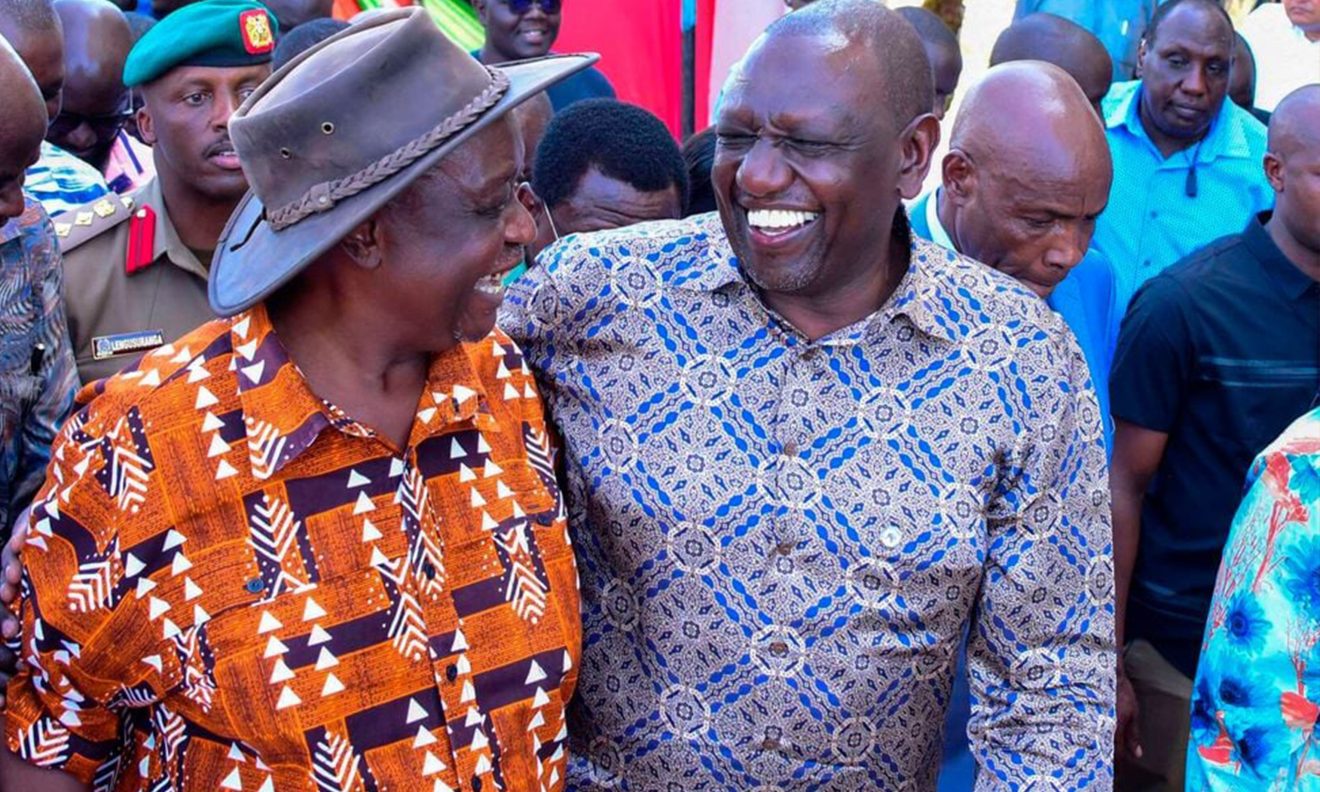
President William Ruto (right) and ODM leader Dr Oburu Oginga (in cap). Photo/File
By Newsflash Writer
Newsflash has learnt of inside plans to form a grand coalition between UDA and ODM parties ahead of the 2027 general elections.
The broad-based political détente between President William Ruto and the late former Prime Minister Raila Odinga’s ODM party is steadily transitioning into what insiders describe as an emerging full coalition pact, as the rollout of their 10-point reform programme hits fresh milestones.
It has been established that the Ruto–Raila reform accord has shifted from a stabilisation mechanism into the groundwork for a possible grand coalition in 2027, with ODM and UDA priming themselves for a shared political pathway. National Assembly Minority Leader Junet Mohamed disclosed that half of the 10-point deal has already been executed. He stressed that completing the outstanding commitments would naturally usher the two formations into a structured coalition. His comments echo the candid stance of ODM leader Oburu Oginga, who took charge after Raila’s death last month.
“ODM must be in government,” he said, presenting the expansive arrangement as both a present necessity and a future plan. In an interview on Saturday, Agnes Zani—the chair of the committee overseeing the 10-point agenda (COIN-10)—and vice chair Javas Bigambo confirmed measurable progress. With President Ruto and UDA boasting sweeping by-election gains as evidence that their approach is landing nationally, the outline of Kenya’s next major coalition appears to be gradually forming.
“Governments here are built through coalitions,” said Mr Mohamed. “If the ten-point agenda is executed and this broad-based setup works for Kenyans, then we can form a coalition. ODM was not created as an NGO. It was created to seek political authority.”
Mr Mohamed revealed that he and Dr Oginga had met Dr Zani’s team, which has reported consistent progress. The Zani-led committee submits updates to both parties every two months and has done so on August 18 and October 6. The next update is expected on December 6, with the final one due on March 6—one day before the deal’s anniversary. “It is a fact, not speculation, that Baba left us inside the broad-based government,” Mr Mohamed stated.
Grand Coalition in the making
“Once the remaining half of the agenda is done, we shall have fulfilled everything agreed, and as a party we’ll be very satisfied.” The 10-point package covers inclusivity, devolution, public debt scrutiny, youth upliftment, constitutionalism, fair public appointments, and reparations for victims of protest-linked violence from 2017 to 2023.
Mohamed, the Suna East legislator, noted that a major hurdle for the programme is an ongoing court matter freezing the committee designated to compensate families of youths injured or killed during demonstrations.
“We urge the Judiciary to conclude that matter urgently so the families can receive compensation. We cannot replace lives, but at least reparations will help,” he said. He also pointed to progress in devolution: an increase in county allocations from Sh385 billion to Sh415 billion—though ODM is pushing for Sh450 billion, in line with Odinga’s vision. Dr Oginga recently clarified the ideological direction underpinning this push. “All political parties exist to gain power,” he said. “As ODM, we want political power. No party anywhere is formed to remain in the opposition.” He added: “How do we implement our policies without power and only rely on protests? ODM also wants to be in government—either now or in a future coalition.” Dr Zani said that the team’s work is on track, with formal reporting every two months. “We are currently mapping stakeholders so we can begin engagement forums,” the former nominated senator said.
Read more: Senator Gloria Orwoba expelled from UDA
“We have been internally reviewing the 10-point agenda, assessing indicators and identifying stakeholders. We are now ready to gather feedback and present it.” The committee’s comprehensive final report will be unveiled on March 7 next year—exactly one year after the MoU was signed. Sources in both ODM and UDA hinted that this date could significantly shape the 2027 coalition landscape. However, Dr Zani was guarded when asked whether implementation guarantees a coalition: “My role is to assess the 10-point agenda, compile data, and present findings. What political parties do with the information is their decision.”
She did not, however, rule out the prospect of a coalition arising from the report. Vice chair Bigambo described the agenda as the “taproot” of the UDA–ODM political structure. “It is nine months since the MoU was signed, and both sides understand the urgency of implementation,” he said. He listed achievements already logged: formation of a panel of experts on protest victims’ compensation, passage and enforcement of the IEBC (Amendment) Act, 2024, a fully reconstituted IEBC, stabilisation of production and commodity costs, assent to the Persons with Disabilities Act, 2025, and increased county allocation. Others include the rollout of NYOTA and Climate WorX youth empowerment programmes, signing of the Conflict of Interest Act, 2025, progress on debt restructuring, and adoption of e-procurement to curb graft. “The 10-point agenda is deliberately crafted to implement, embed, and formalise reforms that foster economic, social, and political renewal,” he said.
Internal disquiet in ODM
Mr Bigambo argued that the agenda broadens the meaning of economic justice and ensures no region survives on “crumbs” from the national development table. His remarks reinforce Mr Mohamed’s assertion that full execution naturally channels the parties toward a grand coalition. The Ruto administration is similarly anchoring its political wins as evidence that the broad-based model is working. UDA Secretary General Hassan Omar celebrated the party’s by-election performance—winning 12 seats directly, with broad-based partners adding six more, totalling 18 out of 24. “These outcomes show clearly that the broad-based government is what Kenyans want,” Mr Omar said Friday. “We have secured an almost super-majority.”
Read more: ODM split widens over cooperation with Ruto
UDA views the mini polls as proof that cooperation with ODM is resonating. But despite these signals and the committee’s optimism, ODM continues to wrestle with internal contradictions that may unsettle the pact. ODM deputy leader Godfrey Osotsi insists that President Ruto must fully implement the 10-point agenda and the NADCO report “to honour Odinga’s legacy.” Secretary General Edwin Sifuna remains the most sceptical voice.
“The MoU is not a coalition agreement with UDA nor does it indicate any realignments for 2027. I perform my duties as SG out of obligation to ODM. There is no government called broad-based,” Mr Sifuna said recently. While acknowledging the 10-point plan, he has repeatedly accused the Ruto government of continuing abductions and extra-judicial killings “in complete breach of the agreement.” Siaya Governor James Orengo has also said the MoU “is not enforceable under the Political Parties Act.” These divergent views point to a party still redefining itself after Odinga’s departure.
Coalition prospects ahead of 2027
“The construction of a grand coalition is rarely theatrical. It often unfolds quietly—through reforms executed, trust cultivated, political incentives synchronised, and legacies protected,” argues lawyer Chris Omore. He observes that the Ruto–Raila 10-point agenda has become the guiding script of this evolving political moment. “For ODM, it is a route to power without the street confrontations of the past. For UDA, it is a chance to cement a broad national front ahead of 2027. For the nation, it could be the next phase of stability—or the start of a new political rearrangement.” UDA Deputy Secretary General Omboko Milemba says their 2027 strategy will depend on decisions made at the summit level between President Ruto and the ODM leader.
Read more: Businessman Buzeki joins UDA, pledges support for President Ruto
“For 2027, they will negotiate at their own level and we shall execute whatever they decide,” Mr Milemba said. UDA Organising Secretary Vincent Kawaya noted there is no need for concern over such pronouncements, saying every party has a right to stake out its interests before formal coalition talks. “ODM’s statement is fine. In every election cycle, each side must assert its space, raise its bargaining power, and outline demands,” Mr Kawaya said, adding that negotiations will determine how positions are shared once coalition discussions commence. “ODM is a major partner with a larger voter base, and there is nothing wrong with making demands,” he said, emphasising that only the presidency is assured for UDA as talks on a joint ticket gather momentum.


About the Author