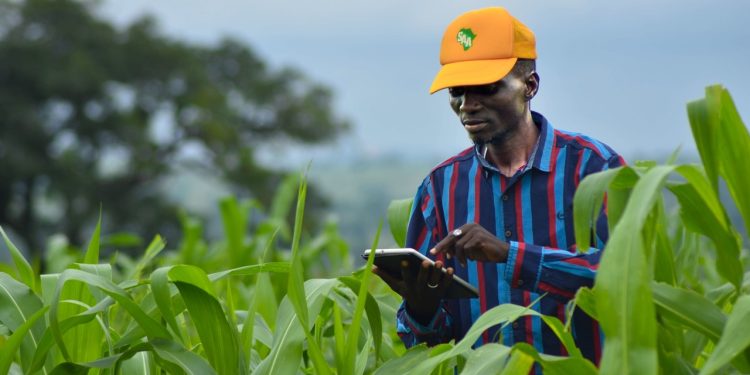
Image shows a Kenyan farmer taking records on his farm using a tablet
NAIROBI, Kenya – July 23, 2025 – Kenya has cemented its position as the undisputed leader in digital agricultural payments across Africa, significantly outpacing regional peers and even global averages.
According to fresh data from the Global Findex Database, a remarkable 71% of Kenyan adults who received agricultural payments in 2024 did so digitally, a share that stands as the highest in Sub-Saharan Africa by a considerable margin.
This striking statistic underscores the profound impact of Kenya’s robust digital payment ecosystem on its agricultural sector, a cornerstone of the nation’s economy. While cash remains dominant for farm-related payments in most other African economies and low- and middle-income countries globally, Kenya’s farmers are embracing mobile money and other digital channels, reaping the benefits of increased efficiency, transparency, and financial inclusion.
The mobile money revolution in agriculture
The rapid transition to digital agricultural payments in Kenya has been largely fueled by the widespread adoption of mobile money platforms, most notably M-Pesa. These platforms empower farmers across the country to seamlessly collect payments for their produce, manage their income, and purchase vital agricultural inputs without the traditional reliance on physical cash.
Read more: AI in agriculture: Kenya’s digital farming reinvention
“Mobile money has delivered speed and security to rural communities once locked out of the financial system,” explains a recent report. The convenience of receiving payments directly into a mobile wallet eliminates the risks associated with carrying large sums of cash, reduces travel time and costs to banking facilities, and provides immediate access to funds.
Key drivers of Kenya’s digital dominance
Several interconnected factors contribute to Kenya’s leading role in this digital agricultural transformation:
- Near-universal mobile phone ownership: Kenya boasts one of the highest mobile phone penetration rates in Africa, providing the foundational infrastructure for digital payment adoption.
- Extensive agent networks: Mobile money operators have established vast networks of agents even in remote rural areas, ensuring easy cash-in and cash-out points for farmers.
- Pro-innovation regulation: The Central Bank of Kenya (CBK) and other regulatory bodies have generally fostered an environment conducive to financial innovation, allowing mobile money and fintech solutions to flourish.
- Interoperability initiatives: Efforts like the Kenya Quick Response Code (KE-QR Code) Standard, introduced in 2023, have further streamlined transactions by enabling interoperability among various banks and mobile money platforms.
- Government initiatives: Programs such as the Hustler Fund, a government-owned financial inclusion initiative, also leverage mobile money for disbursements, further embedding digital payments in the agricultural value chain.
Impact on farmers and the economy
The shift to digital payments has brought tangible benefits to Kenyan farmers:
- Increased transparency and reduced fraud: Digital transactions provide clear records, significantly reducing instances of payment fraud and increasing accountability. Studies have shown a drastic decrease in fraud after digitization of repayments.
- Faster access to funds: Farmers receive payments almost instantly, allowing them to reinvest in their farms, meet household needs, and manage their finances more effectively.
- Improved financial inclusion: Digital payment channels serve as a gateway to broader financial services, including savings, credit, and insurance, for previously unbanked or underbanked rural populations.
- Enhanced efficiency: Agribusinesses procuring from numerous distributed suppliers benefit from greater security, speed, and efficiency in transactions.
- Data-driven insights: Digital transactions generate valuable data that can be used to assess credit risk for farmers, enabling access to loans for inputs or asset financing. Companies like Apollo Agriculture leverage machine learning and remote sensing for this purpose.
While Kenya stands out, other African nations are also making progress. Senegal, for instance, follows with 63% of digital agricultural payments, and Nigeria has doubled its share to 33%. However, countries like Uganda, despite a strong mobile money ecosystem, still predominantly handle farm payments in cash.
Read more: Kagwe demands 10% budget for agriculture
The success story of Kenya’s digital agricultural payments highlights the transformative power of technology in fostering financial inclusion and driving economic growth in rural communities. As the continent continues its digital leap, Kenya offers a compelling blueprint for other nations seeking to modernize their agricultural sectors and empower their farmers.


About the Author