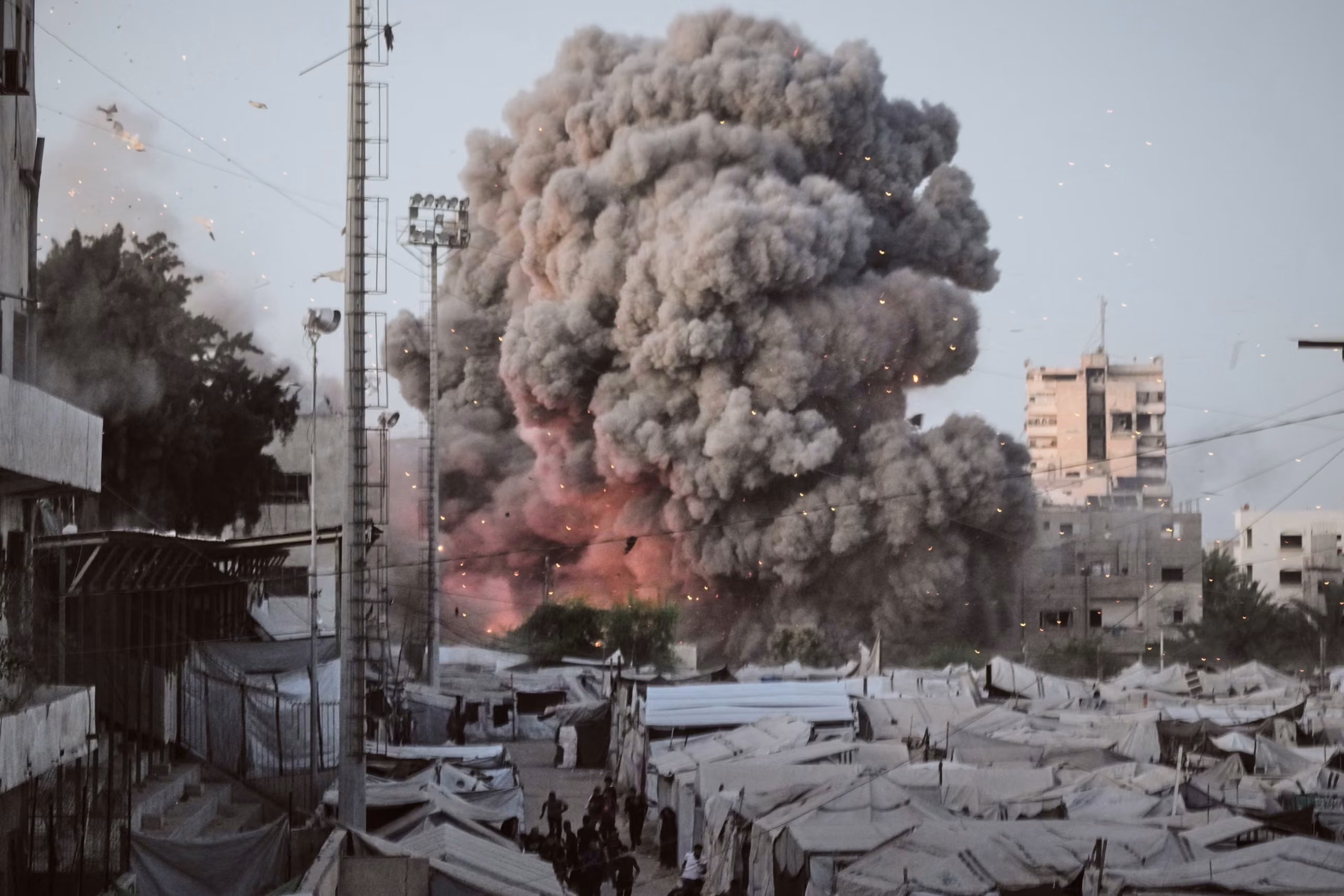
Smoke rises after an Israeli military strike in Gaza. Until now, the Israeli military has continued to expand its military occupation. Photograph: Jehad Alshrafi/AFP
Newsflash and Agencies
US President Donald Trump has announced what he described as a major breakthrough in efforts to end the war in Gaza, saying negotiators had secured an agreement on the complete disarmament of Hamas and other armed groups.
However, Israel has not formally endorsed the proposed roadmap, with senior officials expressing strong reservations.
The announcement, made through Trump’s social media platform on Thursday night, comes after months of negotiations aimed at overcoming key obstacles that have delayed the implementation of the October ceasefire agreement. Trump described the proposed arrangement as “a monumental step toward ending the fighting.”
The deal reportedly links the phased disarmament of Hamas to a gradual withdrawal of Israeli troops from Gaza and the establishment of a Palestinian interim administration to govern the territory.
Roadmap links disarmament to Israeli withdrawal
According to negotiators, the breakthrough followed lengthy talks led by the Board of Peace (BoP), an international body established by Trump last year to facilitate a political settlement.
The proposed roadmap provides for Hamas to surrender its weapons in stages while Israeli forces simultaneously withdraw from areas they currently occupy. Political authority in Gaza would be transferred from Hamas to the National Committee for the Administration of Gaza (NCAG), an interim body of Palestinian technocrats.
The transition would be supported by a specially trained Palestinian police force and an International Stabilisation Force (ISF), while an International Verification Committee would oversee compliance by both sides.
Nickolay Mladenov, the Bulgarian diplomat serving as the BoP’s High Representative for Gaza, said the agreement represented months of difficult negotiations.
“Today, agreement has been reached on the decommissioning of weapons and civilian transition in Gaza,” he said, adding that implementation and independent verification would be critical to the success of the process.
Under the proposal, an initial 14-day period would see military operations halted while international monitors establish mechanisms to verify that both Hamas and Israel fulfil their commitments before subsequent phases proceed.
Negotiators stressed that the agreement is based on reciprocity, meaning neither side would be required to advance to the next stage unless the other honours its obligations.
Israel remains skeptical as Hamas sets conditions
Despite Trump’s announcement, Israel has yet to officially endorse the proposal.
Far-right National Security Minister Itamar Ben-Gvir rejected the initiative, insisting that Israel’s only acceptable outcome remained the destruction of Hamas and encouraging Palestinians to leave Gaza.
Israeli media also quoted unnamed government officials dismissing the proposal as having little chance of success.
An Israeli official told Reuters that Israel continued to insist on the complete demilitarisation of Gaza before any political process could move forward, arguing that the current proposal failed to adequately address those security concerns.
Read more: Trump suspends Green Card lottery
Israeli authorities have consistently maintained that Hamas’s continued military capabilities justify ongoing military operations, restrictions on reconstruction efforts and the continued presence of Israeli troops beyond the ceasefire demarcation line agreed last October.
For its part, Hamas said it had accepted the roadmap only on the condition that Israeli withdrawal and disarmament occur simultaneously.
Ghazi Hamad, a member of Hamas’s negotiating team, said the group would not surrender its weapons before Israeli forces left Gaza. He added that if Israel failed to implement its obligations under the agreement, Hamas would likewise suspend its commitments.
The reported agreement increases diplomatic pressure on Israel to honour commitments made under the October ceasefire, although US officials acknowledged that Israeli leaders remained deeply sceptical that Hamas would genuinely disarm.
One US official said President Trump would be “very disappointed” if Israel declined to implement the proposed framework.
Even if accepted, significant logistical hurdles remain before the agreement can be implemented.
Members of the National Committee for the Administration of Gaza have reportedly not yet been allowed into the territory, specialised training for the planned Palestinian police force has not begun, and international peacekeeping personnel from countries including Morocco and Kosovo are yet to be deployed.
Negotiators therefore cautioned that while the roadmap provides a framework for ending the conflict, successful implementation will depend on careful sequencing, independent verification and sustained political commitment from both sides.


About the Author