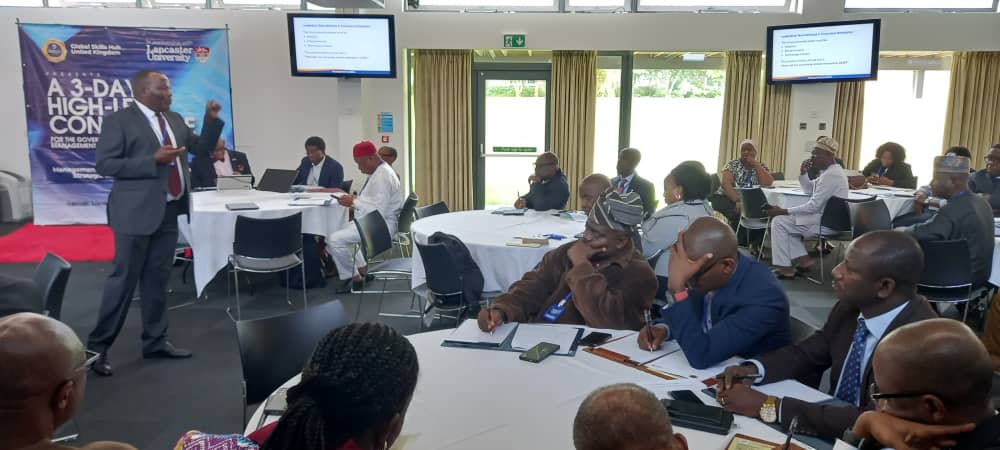
Dr Vincent Gaitho, Chairman of the University Council and Pro-Chancellor of Mount Kenya University (MKU), delivers a keynote address during a conference for higher education leaders in Lancaster, United Kingdom. Photo/Courtesy
By Lawrence Ongaro
African universities must adopt bold governance reforms and strategic leadership if they are to remain competitive, financially sustainable and relevant in a rapidly changing world, higher education leaders have said at a major international conference in the United Kingdom.
The forum, held in Lancaster under the theme “Governing Councils as Strategic Stewards and Custodians of Institutional Performance,” brought together policymakers, university executives and governance experts from across the globe to examine how institutions can thrive amid growing technological, financial and societal challenges.
Delivering the keynote address, Mount Kenya University (MKU) Council Chairman and Pro-Chancellor Dr Vincent Gaitho said the future success of African universities will depend less on physical infrastructure and more on the quality of governance and leadership guiding institutions.
“Institutional success is no longer determined solely by academic excellence. It is increasingly determined by the quality of governance and leadership,” Dr Gaitho said.
He noted that universities are operating in an environment characterised by artificial intelligence, shrinking funding opportunities, increased competition for students and talent, and growing demands for accountability. As a result, governing councils must move beyond routine oversight and take a more strategic role in shaping institutional direction and long-term sustainability.
Governance beyond oversight
A key message emerging from the conference was the need for governing councils to become active strategic stewards rather than compliance-focused supervisors.
Participants said universities across Africa face mounting pressure from technological disruption, changing labour market demands and reduced traditional sources of funding. To respond effectively, governing councils must provide visionary leadership, identify emerging opportunities and help institutions navigate risks.

The concept of “strategic stewardship” featured prominently during discussions. This approach requires councils to safeguard institutional values and resources while ensuring universities remain innovative, resilient and responsive to societal needs.
Read more: MKU wins legal battle over Oral Health degree course
Speakers stressed that effective governance depends not only on structures and policies but also on the skills and expertise of council members. Institutions with strong governance systems are better positioned to achieve sustainable growth and deliver measurable results.
Dr Gaitho challenged university leaders to rethink the role of governing councils, asking whether they are merely supervising universities or actively shaping their future.
“If African universities are to become globally competitive, financially sustainable, innovative and transformative institutions, then governing councils must embrace their role as strategic stewards,” he said.
Leadership and financial sustainability
The conference also highlighted the importance of cohesive leadership teams capable of translating institutional strategies into tangible outcomes.
According to participants, high-performing universities are characterised by shared vision, accountability, innovation and collaboration across departments. Strategic plans alone are not enough without effective implementation.
“A brilliant strategy poorly implemented remains just a document,” Dr Gaitho remarked.
Delegates also discussed the growing importance of digital governance as universities grapple with artificial intelligence, cyber security, data management and digital transformation. Institutions were urged to prepare for a future in which technology will fundamentally reshape teaching, learning and research.
Read more: MKU Maritime Academy unveils Sh30m ship simulator in Malindi
Funding sustainability emerged as another major concern. Dr Gaitho observed that traditional funding models are becoming increasingly unreliable and called on universities to diversify revenue streams through research commercialisation, endowment funds and stronger partnerships with industry.
He further urged institutions to prepare graduates for future jobs, entrepreneurship and innovation-driven economies, noting that Africa’s youthful population presents a significant opportunity for growth and development.
Participants warned that governance failures often arise from unclear roles, poor communication and lack of trust between governing councils and management teams. Successful institutions, they argued, require a balance in which councils provide strategic direction while management oversees day-to-day operations.
“The council governs, management manages—but both must lead,” one speaker noted.
Strengthening global partnerships
On the sidelines of the conference, MKU reaffirmed its commitment to international collaboration through strengthened partnerships with the University of the West of Scotland (UWS) and Mount Kigali University (MKUR) in Rwanda.
The three institutions explored opportunities for expanded cooperation in academic programmes, faculty and student exchanges, research, innovation and governance capacity building.
The Kenyan delegation was led by MKU Vice-Chancellor Prof Deogratius Jaganyi and Dr Gaitho, while Mount Kigali University was represented by Vice-Chancellor Dr Martin Kimemia.
“Our continued partnership reflects a shared vision to internationalise education, expand opportunities for students and strengthen cross-border research,” Dr Gaitho said.
Read more: Over 270,000 candidates qualify to join universities
Prof Jaganyi noted that MKU’s participation in the conference reinforced its longstanding relationship with UWS, particularly through the Centre for African Research on Enterprise and Economic Development (CAReED).
The partnership has enabled academic collaboration, staff development, innovation and international visibility for MKU. It has also facilitated a twinning programme through which students study in Kenya and graduate with UWS degrees.
As the conference concluded, participants issued a strong call for African universities to shift from administrative oversight to strategic governance and from compliance-driven approaches to value-based leadership.
The message from Lancaster was clear: effective governance and strong leadership are now the defining pillars of institutional success in higher education.



About the Author