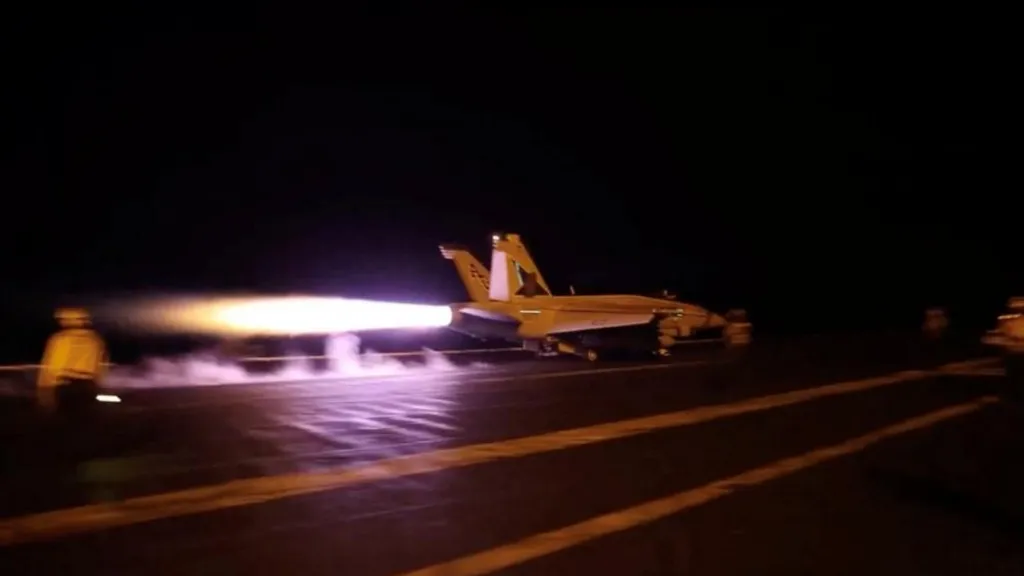
US Central Command released this image of a plane taking off during the strike operation. Photo/BBC
By Newsflash Writer and Agencies
The United States has launched a large-scale wave of airstrikes against Iran, describing the operation as retaliation for Tehran’s attempted ballistic missile attacks on American military installations earlier this week.
US Central Command (Centcom) said the operation targeted dozens of sites associated with Iran’s Islamic Revolutionary Guard Corps (IRGC), following Tuesday’s attempted missile strikes on US bases in Jordan and attacks against vessels sailing through the Strait of Hormuz.
Iranian state media reported that three people, including a two-year-old child, were killed on Qeshm Island during the latest bombardment. Other locations in southern and western Iran were also reportedly hit.
The latest exchange marks another significant escalation in a conflict that has steadily widened over the past week, including the first publicly acknowledged joint US-Saudi military strikes against Iran-backed groups in Iraq.
Retaliatory strikes intensify conflict
Relations between Washington and Tehran have sharply deteriorated since a ceasefire agreed in April collapsed in June. The truce had temporarily paused months of hostilities, but both sides have since resumed military operations.
The United States has maintained pressure through strikes on Iranian military infrastructure and a blockade of Iranian ports. Iran, in turn, has launched missiles and drones targeting American assets across the Middle East while also attacking commercial shipping in the strategically important Strait of Hormuz, which connects the Persian Gulf to the Arabian Sea.
Amid the rising tensions, Axios reported on Wednesday that President Donald Trump met Saudi Defence Minister Prince Khalid bin Salman. Citing an unnamed US official, the report said the Saudi minister conveyed Riyadh’s desire to reduce tensions and avoid a broader regional conflict. The White House has not publicly commented on the reported meeting.
Meanwhile, Egyptian authorities said a fire that broke out at one of the country’s ports on Wednesday was caused by a drone strike. Egypt, a close US ally, had not previously been directly targeted since the latest conflict erupted.
The renewed fighting follows several days of relative calm, during which both sides appeared to suspend military operations as diplomatic efforts were reportedly revived. President Trump described the contacts as “very friendly negotiations”, although Iranian officials insisted no such talks were taking place.
That pause ended on Tuesday after Iran attempted to strike a US military base in Jordan. Trump immediately vowed a forceful response, telling reporters at the White House that it was now America’s turn to retaliate and that Iran was fully aware a response was imminent.
The latest American operation began at about 8:00 pm Eastern Time on Wednesday (1:00 am BST Thursday) and lasted roughly one hour. Centcom described it as a “powerful response” to Iran’s attempted attacks on US forces stationed across the Middle East, adding that all Iranian missiles launched during the attack were successfully intercepted.
According to the US military, the strikes targeted military command centres, missile and drone facilities, coastal surveillance systems, air defence positions and maritime assets linked to the Revolutionary Guard.
Civilian casualties and regional fallout
Iranian media reported that Qeshm and Abadan, two key centres for the country’s oil industry, were among the areas struck during the operation.
The Fars News Agency, quoting Hormozgan University of Medical Sciences, said a residential home in the Chah Tangu neighbourhood of Qeshm was destroyed, killing a father, mother and their two-year-old child.
Residents described growing fear as the conflict intensified. One man in his 30s told BBC Persian that he was preparing to leave the island for Tehran because the security situation had become increasingly dangerous. He said internet services had become unreliable, electricity had repeatedly been cut off and loud explosions had echoed across the island since before dawn.
Jordan’s armed forces later announced that its air defence systems intercepted five Iranian missiles heading towards the Kingdom on Thursday.
Earlier this week, the Revolutionary Guard said it had targeted a US air base and command centre in Jordan, claiming the attack was retaliation for what it described as American aggression. The force also said its naval units had struck three oil tankers in the Strait of Hormuz after accusing the vessels of ignoring warnings while passing through waters it labelled unsafe.
Read more: US strikes Iran’s nuclear sites, warns of greater attacks ahead
The latest escalation comes only days after President Trump suspended a 13-day bombing campaign against Iranian military facilities, an operation that reportedly left scores of people dead.
Centcom also confirmed on Tuesday that joint US-Saudi strikes targeted several logistics hubs and weapons storage sites belonging to Iran-backed militias in eastern Iraq. The United States said the operation was launched in response to more than 30 drone attacks allegedly directed by the IRGC over a three-day period.
Iraq’s Popular Mobilisation Forces (PMF), a coalition dominated by Iran-backed Shia militias, said at least 20 of its members were killed in the strikes.
The Iraqi presidency condemned the attacks, describing them as a blatant violation of the country’s sovereignty. However, President Trump insisted the military action had been carried out in coordination with the Iraqi government.


About the Author