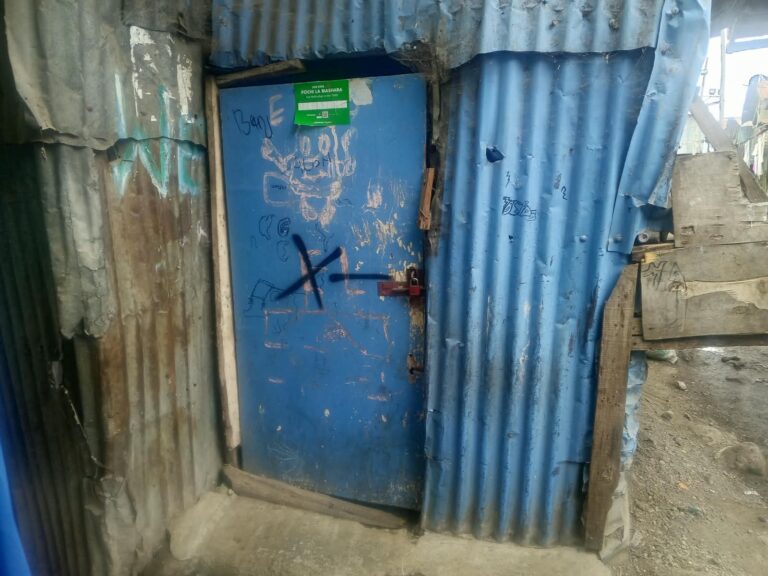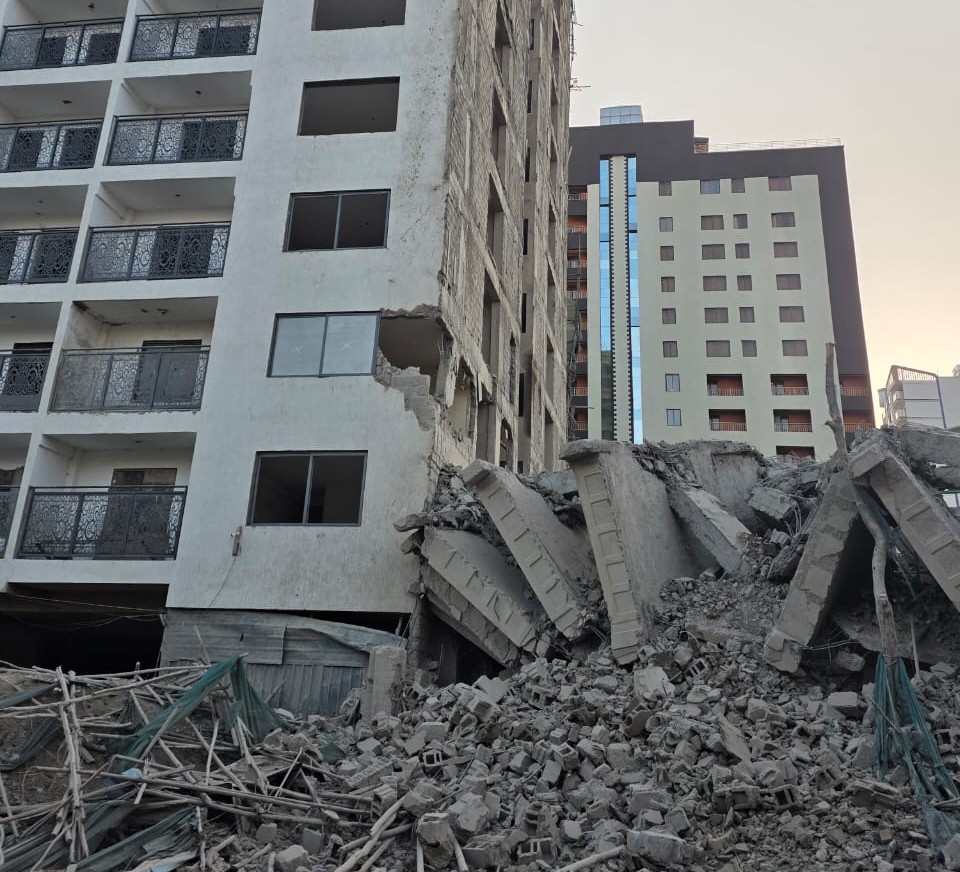
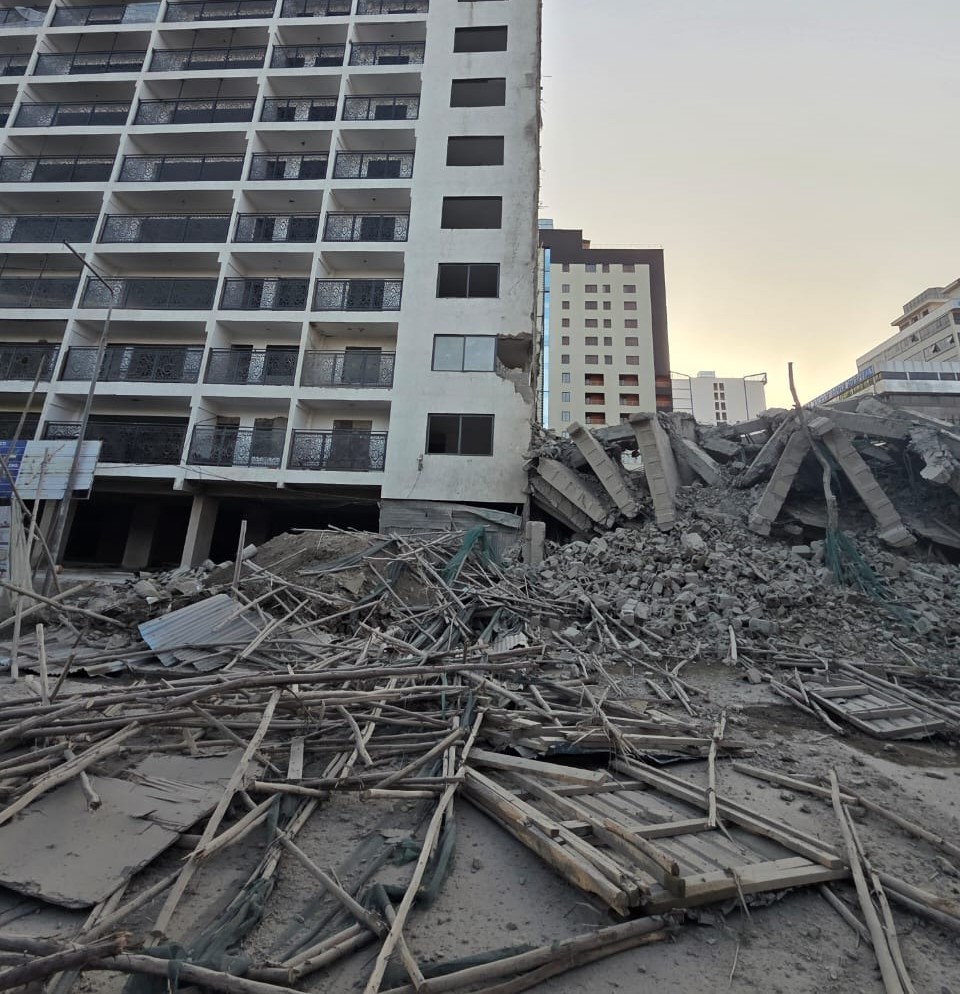
The collapsed building in Nairobi’s South C estate. Photo/Newsflash
By Newsflash Writer
Four people are feared trapped after a 14-storey building under construction in Nairobi’s South C collapsed on Friday, trapping workers and passersby in the rubble.
The incident triggered a large-scale rescue operation and renewed scrutiny of the city’s building approval processes.
A taxi driver who witnessed the collapse said the four individuals were near the site moments before the structure gave way. The driver sustained injuries and was rushed to Mbagathi Hospital, where he is reported to be in stable condition.
Emergency response teams from Nairobi City County, the National Disaster Operations Centre, and the Kenya Red Cross were deployed to the scene. The area was sealed off as search and rescue efforts stretched late into the day.
Government response
Public Service Cabinet Secretary Geoffrey Ruku vowed that the government would hold accountable all individuals involved in the building’s approval and construction. “We are still rescuing those trapped in the rubble, and we will take firm action against those who approved this construction,” he said at the site. “We have already obtained their details as a government.”
Read more: Amara Realty: Rebuilding the trust in real estate sector
County officials confirmed that the building exceeded the approved height. Nairobi City County chief officer for Planning, Patrick Analo, said the structure had been approved for 12 floors but was built up to 14. “In an enforcement notice dated August 11, 2025, the developer was formally notified for exceeding the approved number of floors,” he stated. Several individuals had previously been arrested over violations and released on cash bail, though it was unclear if construction was halted or additional inspections conducted prior to the collapse.
Allegations of corruption and illegal approvals
Kileleshwa MCA Robert Alai alleged that City Hall officials were bribed to allow the developer to exceed the approved height. He said the building, on LR No. 209/5909/10 (Block 68/1306), was permitted for 12 floors under PLUPA-BPM-003455-N but exceeded this limit. “There is a powerful cartel working closely to destroy Nairobi by approving illegal buildings while disregarding all regulations, including public participation,” Mr Alai claimed.
He noted that the approval had been issued to Abyan Consulting Limited through architect Gideon Chege Mwangi.
Read more: JKIA in fresh expansion after Adani fallout
Although no evidence of bribery was presented, Mr Alai said the collapse exposed collusion between developers and planning officials.
South B MCA Waithera Chege called for the prosecution of all officials and private actors involved. “I demand that City Hall planning inspection officers, Nairobi urban planning officials, sub-county planning officers, and the contractor be charged in a court of law,” she said, noting the building violated the Physical and Land Use Planning Act by exceeding its approved height.
Residents warn of longstanding regulatory failures
The South C Residents Association (SouCRA) said the collapse was foreseeable, citing years of ignored warnings over unsafe developments. The association has repeatedly raised concerns with the county over high-rises built in violation of zoning, density, and planning standards.
“This should not be treated as an isolated accident, but as the result of sustained regulatory and enforcement failure,” the group said. SouCRA has previously criticized the county for weak supervision, selective enforcement, and failure to hold developers, financiers, and consultants accountable, while site workers face arrests.
Read more: KICC architect David Mutiso dies at 93
The association’s chairperson, architect Dr Abdulmalik Tuesday Gichuki, emphasized that the cause of the collapse must be established through a forensic investigation. Preliminary assessments suggest a progressive structural failure originating near the lower levels.
The incident has drawn renewed attention to the Physical and Land Use Planning Act of 2019, which requires counties to ensure compliance through inspections, stop orders, and enforcement. It also follows a recent Court of Appeal ruling highlighting Nairobi City County’s inadequate legal framework for approving developments, raising fresh concerns over the legality of some city projects.


About the Author