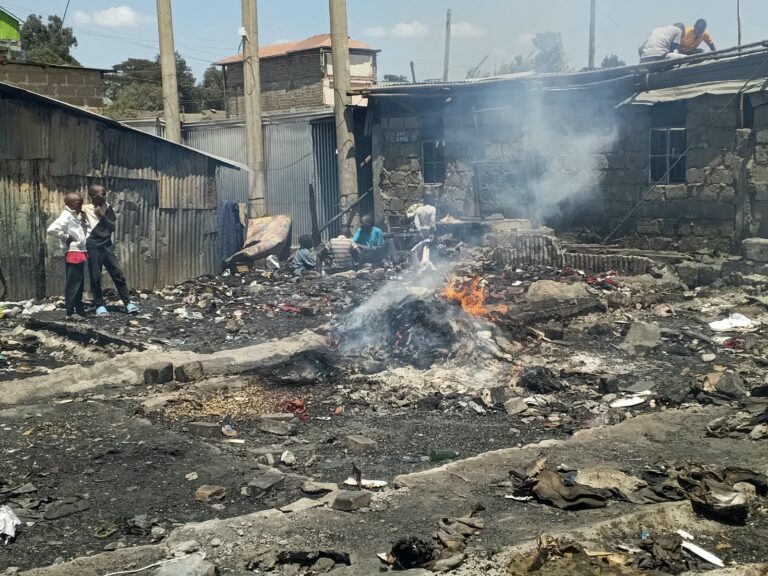
Children playing along Nyali Beach as invisible plastic fragments drift beneath the waves. Photo/Courtesy
By Daisy Okiring
At sunrise on Mombasa’s Nyali Beach, children run along the shoreline, chasing waves that sparkle in the golden morning light. The water looks clear and inviting, but beneath the surface drifts a silent threat — billions of microplastic particles swirling unseen with the tide.
These fragments, smaller than a grain of sand, have become one of the most alarming forms of pollution facing Kenya’s coastline. According to the United Nations Environment Programme (UNEP, 2024), Kenya’s coastal waters contain about 1.3 million microplastic particles per square kilometer, making it one of the most polluted marine zones in East Africa.
Plastic trail from cities to the sea
The story of this pollution begins far from the ocean, deep within the city streets. Plastic bottles, packaging, and discarded bags litter markets and drainages from Nairobi to Kisumu. During heavy rains, these plastics wash into rivers like the Nairobi and Athi, eventually merging into the Athi-Galana-Sabaki River — a main waterway that empties into the Indian Ocean.
The National Environment Management Authority (NEMA) estimates that 30 tonnes of plastic waste flow through the Nairobi River every single day. Once this debris reaches the ocean, sunlight and waves grind it into tiny fragments called microplastics, which are too small to collect and nearly impossible to remove.

Read More: How Kenya’s Gen Z Learned to Thrive in an Economy That Broke the Millennials
Fishermen on the frontlines
For the fishermen of Kenya’s coast, this crisis is not abstract — it’s visible in every catch.
“We used to catch clean fish,” said Suleiman Omar, a fisherman in Old Town, Mombasa. “Now, when we clean them, we sometimes find plastic threads and particles inside.”
A study by the Kenya Marine and Fisheries Research Institute (KMFRI, 2023) revealed that more than 70 percent of fish samples collected along Kenya’s coast contained microplastic fragments in their stomachs. These particles can block digestion and transport toxic chemicals into marine organisms, threatening the food chain that sustains coastal communities.
The cost to livelihoods
The impact of plastic pollution goes beyond the environment. Kenya’s blue economy — which includes fishing, shipping, and tourism — supports more than 150,000 people. Fishermen report declining catches, and hoteliers say littered beaches are turning away visitors.
In Diani, resort manager Grace Muli says cleanup costs have more than tripled since 2020. “It’s not just about dirty beaches,” she explained. “It’s about losing repeat guests who bring business year after year. Once the image of a clean coastline disappears, it’s hard to recover.”

Weak waste management systems
Kenya generates over 400,000 tonnes of plastic waste annually, yet only about nine percent is recycled. Most of it ends up in dumpsites, open drains, or rivers. Environmental scientist Dr. Carol Wambui says the problem begins with poor collection systems. “Our waste infrastructure was designed for organic waste like food and paper,” she said. “It can’t handle the growing plastic load. We must modernize recycling plants and introduce separation of waste at the household level.”
Urban councils often lack the funding and capacity to manage waste effectively. Informal recyclers do much of the work, but they cannot keep up with the volume. In low-income neighborhoods, plastics pile up in drainage channels, leading to flooding and health hazards during the rainy season.
Read More: The Kenya Diaspora Alliance to unveil bold diaspora investment blueprint
When plastic turns into food
The real danger, scientists warn, lies in how microplastics re-enter the human diet. Studies have detected plastic fragments in fish, sea salt, and even drinking water. The World Health Organization (WHO) has linked microplastics to potential hormonal disruptions and cancer-causing chemicals.
“We are literally eating what we throw away,” said Dr. Wambui. “Every bottle or bag we discard eventually finds its way back to us through the food chain.”
Local solutions and innovation
Despite the bleak situation, Kenyans are taking creative action. The Flipflopi Project in Lamu has gained global recognition for recycling ocean waste to build colorful boats and art installations that inspire environmental awareness. In Kilifi, youth-led groups like Clean Shores Kenya organize monthly cleanups, collecting up to 10 tonnes of plastic waste each time.
Entrepreneurs are also innovating. Startups in Nairobi and Mombasa are turning plastic waste into paving blocks, school desks, and eco-bricks. Companies like Bio Foods and Safaricom are switching to biodegradable and refillable packaging.

Policy gaps and enforcement
Kenya’s 2017 ban on plastic bags was hailed as one of the toughest environmental laws in the world. But enforcement has weakened over time. “Banning plastic bags was only the beginning,” said NEMA official Peter Mwangi. “The real challenge is single-use plastics — bottles, straws, sachets — that still flood our markets.”
A 2025 World Bank audit found that fewer than 30 percent of Kenya’s counties have functional recycling frameworks. Many local governments lack waste transfer stations or reliable collection trucks, making national policies hard to implement.
The price of inaction
According to the World Wildlife Fund (WWF), plastic pollution costs Kenya’s coastal economy over KSh 2.5 billion each year in cleanup operations and lost tourism revenue. The longer the country delays large-scale interventions, the more expensive recovery becomes. “If we ignore this,” said WWF Kenya Director Judith Nyongesa, “we could reach a point where there’s more plastic than fish in our oceans by 2050.”

Turning the tide
Yet hope endures. Along the coast, young innovators are building microplastic filters for storm drains. Artists in Lamu transform beach waste into sculptures that tell the story of ocean resilience. Social media campaigns are inspiring behavior change among urban youth, turning clean beaches into a symbol of national pride.
“The sea gives us life,” said fisherman Omar, watching the sunset over the water. “If we don’t protect it, we destroy ourselves. But if we act now, maybe the next generation will still have something beautiful left.”


About the Author