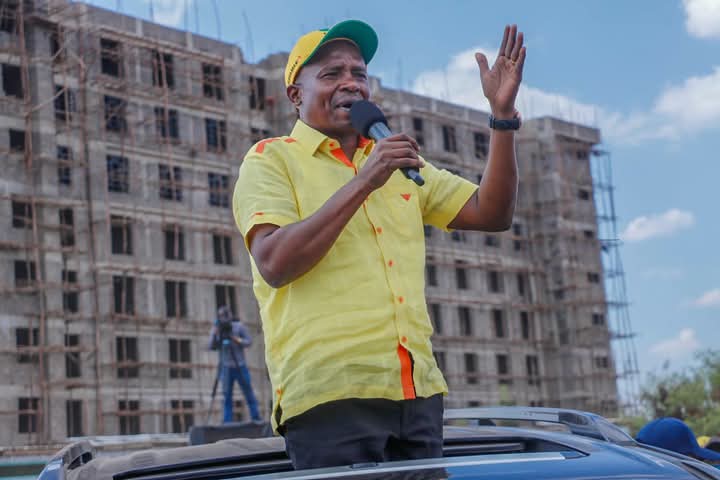
Former Public Service Cabinet Secretary Moses Kuria. Photo/Citizen Digital
By Maina Mihiato
Former Public Service Cabinet Secretary Moses Kuria has explained why President William Ruto is likely to drop Deputy President Kithure Kindiki in the 2027 General Election.
Kuria, who has turned into a critic of President Ruto, argues that the decision will be driven by the President’s widening fallout with the Mt Kenya region and a calculated effort to replace the support he enjoyed there in 2022 with new political constituencies.
According to Kuria, the President is now aggressively seeking to compensate for the lost Mt Kenya support by consolidating backing in other regions — a strategy that could make the current Deputy President politically expendable.
“Politics is not about tribes or friendships,” Kuria said. “There is a real possibility that Kithure Kindiki will be dropped. The President wants votes, and he will go wherever he can find them. The calculations for 2027 are about numbers, not sentiment.”
Kuria argued that as Ruto recalibrates his electoral strategy to survive 2027, regional arithmetic — not loyalty — will determine who stays on the ticket and who is sacrificed.
He said shifting regional alliances and economic pressures are reshaping the internal calculus of the Kenya Kwanza administration as the next polls draw closer.
The former Gatundu South MP, a University of Nairobi graduate in Economics and Government and a former adviser to ex-president Uhuru Kenyatta, turned his criticism on former Deputy President Rigathi Gachagua, assessed the state of the economy, and offered insight into why loyalty alone may not save Kindiki’s place on the 2027 ticket.
Read more: Kuria ‘comforts’ Gachagua over Mwiki church attack
On Gachagua, Kuria was scathing, insisting the former DP may never politically recover from the controversial “shareholders” remarks, which he said alienated key regions.
“He does not know when to speak and when to keep quiet,” Kuria said. “He even commented on Raila Odinga when Raila was unwell, and then something unfortunate happened. That level of insensitivity has serious political consequences.”
Kuria noted that although Gachagua is older than both President Ruto and himself, his public utterances often lack restraint. Age, he argued, does not necessarily translate into political wisdom.
How Gachagua reshaped Opposition politics
In a twist of political irony, Kuria said Gachagua’s missteps have inadvertently strengthened the opposition, particularly the Orange Democratic Movement (ODM).
“In politics, you must have a common enemy,” Kuria said. “Raila Odinga played that role in Central Kenya for years. Abuse Raila and you were guaranteed votes. Today, ODM only needs Gachagua. He has become their rallying point.”
According to Kuria, Gachagua succeeded in uniting opposition supporters by creating the perception that some regions were excluded from government. That sense of exclusion, he said, has hardened political attitudes and will not be easily forgotten.
He likened politics to religion, arguing that movements thrive on confrontation. “Even churches don’t need angels; they need one devil. Without an enemy, people lose interest. Gachagua positioned himself as that enemy.”
Economy: Stability without relief
Turning to the economy, Kuria delivered a mixed verdict on the Kenya Kwanza administration. While acknowledging progress in stabilising macroeconomic indicators, he said the benefits have failed to trickle down to households.
“I would give the government a C-plus for stabilisation, but an E for money circulation,” he said. “People can see roads and buildings, but the real economy is what citizens feel in their pockets — and right now, there is nothing.”
Drawing from his experience as a fiscal adviser during the Kenyatta administration, Kuria recalled that targeted payments to contractors and major bond releases previously injected liquidity into the economy almost instantly.
He expressed concern over Kenya’s ballooning public debt, now estimated at about Sh7 trillion, noting that roughly Sh750 billion is spent annually on domestic interest payments.
Read more: Hard times? Moses Kuria’s property faces auction
If he were still advising President Ruto, Kuria said he would prioritise economic growth through productive sectors such as agriculture, which supports nearly 40 per cent of Kenyans. He warned that mega infrastructure projects, while visible, often drain liquidity instead of stimulating economic activity.
Kuria also cautioned that statutory deductions — including the housing levy, SHIF and PAYE — are squeezing salaried workers without clear returns to taxpayers.
On governance, Kuria said President Ruto has strong ideas but faces serious execution challenges. He argued that the President has been forced to overextend himself due to an underperforming Cabinet and advisory team.
While praising digital initiatives such as e-Citizen, Kuria criticised poor implementation, warning that flawed procurement reforms could hurt the economy if not corrected.


About the Author