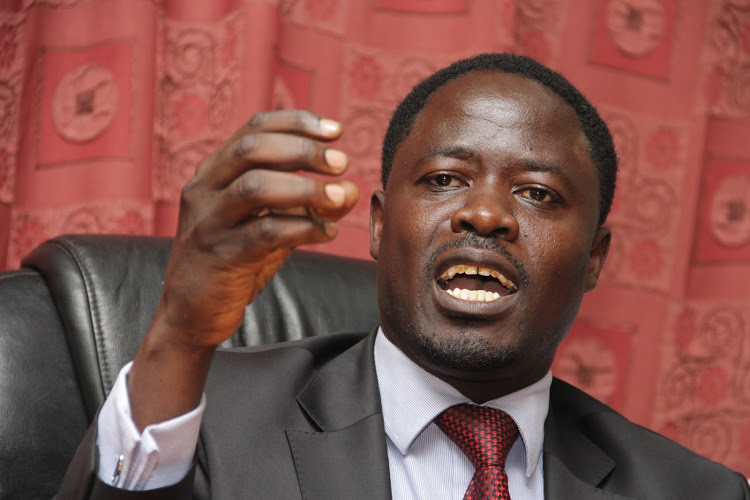
MCK CEO David Omwoyo. FILE
By Daisy Okiring
The Media Council of Kenya (MCK) is seeking a Sh1.5 billion allocation to establish an artificial intelligence-powered monitoring system designed to strengthen ethical oversight in the country’s media sector.
Appearing before the National Assembly’s Committee on Communication, Information and Innovation on Tuesday, MCK officials stressed the urgent need to modernise how the council monitors media content. They said the growing number of broadcasters across Kenya has outpaced the council’s current human-driven framework, making it difficult to ensure full compliance with professional standards.
MCK Chief Executive Officer David Omwoyo told lawmakers that Kenya now has about 250 television stations, many of which broadcast in vernacular languages. He noted that the current system, which relies heavily on human analysts, is unable to keep up with this expansion.
“This gap calls for an urgent and strategic investment in an advanced system capable of delivering comprehensive, real-time monitoring to safeguard ethical compliance,” Omwoyo said.
Read More: Calls intensify for release of Standard journalist Collins Kweyu
He explained that the proposed AI system would allow unethical or harmful content to be flagged instantly. This would be especially useful for vernacular stations, which have historically been harder to monitor and at times accused of spreading inflammatory or divisive content.
At present, the council depends on just 37 analysts who manually monitor broadcasts and escalate violations. According to Omwoyo, the proposed automated system would strengthen oversight capacity while reducing reliance on human labor.
Press freedom violations raise alarm
MCK also revealed that it had recorded 84 cases of press freedom violations between January and September 2025. Out of these, 56 involved physical assaults on journalists, most of them during political rallies and anti-government demonstrations.
The council also documented 16 cases of intimidation, eight incidents of censorship, three arrests and one abduction. Omwoyo noted that male journalists accounted for the majority of the attacks, with 65 cases compared to 19 involving women.
Police officers were implicated in 65 of the violations, making them the leading perpetrators. Other cases were attributed to hired gangs (28), government officials (15), protesters, teachers, politicians, a governor and even a magistrate.
Read More: Ruto urges urgent UN Security Council reforms to include Africa
Parliament urged to balance freedom and regulation
Committee chairperson John Kiarie underscored the importance of Parliament’s involvement in shaping a fair and effective regulatory environment for the media sector. He cautioned that while misinformation and harmful content were rising concerns, efforts to address them must not compromise media freedom.
“The narratives shaping our world today are increasingly driven by algorithms and platforms outside traditional newsrooms,” Kiarie said. “Parliament must strike a balance between protecting Kenyans from misinformation and upholding a free, responsible press.”
In addition to considering the Sh1.5 billion request, the committee resolved to collaborate with the Media Council and the Centre for Parliamentary Studies and Training to boost legislators’ media literacy ahead of the next general elections. Members also urged media houses to embrace digital transformation to remain competitive and uphold credibility in a fast-changing information landscape.


About the Author