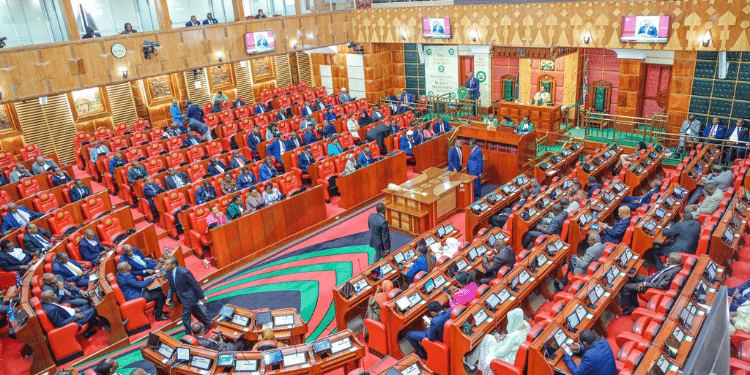
The Kenyan Parliament. Photo/Kenyan Parliament
By Newsflash Writer
You could face a fine of up to Sh100,000 or a jail term of three months for participating in a protest outside designated areas if Parliament passes the proposed Public Order (Amendment) Bill, 2025.
Sponsored by Nairobi Woman Representative Esther Passaris, the Bill aims to bar demonstrations within 100 metres of Parliament, protected areas, or buildings housing courts.
Currently under review by the National Assembly’s Committee on National Security and Administration, the amendment would empower the Interior Cabinet Secretary – in consultation with county governments – to identify and gazette protest zones within cities and urban centres. Protesters with petitions would be required to wait at these sites for their representatives to submit them to Parliament.
“A person who contravenes the provisions of this section commits an offence and shall, on conviction, be liable to a fine not exceeding Sh100,000 or to imprisonment for a term not exceeding three months or both,” reads the draft law.
Push for protest order sparks debate
The Bill is being scrutinised by the committee chaired by Narok West MP Gabriel Tongoyo. The committee has invited input from the Attorney-General and the Kenya Law Reforms Commission. While appearing before the committee, Ms Passaris defended the Bill, insisting that its intent is not to suppress protests but to maintain public order and ensure safety.
“This law is not meant to criminalise protests or silence the public,” she explained. “It’s to prevent infiltration by violent elements and protect sensitive installations like police stations and Parliament.” She cited past incidents such as looting of supermarkets during protests, arguing that designated protest zones could prevent such occurrences.
Read more:ODPP releases update on Gen Z protest files
However, the Bill has already triggered internal discord. Nyakach MP Aduma Awuor questioned the practicality of enforcing such restrictions, arguing that protestors can access city centres from multiple routes. “There is already a law for looters and thieves. How will we enforce this when the CBD is accessible from everywhere?” he asked.
Kisumu West MP Rosa Buyu added that demonstrations should be visible to be effective. “If you designate a place without people, it defeats the purpose,” she said. “Today’s mobilisation is different. How will protesters even gather in one location?”
Constitutional lawyer Bobby Mkangi warned that the proposal infringes on Article 37 of the Constitution. “Protests are meant to disrupt normalcy to capture the government’s attention. If I want to protest the presidency, why should I be taken to Uhuru Park?” he posed.
Balancing rights and security concerns
Defending the proposal, Mr Tongoyo said there was a need to strike a balance between the right to protest and maintaining law and order. “We must learn from recent events and ensure protests are not hijacked. We need to sanitise public spaces,” he said.
Mandera East MP Abdirahman Mohamed backed the proposal, noting that public institutions such as State House and police stations must be safeguarded. “If people storm places with guns, what next? The future is not safe,” he said. He argued that even protests at places like Uhuru Park could still be covered by media and gain national attention.
Read more: Nairobi protests: How police colluded with goons
Sotik MP Francis Sigei also voiced his support, saying the recent unrest underscored the importance of safeguarding public order. “We must respect the rule of law. This amendment is for peace-loving citizens,” he said.
Memories of the divisive 2014 security laws loomed as MPs deliberated. Back then, Jubilee MPs pushed through laws allowing punishment of media organisations deemed to publish alarming content. Critics worry the current Bill could follow a similar path of limiting constitutional rights.
Comparing global protest regulations
In Kenya, Article 37 of the Constitution and the Public Order Act regulate demonstrations. Section 5 of the Act requires prior notice of at least three days, indicating the intended protest site or route. The Parliamentary Powers and Privileges Act also empowers the Speaker to designate areas where demonstrations near Parliament may be held, in line with constitutional provisions.
Comparatively, in South Africa, Section 17 of the Constitution permits peaceful demonstrations but bars protests near courts, Parliament, or Union buildings without special permission. Nigeria’s Public Order Act gives state governors authority over public assemblies and requires 48-hour prior notice.
Read more: Protesters demand justice for Albert Ojwang’
In the United Kingdom, the Public Order Act of 1986 mandates that protest organisers give written notice specifying the date, time, route, and organiser’s identity. Police can impose restrictions if they foresee a threat to public order, property, or community life.
The proposed Kenyan Bill is, therefore, part of a broader global trend of governments attempting to manage the tension between public protests and national security. However, if the current version is adopted, it could face strong opposition from civil society, the public, and constitutional watchdogs concerned about its potential to undermine the right to peaceful assembly.


About the Author